When done correctly, SEO can be one of the most profitable long-term marketing strategies for your business.
The problem is, many don’t do it right or aren’t patient enough to see it through.
With search habits shifting between social media, Google, Reddit and AI search platforms, it’s not exactly as straightforward as it used to be, either.
We’ve run successful SEO campaigns for hundreds of clients over our 16+ years as a digital marketing agency.
In this post, we’ll explain what SEO is and how to succeed using real client examples.
What Is SEO? (And Why It Can Be So Profitable)
SEO, which stands for “search engine optimization,” is the term used to describe the strategies used to rank highly in search engines, most notably Google.
The goal of SEO is to show up prominently on search engines without paying for ads, so searchers looking for your product or service find you organically.
Let’s look at an example: below are the organic listings of the SERP (Search Engine Results Page) of Google for “best shoes under $100.”
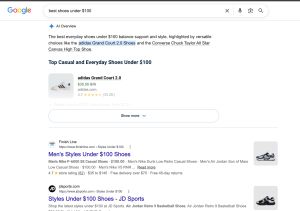
The topic “best shoes under $100” (and related topics) has over 30 million monthly searches in the United States, according to Semrush’s Keyword Magic Tool.
Now, imagine how many of those roughly 30 million monthly visitors will buy the Adidas Grand Court 2.0 shoes shown in the AI Overviews or one of the pairs from Finish Line and JD Sports because it was one of the first things they saw in their research.
That is the revenue potential SEO holds for your business if you do it right. It’s how we grew our agency from a one-person operation out of an apartment to a 20-person firm. We’ve ranked well on Google and subsequently have been able to grow.
The key is doing it correctly and being patient.
There are some instances when low-hanging fruit on the website or an optimization of your Google Business Profile can result in an immediate uptick in SEO rankings. 6-12 months is the sweet spot we see for significant progress in an SEO campaign.
We’ll spend the rest of this post explaining how you can succeed at SEO so it’s profitable for your business.
Note: While SEO has traditionally meant achieving visibility in search engines, the introduction of AI search platforms like ChatGPT, Claude, and the increased use of social media for discovery have made an SEO strategy much broader. It’s led some to define SEO as “search everywhere optimization.” The tactics we will discuss in this post will help with your traditional and AI search components. We recommend also investing in an organic social media strategy to complement your traditional SEO/AI search performance.
What Needs to Be Done at the Beginning of Any SEO Campaign
Starting an SEO campaign is like buying a home.
Before you can start furniture shopping and decorating, you must ensure there’s a strong foundation (no leaks, roof issues, bowed basement walls, etc.). Otherwise, you’re going to run into all sorts of issues down the road.
The following are what we consider to be foundational SEO tasks:
- Keyword research & competitive analysis
- Technical & sitemap audit
Let’s discuss each in more detail.
Keyword Research & Competitive Analysis
Keyword/topical research and competitive analysis is an essential part of your SEO campaign commencement.
It establishes what people are actually searching for when they look for the products/services you sell. It also shows how competitive it’ll be to achieve organic visibility in your market, so you can gauge how extensive the campaign needs to be.
Here’s our process for conducting keyword/competitive research for clients:
- We first compile a list of relevant keywords.
- We then run these keywords by the client to ensure accuracy.
- We utilize tags within Semrush (our preferred SEO tool) so we can monitor progress across different areas on the site.
- We determine who the top competitors are to track against.
- We establish a baseline visibility score (prior to us starting) and then measure results after this.
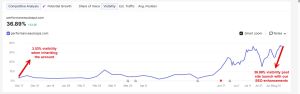
Semrush Visibility Score trend from one of our clients, Performance Auto Spa. This is a good metric to track as your SEO campaigns progress. You can see that when we started on their account, the visibility score was 3.53% and has jumped above 36% due to our SEO enhancements.
Technical & Sitemap Audit
If you have a website, a technical audit is a must before starting an SEO campaign.
It can detect underlying issues that are dragging you back. These include:
- Crawlability/indexability problems.
- Messy site architecture and internal linking.
- Slow site speed & poor Core Web Vitals on desktop and mobile.
- Duplicate content and canonicalization.
- Missing title tags and meta descriptions.
- Improper or underoptimized heading structures (especially H1s).
- Broken links, broken images, and missing image alt text.
Let’s look at an example of what technical audits can uncover and the quick wins you can enjoy with these relatively minor actions.
Real Client Example: Feazel Roofing (URL Structure Audit)
We conducted a URL structure audit for our client, Feazel Roofing, where we assessed existing URLs for relevance and content quality.
During the audit, we found hundreds of irrelevant pages on their website. After deleting and redirecting the pages, they experienced notable growth in organic keyword rankings on Google.

The technical audit wasn’t the only reason for the growth, but it was a critical factor that helped set the right foundation for success.
Two key takeaways on initial technical audits/ongoing technical SEO:
- Every website is different. What you should prioritize is dependent on your website’s current state and your SEO history. Whoever is leading your campaign should prioritize accordingly.
- In addition to the initial audit, you should conduct ongoing monthly technical audits to flag new issues that arise during your campaign.
When seeking an SEO company, it’s important to understand if they are better at making SEO content or strengthening the technical side.
Those are typically two distinct areas. Some companies (like us) do both; we have developers and technical SEO experts on staff who are dedicated to running reports and discovering key issues. We also have content creators and strategists who handle the on-page side of SEO.
Not every SEO company will do both. Make sure to understand what you’re getting before signing a contract.
Where the Bulk of Your SEO Campaign Needs to Be
Once you complete your keyword/competitive research and initial technical audit, you’re on to the next list of action items.
These will take up the majority of your campaign and can be considered ongoing initiatives. They cover everything from on-page optimizations on your website to off-site actions like building backlinks/brand mentions.
SEO is much more than just putting the right keywords on the page! You must execute each core component of the strategy to reap the benefits.
Note: Technical SEO is a part of your ongoing action items too; however, since we covered it extensively in the last section, there’s no need to expand on it further.
1. Local SEO
Local SEO is the broad term used to describe getting a business to rank for keywords in its local market.
There are many vital components to a local SEO strategy (many of which we’ll cover in the upcoming sections), including:
- On-site optimizations, which are SEO enhancements to your website. These include optimizing your homepage for your primary local keyword and adding relevant secondary pages, including service pages, service area pages and location pages.
- Google Business Profile set-up and optimization, which is the key to ranking in Google’s valuable local Map Pack.
- Generating local backlinks and brand mentions to increase authority in your space. You can do this through blog content, PR initiatives and partnerships.
- Achieving visibility in relevant national (ex: Yelp) and local directories, and ensuring your NAP (Name, Address, Phone Number) is consistent across listings.
- Setting up reliable tracking mechanisms via tools like Google Analytics/Search Console, Semrush and Local Falcon.
2. Google Business Profile
Your Google Business Profile is essentially your digital business card on Google, and it’s arguably the most important local SEO asset you’ll manage. It shows your address, hours, photos, user reviews and services, among other things.
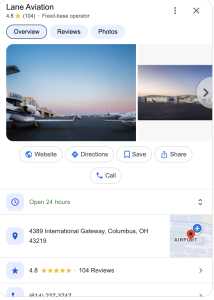
Example of a Google Business Profile.
Setting up your GBP properly and actively maintaining/optimizing your profile is an essential local SEO action item.
This is because your GBP is primarily responsible for positioning in Google’s local Map Pack, which gets about 44% of clicks for local searches. It’s also shown to directly influence recommendations in AI search platforms like Google’s Gemini.

Example of Google’s Map Pack.
Here’s a high-level overview of how to ensure your GBP is set up for success:
- Ensure your business name is correct; don’t try to keyword stuff to manipulate search engines.
- Pick the right primary category that reflects the service that brings in the most profit for your business. This is arguably the most important local Map Pack ranking signal.
- Link to the correct landing page from your GBP to your website. The right page will depend on whether you’re a single or multi-location business.
- Be proactive about review generation. Companies with several 5-star reviews from locals come off as more trustworthy than companies with only a few reviews.
- Conduct competitive research and report any spammy behavior to Google. This can make a meaningful difference in your rankings if a competitor in front of you is aggressively trying to game the system.
- Post photos of your office, staff and services. Update them at least 1-2 times a year to keep generating fresh content.
- Post regular company updates, and monitor your performance monthly to assess trends and areas of improvement.
Get a full Google Business Profile Optimization checklist here.
3. AI/GEO
This next section will touch on a growing aspect of modern organic search, which is AI search (also called GEO or AEO).
These include optimizing to show up in platforms like ChatGPT, Google’s Gemini/AI Mode, Claude and Perplexity, among others.
Many of the traditional SEO tactics you use to rank in Google apply to AI search as well. However, there are some notable shifts to make in your overall SEO strategy to ensure it covers AI as well.
These include:
- Maintaining clear and consistent messaging points about what you sell, value propositions and key stakeholders across channels.
- Creating non-commodity content (more on this later), which is content that can’t be replicated by AI. It’s your unique insights, data points and case studies/testimonials.
- Ensuring your content has the right intent, focusing on more long-tail topics rather than on strictly informational topics (which used to be a traditional SEO staple).
- Prioritizing inclusion on directories and relevant local sources. AI platforms commonly cite directories when providing recommendations for local searches.
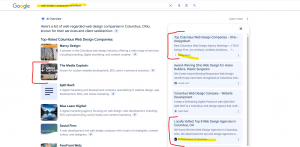
This shows how directories are used as sources for AI engines like Google’s AI Overview when providing recommendations.
- Actively posting on social media and forums like Reddit. A Semrush study revealed that four of the top six domains cited by ChatGPT, Google’s AI Mode and Perplexity were social media channels/Reddit. LinkedIn was found to be the most cited social channel (2nd overall to Reddit), making it a particularly important channel to optimize for the AI era.
- Outreaching for brand mentions, not just backlinks. Simply getting mentioned in reputable industry publications or sources has been shown to correlate with greater AI visibility.
- Running manual test prompts to see how you’re performing against competitors and using Google Analytics to measure referral traffic from AI platforms.
Note: AI search is an evolving phenomenon. As more information comes out about these platforms, and as more people use them for discovery, your overall SEO strategy may need to adjust. Keep tabs on the latest trends, but hold steady for the time being: the traditional SEO tactics should still make up the bulk of your efforts.
4. Blogging
Blogging has evolved from a personal hobby back in the aughts/early 2010s to a modern SEO staple for several reasons:
- They help build topical authority, which is essential to ranking well on Google and other platforms.
- They generate high-quality backlinks/brand mentions. For example, our agency wrote a blog on Google Local Service Ad Stats. Within six months of publishing, we’ve earned 50+ backlinks to our site. We didn’t have to do any outreach or PR, and the sites that linked back were relevant (other marketing agencies and digital marketing sites), which Google likes.
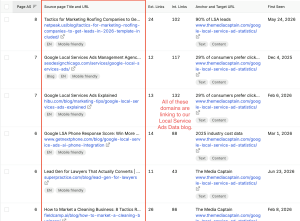
- They become source material AI engines pull from to answer users’ related questions. Blogs can also be cited when AI uses retrieval to generate answers.
- They educate your prospective clients, which can improve their customer journey and entrench you as an authoritative source they can trust. We believe each blog on your site should serve as sales collateral. Oftentimes, you can get a two-for-one deal with blogs: generating organic traffic to gain leads while serving as educational materials for your current clients.
- They serve as a pillar of your internal linking strategy, since you can use them to link back to your core service pages.
5. Backlink Building
Beyond your owned assets (website, GBP, social media channels), there’s a PR element to SEO that is a key part of the overall strategy.
The main action item for what’s traditionally been called off-site or off-page SEO is generating backlinks and brand mentions from respectable industry sources.
Google and other search platforms use external signals like backlinks to assess your credibility and domain strength, which has a direct effect on how strong your site is perceived to be. You can measure this using proprietary metrics like Semrush’s Authority Score or Moz’s Domain Authority.

We mentioned in the last section that blogging is a useful tool for generating backlinks (especially data-driven content with original research).
You can also generate backlinks via partnerships with other related companies.
At the local level, which is where we primarily focus, you can build backlinks by joining your local chambers of commerce, neighborhood business associations and downtown development associations (see the full list below, courtesy of Todd Anderson):
Nine times out of ten, traditional backlinks are worthless for local SEO.
However, local backlinks turn map pack scans green.
Here’s a list of types of local links we build:
Local chambers of commerce
Neighborhood business associations
Downtown development associations
Local business networking groups
Regional contractor associations
Local homebuilder associations
Independent business alliances
City and county business directories
Local “shop small” directories
Community newcomer guides
Local newspapers
Suburban newspapers
Neighborhood news websites
Local television stations
Local radio stations
City lifestyle magazines
Regional home and design magazines
Local business journals
Community newsletters
Local podcasts
Little League baseball organizations
Youth soccer clubs
Youth football programs
Youth basketball leagues
Youth hockey organizations
Local swim clubs
High school athletic booster clubs
Travel sports teams
Local running and cycling clubs
Minor-league sports teams
Local trade schools
Community colleges
University community programs
High school vocational programs
Apprenticeship programs
Workforce development organizations
Local career fairs
Parent-teacher organizations
School foundations
School robotics teams and band boosters
Local Habitat for Humanity affiliates
Community home-repair nonprofits
Veteran housing organizations
Senior assistance organizations
Food banks and food pantries
Animal shelters and rescues
Homeless shelters
Rotary, Lions, and Kiwanis clubs
Churches and faith-based organizations
Community foundations
Home and garden shows
County fairs
Neighborhood street festivals
Local music festivals
Holiday parades
Charity races and fun runs
Charity golf tournaments
Fundraising galas
Community wild-game dinners
Local sustainability and energy fairs
Independent movie theaters
Community theater companies
Local symphony orchestras
Community arts centers
Local museums
Historical societies
Friends of the Library organizations
Community centers
Makerspaces
Historic preservation organizations
Local real estate agents
Real estate brokerages
Property management companies
Landlord associations
Apartment associations
Homeowners associations
Condominium associations
Neighborhood associations
Local relocation companies
Home inspection companies
General contractors
Custom homebuilders
Kitchen and bathroom remodelers
Roofing companies
Flooring companies
Water and fire restoration companies
Local electricians
Local plumbers
Insulation and energy-audit companies
Architects and interior designers
Local HVAC distributors
Plumbing supply houses
Electrical supply companies
Building-material suppliers
Independent hardware stores
Equipment rental companies
Commercial vehicle dealerships
Vehicle-wrap and sign companies
Local photographers and videographers
Local web designers and IT providers
Economic development organizations
Utility-approved contractor directories
Local energy-efficiency programs
Community weatherization programs
Water-conservation initiatives
Organizations the company already sponsors
Associations the company already belongs to
Nonprofits employees volunteer with
Commercial customers’ project pages
Suppliers’ customer spotlight pages
Local award winner directories
Past speaking engagements and workshop pages
Existing unlinked local business mentions
Existing sponsor pages with unlinked logos
Local websites linking to competitors— Todd Anderson – SEO for the Trades (@_toddanderson) September 20, 2026
A note of caution: you have to be careful when it comes to backlinks. High-quality backlinks are worth pursuing. However, some agencies sell link building as a service, which can result in spammy, low-quality links that actually hurt your SEO.
An example of the damage of low-quality links comes from our founder, Jason Parks, who helped SafeAuto recover from a Google Penalty back in 2012 after a prior SEO agency built millions of low-quality links [watch video and listen to story].
We typically work with our clients to formulate 8-10 quality links based on their local and industry connections. If ongoing backlinks/brand mentions are a priority for you, we’d recommend hiring a well-connected PR firm.
6. Website Page Buildout
Something that surprises some people investing in SEO is that it can often mean completely redoing many pages on your website.
In the past, you could throw 1,000 words on a page with the right keywords and generate high organic rankings. This isn’t the case anymore.
In Google’s Guide to Optimizing Your Website for Generative AI Features, it specifically mentions making “non-commodity content,” defined as “content that people find unique, compelling, and useful.” This is increasingly important in a digital space filled with AI fodder.
Not only does your content need to be unique and insightful, but the user experience needs to be top-notch. That’s why we employ content strategists, UX experts, designers, and developers. It takes an entire team to run an SEO campaign correctly.

An example of non-commodity content from our client, Bainbridge Law Firm. Your About Us page is the perfect place to put your company’s history, unique data points, and client success stories. Check out Bainbridge’s About page to see how we went about listing their differentiators.
With website pages specifically, you need to spend your most effort on your money-making pages.
A money-making page has commercial intent, meaning the people who are viewing it are likely interested in making a purchase.
Optimizing and enhancing the following pages (not all of which will apply to your business) is crucial to producing revenue from an SEO strategy:
- Homepage optimization
- Service pages
- eCommerce product & category pages
- Location pages
- Service area pages
- Industry pages
Need Additional SEO Resources to Get You Started?
Frankly, SEO was complicated enough when Google was the primary channel you had to optimize for.
Now, with AI platforms rising in popularity, coupled with social media being a large source for discovering brands/products, an SEO strategy is much more multi-layered than ever before.
What hasn’t changed is nailing the basics of traditional/technical SEO and making uniquely helpful content. If you do that, you’ll be on the path to success.
The key to long-term results is to avoid stagnation. The ways people search are constantly changing (for example, we didn’t even mention voice search in this post, which will undoubtedly be part of future SEO strategies).
As much as possible, stay up-to-date on the latest trends and tweak your strategy as necessary. We’ve linked some helpful resources below:
- SEO Strategy Done Right: Real Examples From a 15-Year Agency Owner
- Content Pruning for SEO: When to Redirect, Delete, or Enhance
- How to Use PPC Data to Make Your SEO Smarter (With Real Client Examples)
If you’d rather have somebody else handle all of the SEO grunt work, reach out to us for a consultation.