Traditionally, About Us pages served as the area on your website to cram all you could about company history, milestones, key differentiators and team members.
For many, this resulted in a page full of fluff that did little to distinguish your company from the competition.
The emergence of AI search platforms and Google’s insistence on creating non-commodity content has challenged the notion of having one, all-encompassing About Us page on your website.
As a digital marketing agency, we’ve worked with hundreds of clients and found that breaking up your About Us page into three separate, purpose-built pages has delivered notable results in both traditional and AI search.
In this post, we’ll discuss how to do this for your business with real client examples.
Most About Us Pages Are Fluff
When you look at most companies’ About Us pages, they are filled with mission statements and lists of all the reasons “why we care”.
The problem with this is your competitors are saying the exact same thing. Let’s take Seiler’s Landscaping’s mission statement on their About Us page as an example.
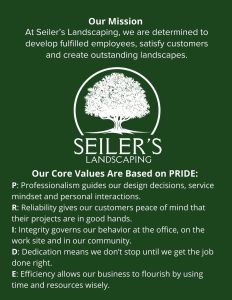
The concept and the words are fine, but does this really make you believe that Seiler’s Landscaping is different from any other company in the area?
Google and AI search platforms like ChatGPT and Perplexity reward non-commodity, proprietary content when ranking and recommending companies in search results and AI-generated answers.
A generic mission statement won’t help your organic visibility or your conversion rates. You need to include:
- Proprietary stats and outcomes, including years in business, certifications, awards, results and success rates (e.g., “100% success rate at trial” beats “award-winning”) to improve E-E-A-T signals, which is Google’s content quality framework that stands for Experience, Expertise, Authoritativeness and Trustworthiness.
- Team/personnel details, using the names, roles, and photos of the people that will be working directly with your potential clients. Don’t just use generic headshots or bios.
- Company history with visual proof, including photos from your first office, your first employees and growth milestones. This is literally your unique story, so competitors can’t replicate it.
- Reviews and client success stories, pulled directly from your verified reviews. This lets your clients’ words speak for your credibility.
- Real project photography, utilizing original photos/video of actual work, not stock images or AI-generated visuals.
This is a lot to fit neatly onto one page, which is why we’re recommending breaking it up into three pages.
Split “About Us” Into Three Purpose-Built Pages
The three pages you should create for your About Us trio on your website include:
- A company history page.
- A meet the team page.
- A why choose us page.
We’ll cover what you should include on each in the sections below.
Note: A strategic SEO play to keep your current About Us Page’s SEO equity and backlinks is to set up a 301 redirect from your old About Us URL to whichever of the three new pages is the closest match content-wise to the current one (likely history or why choose us). Even if you have little-to-no SEO equity built up on your current About Us page, still use a redirect to one of the new pages to avoid a 404 error.
History Page
This is the page where you tell the story of your company’s timeline, starting from the very beginning to where you’re at today.
Our Media Captain History page uses visual storytelling, which we’d highly recommend doing to add personality. A picture is worth more than a large chunk of text describing your story.
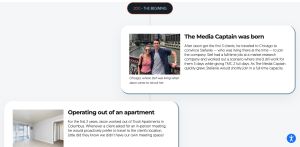
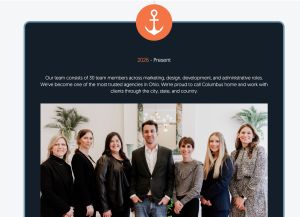
We’re spoiling a lot of steps along the way with these two screenshots. Read through the whole story on our History page to see the entire journey.
Meet the Team Page
This page should at least cover all of your leadership team and other key client-facing team members. Show people who they will be working with; it helps build legitimacy and trust.
Include photos of each team member with their name and role. We’d also highly recommend creating bio pages that expand on each person’s journey, experience and fun facts.
Nurenberg, Paris, Heller & McCarthy, a personal injury law firm in Ohio, does this well, listing each attorney with a professional photo and a “Learn More” button that links to a bio page:

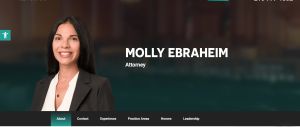
Here’s an example of one of their attorney’s bio pages:
Why Choose Us Page
This is your differentiation page. Include 10 bullet points of true distinguishing factors that make your business unique.
This page should include certifications, years in business, awards and real client results. Show your potential client proof that you’re the best company in your space; don’t just say it.
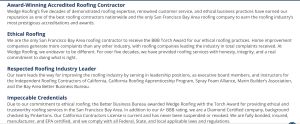
Wedge Roofing’s Why Choose Us page is a good example of this in practice:
Notice how they:
- Expand their extensive experience in the first point (“five decades”).
- Distinguish themselves as the “only San Francisco Bay Area roofing contractor to receive the BBB Torch Award.”
- List several associations they are a part of, including the Independent Roofing Contractors of California and Marin Builder’s Association.
- Include their status as a Diamond Certified company, noting that they have never had their license suspended or revoked.
How to Structure Your About Us Pages in Navigation
After creating your three new About Us pages, you will want to update the structure in your navigation bar.
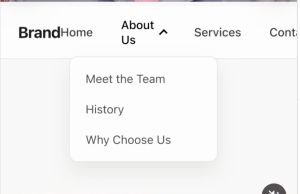
To do this, create an About Us tab with the dropdown items titled:
- Meet the Team
- History
- Why Choose Us
Here’s an example of what this looks like from BrandHome:
Revamped About Us Pages = Better AI Search Visibility
This multi-page About Us strategy works particularly well in AI search because AI search platforms use proprietary, differentiation-focused content when responding to comparison queries (i.e., comparing one company against another).
Here’s an example for the query “Why choose feazel roofing over muth”, asked in Google’s AI Mode – Feazel Roofing is a client of ours:
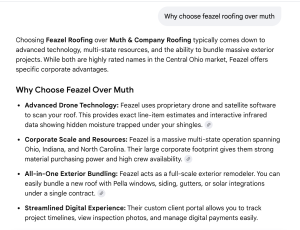
The information in this response is exactly what you would put on a why choose us page. You want AI search platforms to be crystal clear on your key differentiators, and your About Us pages can serve as a dedicated source for AI to easily retrieve this information.
What to Do Next to Create Your About Us Pages
To recap, here are the immediate next steps you should take to put this strategy into action:
- Audit your current About Us page for fluff. If it’s missing the mark and not producing strong results, then set up a 301 redirect from that URL to whichever new page is the closest match.
- Create three new About Us pages using original, non-commodity content.
-
- History page – explain your company’s timeline (visually if possible)
- Meet the team page – showcase your team members
- Why choose us page – detail your core differentiators
- Update the navigation bar on your website to have the three pages live under the About Us tab.
Once you create these pages, start tracking how AI search platforms talk about your company (using an incognito window on your browser or signing out of your account to avoid bias).
Check in on your Google Analytics 4 data as well to see which of the pages are generating more engagement and active sessions.
If you need help strategizing a direction for these pages, reach out for a free consultation and we’ll help get you started.