In Google’s recently released AI Optimization Guide, they specifically emphasize the need to create “non-commodity” content.
So, what is non-commodity content, and how do you start creating it?
We’ve helped hundreds of clients across various industries answer this question, and we’ve seen non-commodity content pay off massively in terms of SEO/AEO performance.
We’ll share a few detailed examples of that success in this post, but first, let’s dive into what commodity vs. non-commodity content is.
What Is Commodity Content?
Commodity content, as defined by Google, is “based on common knowledge, which could originate from anyone, and typically adds little unique insight for readers.”
This is the type of content that ChatGPT and Claude can easily create with a simple prompt.
Examples of commodity content include:
- 5 Benefits of Hiring a Digital Marketing Agency
- 10 Ways to Improve Your Social Media Presence
- The Beginner’s Guide to Email Marketing
When ChatGPT launched in 2022, companies started creating generic AI-generated content at scale. It’s one of the reasons Google had to release a Scaled Content Abuse Policy to discourage companies from spamming their websites with low-quality content.
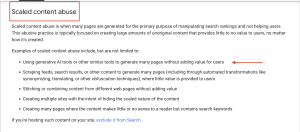
Commodity content not only can stagnate your organic search visibility, but it can also hurt your website’s SEO/AEO performance if you make a habit of posting content that is useless or manipulative to search engines.
What Is Non-Commodity Content?
Non-commodity content “provides unique expert or experienced takes that go beyond common knowledge and the ordinary,” according to Google.
“Non-commodity” refers to content that competitors can’t just copy or generate with AI. It includes components like real, firsthand insights from experience, proprietary data and original visuals.
Examples of non-commodity content include:
- Why We Lost a $40,000 Client (And What We Changed Because of It)
- The Exact Ad Budget Breakdown That Generated 3x ROI for Our HVAC Client
- How We Ranked a 2-Location Law Firm Above Morgan & Morgan in Their Own City
There is an expectation that non-commodity content has to be long, exceeding a certain character or word count. We’ve found this not to be the case.
Oftentimes, non-commodity content is short and incorporates skimmable text with bullets and eye-catching imagery/video.
Google specifically mentions organizing your content in a way that’s easy to follow in its AI Optimization Guide. There’s no reason to overdo it.
How to Make Non-Commodity Content That Actually Performs
As a marketing agency with over 100 clients, we can’t just create non-commodity content for a client on a whim. We’re not the experts. We don’t know the industry.
We have to put on our journalism hats and ask the right questions to create the kind of non-commodity content that performs.
To achieve the non-commodity standard for your business, you have to invest real time and effort into your content. It can’t just be a quick tidbit or two, either.
When you’re creating content to perform well in modern search, you need to think:
How can I make this the most unique piece of content in my space?
To stand out, you must be willing to offer a perspective that your audience can’t get anywhere else.
Let’s run through a few examples of how to do this from our experience creating non-commodity content for clients and our own Media Captain website.
Real Example #1: Bainbridge Law Firm
Our client, Bainbridge Law Firm, has 8 locations throughout Ohio and 8 respective location pages on their website.
Each location page had similar content, with nothing unique aside from the address and phone number.
To improve their organic visibility, we needed to put more non-commodity content on the page.
We first spoke with Bainbridge to gather unique insights, and discovered that:
- Each location has a legal assistant who is the primary point of contact.

- All of their attorneys are based in Columbus but work on cases in different markets that suit their areas of expertise.

In addition to these revelations, we made sure to pull reviews from the Google Business Profile onto the page since this is unique to each market:

One area where Bainbridge lacked before this revamp was unique selling propositions.
We worked with Bainbridge to develop the following data points that were used for each location page. Even though they were used on each location page, they are considered non-commodity because no other workers’ compensation attorney can pull the same stats.
- Millions recovered every year for injured Ohio workers
- 100% success rate at trial for the past decade
- More than 1,000 Ohioans trust us with their workers’ compensation claims each year
- 40+ Years in Business

The result: The enhanced location pages helped move the client from an average ranking position of 4.5 into the #1 position organically and on the local Map Pack on Google for “Ironton Workers’ Compensation Lawyer”.
See Bainbridge’s revamped Ironton location page here.
Real Example #2: SpaceManager Closet
Another client of ours, SpaceManager Closet, makes custom closets in the Houston Metro area. One of their key target markets is the affluent suburbs of Houston.
To attract more business in these areas, they built out service area pages targeting primary suburbs in the Houston area (Katy, The Woodlands, Sugar Land, etc)
The problem is that their existing content was too similar to their other service area pages and was very generic.
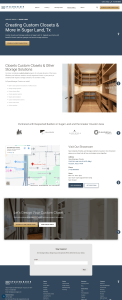
Here is an example of their existing Katy, TX, page:

Compare that to their Sugar Land, TX, page – it’s essentially the same:
To take these pages from commodity to non-commodity, our SEO and UX teams worked on a revamped page for Katy, TX. Here is what the mockup looks like via Claude – they are not live as of this posting:
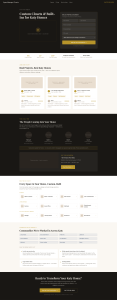
Here’s what we focused on to check the non-commodity content box for these pages:
- The most important thing to incorporate on the pages was projects from each suburb. Specifically, we added photos from past projects to the pages (see examples below).
Here’s a photo of a project they did in Cypress:

Here’s a photo of a project they did in Pearland:

- We also asked SpaceManager Closet for team members who come into homes in this specific suburb. Their team operates across different regions throughout Houston. This improved the sales process to let residents know who will be working with them.
- We also wanted to provide transparency on the page: they have a showroom in Houston, but it’s 20 minutes away from Katy. Letting potential clients know this upfront helps build trust and shows that you’re not trying to be deceptive just to make a buck.
The result: We’re rolling this out to all of SpaceManager Closet’s service area pages and anticipate a significant jump in rankings after flipping the script from commodity to non-commodity content.
Real Example #3: The Media Captain
For this last example, we’ll show you how we’re using non-commodity content to generate traffic and leads.
Our standard is that all blogs we write for our agency should be non-commodity.
Due to our work with hundreds of clients, we have the opportunity to share insights from case studies (like Bainbridge and SpaceManager Closet). This is extremely valuable, as it allows us to provide concrete examples to support the content we’re writing about.
An example of a recent non-commodity blog we wrote that has generated positive SEO results is How Attorneys Can Win Against Morgan & Morgan’s Advertising In Their Local Market.
Morgan & Morgan is the largest personal injury law firm in America. They spend hundreds of millions on advertising.
In the blog, we discussed how local law firms can combat Morgan & Morgan’s deep pockets. We talked about the work we’ve done with Schiff & Associates, a local attorney in Columbus, Ohio.
One of the areas we touched on was that Morgan & Morgan blasts out generic social ads, so we made social ads specific to Scott Schiff, the founder’s upbringing in Columbus [view YouTube video].
We also talked about how Morgan & Morgan doesn’t rank well in local markets on Google, so there’s an opportunity to attract clients through SEO/AEO.
The content we wrote didn’t just state that Morgan and Morgan spends $350-$400 million on advertising. That is common knowledge consistent with what you would find in commodity-based content.
We shared personal anecdotes about how local firms are combating them, with strategic guidance based on real client examples.
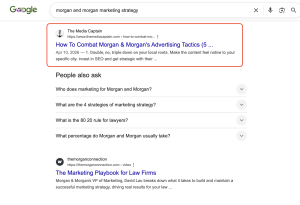
The result: We are currently ranking #1 on Google for “Morgan and Morgan Marketing Strategy.”
How to Incorporate Non-Commodity Elements Into Your Content
The three client examples show that creating non-commodity content can help you win in a modern SEO strategy.
To recap the learnings from the examples, here is where to focus when creating non-commodity content for your business:
- Reviews and reputation data – Pull from verified user reviews and let their words speak on how reputable your business is. Also incorporate client success stories and testimonials, as they are powerful trust-builders and credibility-enhancers.
- Proprietary stats and outcomes – “40+ years in business”, “100% success rate at trial”. Find your unique data points and make them prominent. Saying that you’re a “Top Law Firm” won’t cut it. It needs to be more specific. When there’s a source to back it up, it becomes even more powerful (“Top 1% Law Firm as voted by Super Lawyers”).
- Team/personnel details – Add unique/fun tidbits about your team. People like to go behind the scenes and learn about the team that’s serving them.
- Real project photography – Don’t use stock or AI-generated images. Original imagery/video can distinguish your business for both the user and search/answer engines.
If you do it correctly, non-commodity content is not only a standard to rank highly in search/answer engines, but also to resonate with your audience.
Remember: we’re creating content for humans at the end of the day. Don’t lose sight of that when crafting your content.
Need Help Creating Non-Commodity Content for Your Business?
Anybody can create content nowadays. The point of the non-commodity content standard is to create content that sticks out from the others.
Take what you learned here today, and start making content that rises above the ordinary.
If you need help generating non-commodity content that distinguishes your business from the competition, our team can help get you started.