With the rapid emergence of answer engines like ChatGPT, Gemini and Claude, many assume that the traditional ways of doing SEO are outdated.
There’s a common fear among businesses that “if we don’t adapt to the trends, we’ll fall behind our competition!”
Based on our experience running SEO/GEO campaigns for hundreds of clients across numerous verticals, we’ve found that the need to create an entirely new organic search strategy to rank in AI is unfounded.
We will show you what the data says and run through real examples so you can inform your SEO/GEO strategy with facts.
Why the SEO/GEO Misconception Exists
When AI burst onto the scene with the launch of ChatGPT in late 2022, it left many business owners perplexed about how they would achieve visibility in this new era.
This left many feeling that all traditional SEO tactics needed to be thrown out entirely.
Unfortunately, this misconception has led to a lot of misinformation about how to rank in AI from bad actors looking to prey on business owners or marketers by promising major results from their bold, new AI search strategy.
The truth is, most of the traditional SEO tactics should still be part of your organic search strategy today.
You just need to update it to include elements that will help with your visibility in answer engines like Google’s suite of AI tools, Claude, ChatGPT and Perplexity, as well as social media platforms and forums (more on this later).
What The Current Data Says About SEO/GEO
After studying 1.9 million citations from 1 million AI Overview results, Ahrefs found that 76% of AI Overview citations pull from Google’s Top 10. This stat indicates that you should stick to traditional SEO.

Photo courtesy of Ahrefs.
After running 4,300 prompts across 500 commercial keywords, NPDigital found that 75% of AI citations pull from sources outside of Google’s Top 10. This stat indicates that you should start drafting up a completely new SEO/GEO strategy.
Both of these contradictory datapoints are why many marketers and business owners are left scratching their heads at what a modern SEO strategy should look like.
On the one hand, you’ve got a study (and examples we will show later) of traditional SEO rankings correlating to strong GEO results.
On the other hand, there are studies from very reputable sources that say you don’t need to rank in the traditional Top 10 to get cited by AI.
Our take is that the bulk of your strategy should still include the traditional on-page, technical and off-page SEO tactics. However, you should update components of the strategy to include elements that have been shown to help increase AI visibility.
5 Components of a Strong SEO Strategy in the AI Age
Here are the elements that you can add to a traditional SEO strategy to ensure your company ranks well on all the platforms your audience uses for discovery.
1. Ensure Your Content Has the Right Intent
Not even a couple of years ago, a key component of an SEO strategy was to target informational, top-of-the-funnel topics, mainly with long-form blog posts.
The increased presence of AI, however, has made informational topics less advantageous to target because it’s reducing the amount of traffic that goes to your website (small publishers are seeing a 60% traffic reduction).
This is primarily because AI is giving the user the answer to their question in an easy-to-digest way right in their chatbox. They don’t need to click through to a website to get their answer.
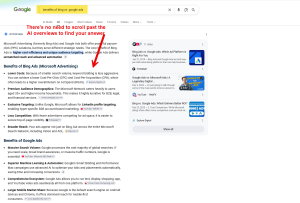
An example of this from our own website is on a blog we wrote about the benefits of Bing advertising vs. Google.
We initially wrote it with the hope that someone searching for this query would be interested in working with us for paid ads once they were on our site.
The issue is that AI overviews have now absorbed all of this information, so a user can get their answer in one place without needing to visit our website.
Instead of targeting informational topics, you should focus on long-tail, commercial-intent topics that will have greater potential for revenue generation.
Something like “Best SEO Companies” is no longer the best type of query to target. “Best SEO companies that specialize in personal injury lawyers” would be a better topic to target in the AI era.
2. Create Non-Commodity Content
Thanks to Google’s recently released AI Optimization Guide, there is a buzzword going around in content marketing called “non-commodity content”.
Essentially, non-commodity content is the type of content that can’t be reproduced by AI from a simple prompt. Commodity content, on the other hand, is based on common knowledge and adds little in terms of unique insight.
To create non-commodity content, include the following in all of your SEO content:
- Firsthand insights and perspectives pulled from your company’s experience and team members.
- Real case studies or examples from your clients.
- Original imagery/photos.
- First-party data that is proprietary to your company.
3. Get Included in Relevant Directories
The importance of directories has increased in the AI era, particularly for local SEO. Answer engines like to pull from reputable lists, including Yelp, Better Business Bureau, Angie’s List and Health Grades when recommending businesses for the user.
As part of your AI-informed SEO strategy, you should ensure your business is listed on industry-specific directories.
If you’re unsure which directories to target, do a Google Search of your industry and find the ones ranking on the first page of Google. These will be your most important directories to target.
Also, run some tests for your primary keywords in the popular answer engines like Gemini and ChatGPT to see what sources they are citing.
4. Be Active on Social Media and Forums
It’s not enough nowadays to focus only on your website when generating content. You need to be everywhere your audience frequents.
One of those key platforms is YouTube, which is the most frequently cited social and video platform in Google’s AI Overviews (AIO), appearing in nearly 30% of all AIO responses [source].
The great thing about creating video content for YouTube is you can repurpose that content for other social media platforms like TikTok, Instagram and Facebook, which can show up prominently on the first page of Google and can also be cited by AI in its responses.
LinkedIn should also be a part of your organic search strategy. According to a recent Semrush study, LinkedIn ranks #2 in AI citations in their dataset, appearing in an average of 11% of citations across ChatGPT, Perplexity and Google’s AI Mode.
Also, don’t forget about Reddit, community groups (like Facebook groups) and other forums like Quora. Even though Reddit AI citations have dropped from 2025 to 2026, they still serve as a valuable place to interact directly with your audience while still helping with your AI search visibility.
5. Outreach for Brand Mentions, Not Just Backlinks
One area that the AI age has made easier on SEO is the off-page component.
Off-page SEO used to mean reaching out to 100+ companies to try to get one high-quality backlink or paying a pretty penny to get a “dofollow” backlink from an authoritative domain in your niche.
However, simply getting mentioned on blog posts, listicles or video transcripts from sources in your industry can help improve your AI visibility.
According to an Ahrefs study, branded web mentions correlate highly with AI visibility (0.66–0.71).
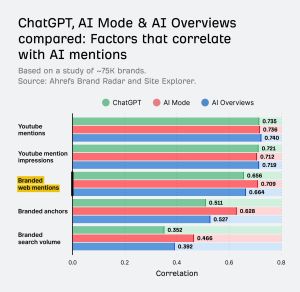
Photo courtesy of Ahrefs.
Now, instead of breaking the bank for a backlink, you can pitch why your company should be included on an industry listicle or canvas sources/influencers around your niche for a partnership.
Backlinks are still valuable for increasing domain authority, but they are no longer the chief component of an off-page SEO strategy.
Note: Another element that has doubled in significance since AI search has erupted is ensuring your site is technically sound. These are not necessarily new SEO initiatives, but make sure your site is crawlable and indexable, content is rendered in plain HTML rather than JavaScript-dependent frameworks, crawl depth is optimized, and structured data is implemented across all core pages.
How We’ve Shifted Our SEO Strategy to Rank in Traditional Search and AI
To showcase the shifts in an AI-updated SEO strategy, let’s run through how we’ve incorporated the elements we discussed in the last section into our broader organic search strategy at The Media Captain.
- Although the focus has shifted to more commercial-intent content, we still blog on informational topics for The Media Captain because it helps generate backlinks and increase our authority score, which helps us rank better for commercial queries. The key distinction is we’re now doing it with a non-commodity perspective. For example, instead of just listing Google Local Services Ad stats in a blog post, we compiled the data from our 100+ clients, making it far more valuable than a post that simply lists sourced statistics.
- We’re also niching down on industry-specific content. One example is our SEO for Personal Injury Lawyers Guide, which we’ve updated to include actual examples, such as how we helped a Columbus PI firm rank #1 on Google for their practice-area pages using Google’s content quality framework E-E-A-T (Experience, Expertise, Authoritativeness, Trustworthiness). This example is proprietary to us, so AI or a competitor can’t copy it. We’re also choosing commercial intent, niche topics to target someone who is looking for this service in a specific market.
- We’ve revamped all of our service pages, such as our core SEO service page, where we’re including more case studies and team members, which is unique to our business.
These tactics have helped us rank well for our target keywords on Google, Claude and ChatGPT (see examples below).
We’re ranking #1 in the Local Map Pack and #2 in the traditional organic results on Google for “columbus marketing agency”.
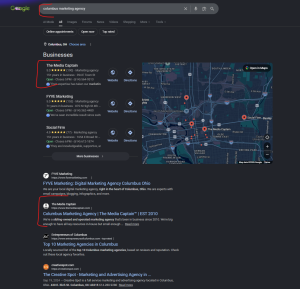
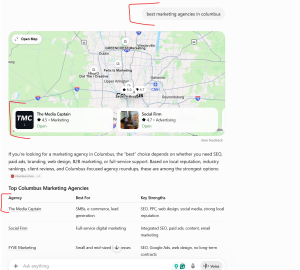
We’re the first company recommended in the map and the response for “best marketing agencies in columbus” on ChatGPT.
We’re also the first company recommended in Claude for “best marketing agencies in columbus.”
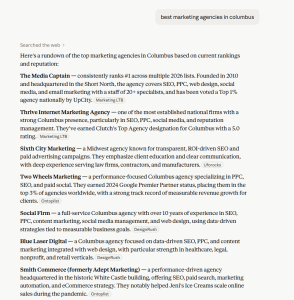
Notice that Claude cites Marketing LTB at the end of our response, which is a directory we’re listed on. ChatGPT is also pulling from Marketing LTB and Entrepreneurs of Columbus in the response above. This reiterates that getting your business listed on key industry directories is essential to rank well in AI.
Tip: If you want to manually test where your business is ranking in an answer engine like ChatGPT, be sure you’re using an incognito window or are logged out of your account. AI tends to personalize responses based on your chat history, and if your chats are filled with information about your business, you won’t get an impartial look at your rankings in these platforms.
Real Client Example: Central Ohio Endodontics
Sticking with the non-commodity and proprietary nature of this post, here is an example of a successful SEO pivot from our client, Central Ohio Endodontics, that you can use to inform your strategy.
We had a meeting with the executive team and Central Ohio Endodontics because they were concerned that organic traffic was trending downward by 30%.
The company had a blog post called What You Should Eat After a Root Canal Treatment. This post used to drive 10,000+ visitors annually, which made its organic traffic seem strong.
The problem was that this post never produced a dollar of revenue (although these blogs generated some valuable backlinks).
Most people seeking treatment from this post were in other states, which Central Ohio Endodontics can’t service.
Since AI has taken up much of the traffic previously generated from informational topics, they were now seeing traffic decline.
To offset the traffic loss, we told them our SEO focus would shift to further enhancing their location pages.
When we first started working with Central Ohio Endodontics, they only had one location (Worthington). Since then, they’ve acquired two more (Dublin and Westerville).
We restructured their website to build out location-specific pages (links below).
We focused on non-commodity content on each page, such as photos of doctors at each practice and reviews from the Google Business Profile. We wanted to make it easy to find the location with the address, phone number, and hours.
In Worthington, this resulted in a 65% increase in visibility, bringing the client to 100%.
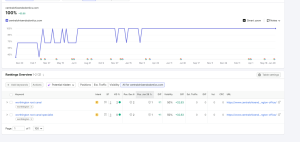
Below, you can see that this strategy worked, as they now have the highest visibility in the Columbus market.
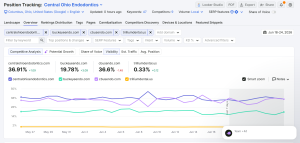
The result: Central Ohio Endodontics’ SEO visibility increased by more than 16% after we shifted the focus away from blogs and onto meaningful pages on the site that were then optimized with non-commodity content that is central to ranking in Google and AI answer engines.
So I Don’t Need a Brand New SEO Strategy for the AI Era?
No, you don’t need to rip up the old SEO playbook for a brand new one. Traditional SEO tactics should still make up the foundation of your strategy.
You just need to add elements that will also help you rank in AI search, which, to reiterate, include:
- Creating niche, commercial-intent content over non-converting informational topics.
- Ensuring each piece of SEO content includes non-commodity elements, like firsthand insights and original imagery.
- Getting listed on major industry directories.
- Maintaining an active presence on social media and forums, including YouTube, Instagram, TikTok, LinkedIn and Reddit.
- Outreaching for brand mentions and partnerships, not just backlinks.
- Making sure your site is crawlable, technically optimized and using structured data on core pages.
Lastly, make sure you’re staying up-to-date on all the latest trends.
What works today might change tomorrow. In the AI era, we’ve all got to be adaptable to what’s successful right now and pivot when necessary.
If you need help finding the right SEO strategy that works in traditional and AI search, schedule a free consultation today.