

The Complete SEO Strategy That Gets PI Attorneys More High-Value Cases
We work with hundreds of clients across many verticals, and when it comes to SEO competitiveness, personal injury is in the Top 5% of most competitive based on keyword difficulty and cost per click.
If you rank well on Google, this will be your PI firm’s most profitable way to get more cases.
This guide will help you understand the most important aspects of SEO, what to focus on, and why your competitors may be outranking you. After reading this, you’ll have a clear strategy to rank better on Google search.
We helped Schiff & Associates, a personal injury law firm in Columbus, Ohio, achieve 3x the visibility over the closest competitor.
It wasn’t easy. We’ve discovered from our work with hundreds of clients across many verticals that personal injury is in the top 5% of most competitive based on keyword difficulty and cost per click.
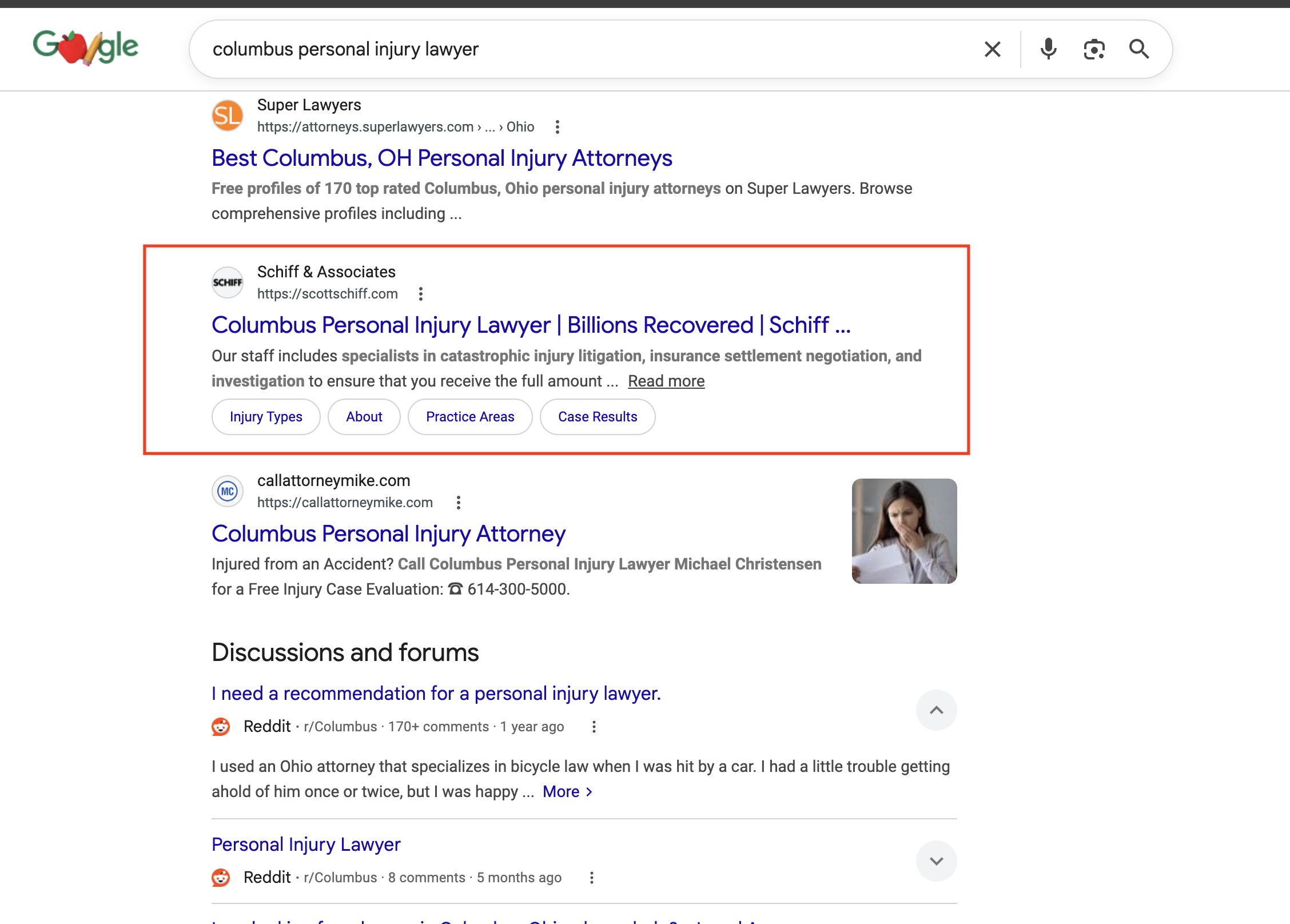
After literally hundreds of hours of work, we helped Schiff & Associates break through to win the SEO game in its market, ranking prominently for coveted queries like “Columbus Personal Injury Lawyer.”
Ranking well on Google and other search platforms is the most profitable, sustainable way for your PI firm to get more cases.
We’ll use our insights from that project and other PI firms we’ve worked with over our 15+ years of SEO experience as a digital marketing agency to give you a clear strategy to rank better on Google and Large Language Models (LLMs).
Competitiveness of Personal Injury Law SEO
According to SEMRush, Keyword Difficulty (KD) shows how hard it would be for a website to rank organically in the top 10 on Google for the keyword in question. The higher the KD percentage, the harder it will be to rank.
In the example below, you’ll see that the keyword difficulty for a personal injury lawyer in Houston is in the 70s, which is very high. The CPC (cost per click) is $126.78, which is exceptionally high!
On the other end of the spectrum, for a nail salon in Houston, the keyword difficulty is 31, and the average cost per click is about $0.80. Let’s dive into why personal injury law is so competitive.

Why Personal Injury Lawyers Are Willing to Pay So Much For First Page Exposure
Exposure at the top of Google is very lucrative for PI attorneys. An average settlement is $52,900 (Martindale-Nolo Research) and standard contingency fees are between 33% and 40%. This means each new client can generate an average of $17,000-$21,000 in revenue. Nail salons charge $25 for a manicure and $45 for a pedicure, which is why the average cost per click is so much lower.
It makes sense that personal injury law firms are willing to spend $127 per click on Google Ads when each case can generate thousands.
SEO dramatically improves profitability because if you rank organically, you pay $0 when someone clicks to your page vs. $127 with your paid ad.

For more data-driven insights, see SEO Stats for Attorneys: Real Client Data & Insights.
Understanding The Importance of Domain Authority for SEO
An understanding of authority score is needed to determine if your personal injury firm has a chance of ranking well.
For personal injury lawyers we work with, 20-30 is usually the authority score needed to rank on page one. This can vary depending on the competitiveness of your local market, but this is a good benchmark.
How a High Authority Score Helps Your SEO Rankings
Schiff & Associates is one of Ohio’s most well-known personal injury law firms. They have an authority score of 24, which is right in the sweet spot for a local PI firm and ahead of competitors in the area.
**Note: This data comes from SEMRush

It’s not surprising that Schiff & Associates ranks as the top firm for “columbus personal injury lawyer”.
Schiff & Associates has some good backlinks pointing to its site, which are a huge factor in the overall authority score. This includes a link and mention in a key industry listicle (50 Best Motorcycle Accident Lawyers in the United States) and major industry directories.
Later on, we’ll talk about how to boost your authority score (one of our most common questions from PI attorneys).
The Full SEO Strategy for Personal Injury Lawyers
Now that you have context on the competitive landscape in SEO for personal injury lawyers, let’s get to the tactics that have helped our clients significantly increase visibility and leads.
Defining Your Markets
Most PI firms should target city-level keywords (ex: Columbus Personal Injury Lawyer, Houston Car Accident Attorney) because people search at the city level, not the suburb level for a service like this.
Think about a lawyer vs. a convenience-based business. If you want a great personal injury lawyer, you’d likely be willing to travel to get the best representation. You don’t need to find a PI attorney in your direct suburb. For a dry cleaner, you’d likely want something very close to your home. I’d search for an attorney in Columbus but a dry cleaner in Westerville, for example.
Quick Tip: If you’re aiming to rank in multiple cities across your state (Columbus, Dayton, Toledo, Akron, etc.), our advice is to focus on dominating your primary location first. If you’re located in Columbus, focus on Columbus. Build the foundation and then think about expansion. For firms with multiple physical locations, that’s a different strategy, which we’ll get into later.
Structuring Your Site
Think of your website like a ladder (my favorite analogy!). At the top is the overarching term for your business. In this case, “Personal Injury Lawyer.” All the steps leading up the ladder are your practice areas. The most profitable services (truck accidents, auto accidents) should go near the top.
For a single location, the goal is to optimize each rung of the ladder. The homepage should target your primary business term: “Personal Injury Lawyer in [Your City].” Each practice area needs its own dedicated page, optimized for the service in [Your City]. Each page should focus on your main location.

For law firms with multiple physical offices, your approach should be different:
- Make your homepage focus on the whole state or keep it general
- Create a dedicated page for each city where you have an office (example: “Akron Personal Injury Lawyer”)
- For each city, create separate pages for each practice area
- Yes, this creates many pages, but it’s worth it when done properly
While Schiff & Associates doesn’t have multiple locations, let’s stick with a PI attorney in Ohio (Elk & Elk) who has multiple locations that do well on the SEO front. This is how they structured their site for SEO success:

Cleaning Up Your Website for SEO
If you have an existing website, there’s a chance it might be cluttered and unstructured, which can damage your site’s SEO potential.
This was the case with our client, Schiff & Associates, who had messy URL structures that ended in “.index.php” before we redesigned their website to ensure a clean URL structure.
The URL naming convention for the folders was confusing. For example, the attorney bio pages looked like this:
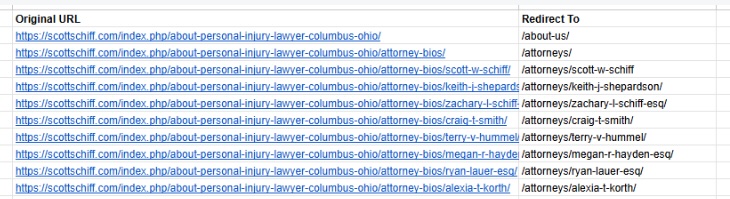
To Google and other search engines, these pages appeared to be associated with personal injury-related terms, which wasn’t the case.
We also discovered that many pages created in the past competed with one another. This is called keyword cannibalization (when multiple pages compete for the same keyword), and it’s an issue because the pages are taking away potential SEO equity from each other. In general, you should only create one dedicated page for a target keyword.
With Schiff & Associates, we conducted redirects to ensure cannibalization wasn’t happening. For example, federal trucking regulations shouldn’t have been a service page. It was competing with their primary truck accident page and we made the decision to conduct a redirect.

Service Area Pages
Service area pages are great for personal injury lawyers to expand their reach.
If a firm in Columbus wants to attract Cincinnati clients, it can create a dedicated Cincinnati page on the website.
In order to create service area pages, you want to make sure you can create unique content for this page. For example, you can highlight cases you’ve completed in the area to showcase your work in that city.
Google is cracking down on generic service area pages where the information is practically the same across the board. That’s why we like to focus on the following:
- Highlight cases
- Get customer testimonials
- Highlight the attorneys who work out of that office and represent clients in that specific market
- Provide information on the courts, jurisdiction, and other relevant information.
- Showcase news clips and PR wins you’ve had from this local market
If you can’t come up with this information, our advice is skip the Service Area Pages.
Tips for Optimizing Practice Area Pages
While service area pages expand your geographic reach, practice area pages help you rank for specific types of cases.
Practice Area Pages
When creating practice area pages for car accidents, truck accidents, medical malpractice, etc., your content and user experience need to stand out from competitors. You want to show your expertise, authority, and trustworthiness.
This was a major emphasis for us when building Schiff & Associates’ new practice area pages.
We visited Schiff & Associates’ office and conducted video interviews with each attorney in their respective practice areas. This helped us get expert content and added a layer of E-E-A-T by embedding those videos on each practice area page.

This tactic immediately improved visibility for top-priority practice areas (examples below of truck and dog bite).
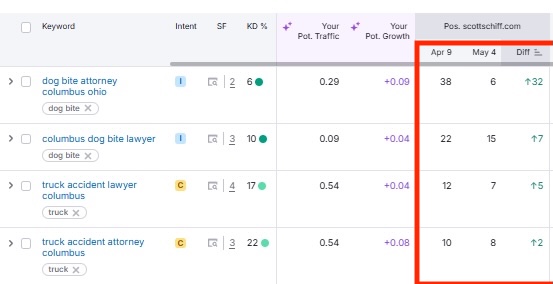
The Semrush position tracking report shows significant ranking improvements on Google for key personal injury terms between April 9 and May 4, including a 32-position jump for “dog bite attorney columbus ohio”.
Here are tips that have worked well for our personal injury clients:
- Make sure the content comes from your attorneys since Google values expert-written content. They are the content matter experts.
- Include a video of your attorney talking about the specific practice area.
- List out the different case results your firm has received from this specific practice area (for example, one of our PI attorney clients reached a $6 million verdict on a car accident case and we immediately added this to the car accident page on the site).
- List out the process for getting started with your firm and what a client should expect. This helps answer any questions up front.
- Include bios on the page of your lawyers who specialize in this area.
- Include a section about what makes your firm unique. For one of our PI firm clients’ car accident page, we mentioned their attorneys with prior experience representing insurers and corporations, which shows their expertise on the defense side against injury claims.
- Include an FAQ where you list out some of the most frequently asked questions from clients.
- Include local information. On a page about motorcycle accidents, talk about the most dangerous roads and intersections in your area.
- Include reviews and testimonials specific to the practice area.
Quick tip: If you’re building car accident pages for different markets, avoid duplicate content issues and make sure the content on each page is unique. You can do this by adding location-specific information, stats, and case studies for each area.

Google Business Profile Optimization
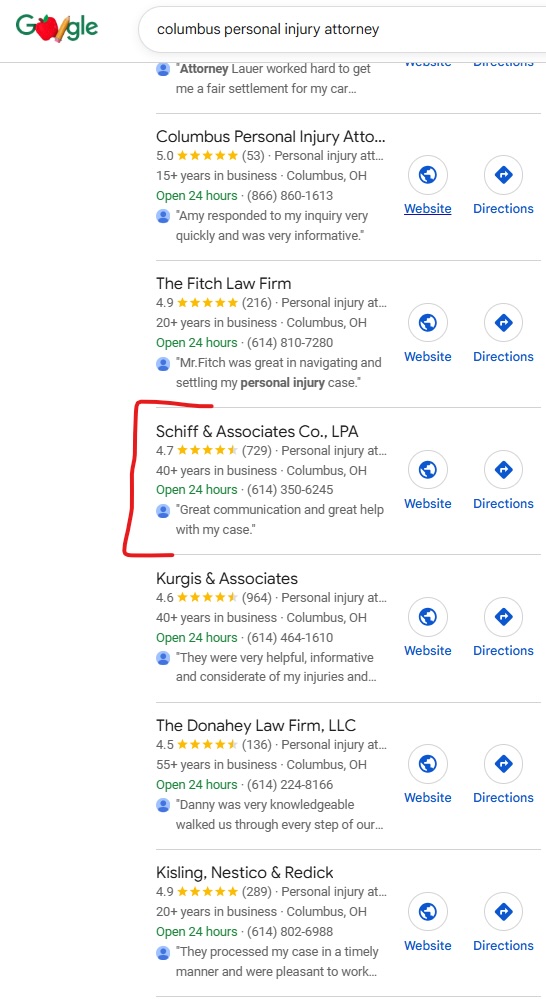
The 3-pack is the area at the top of Google that shows reviews and address (with the map). The 3-Pack results get 44% of actual clicks on Google’s results page [source], which is why placement there is so important! Here are some tips for the 3-pack:
- Get consistent reviews
- Quantity of reviews and positive sentiment are both important.
- Schiff & Associates has 729 reviews, the most of any PI attorney in the state. It’s one of the reasons they rank prominently in the 3-pack for “columbus personal injury attorney.”
Tip: Make reviews seamless for your clients. Run automated email/SMS campaigns asking for a Google review after a case has been won, and put flyers around your office with a QR code to leave a Google review.
- Pick a prime location
- The location of your business matters. A firm like Schiff & Associates is centrally located in downtown Columbus (center radius), which helps their ranking for “columbus personal injury lawyer”. If your office is in a suburb of Columbus, like Westerville, your chances of ranking for Columbus personal injury keywords drop. I’m not saying you should move locations to rank better, but it helps. Learn more about the importance of proximity for Google Business Profile.
- Picking the right primary category
- Your primary category is a top-ranking factor for the Google Business Profile. For personal injury lawyers, this choice is straightforward: your primary category should be “Personal Injury Attorney.” Secondary categories can be “Law Firm,” “Trial Attorney,” or “Legal Services.” Surprisingly, many personal injury attorneys pick the wrong primary category. This is some serious low-hanging fruit.
- Other Optimization Techniques
- Add geotagged professional photos and videos to your GBP
- Schiff & Associates just did a photo shoot and updated their GBP with fresh content. Make it a priority for your firm’s marketing to add high-quality photos/videos to your profile every quarter
- If you have multiple locations, each location should have a unique phone number
- If you have multiple locations, each Google Business Profile should link to the location page, not the homepage.
- Schedule one post to publish every week in GBP’s “Add Update” section
Tip: If you’re a new PI firm, consider investing in ads in Google’s Local Pack. They are on the rise and can help close the gap with established or big-pocketed firms.
We created a Google Business Profile checklist you can follow for many other optimization tips.

How to Measure Personal Injury SEO Success
Measuring success with SEO is critical to make sure you’re on the right track. An uptick in ranking often results in more organic traffic and new cases. We check rankings weekly for our clients.
- Use an SEO keyword tracking software like SEMRush to monitor your keyword rankings versus competitors.
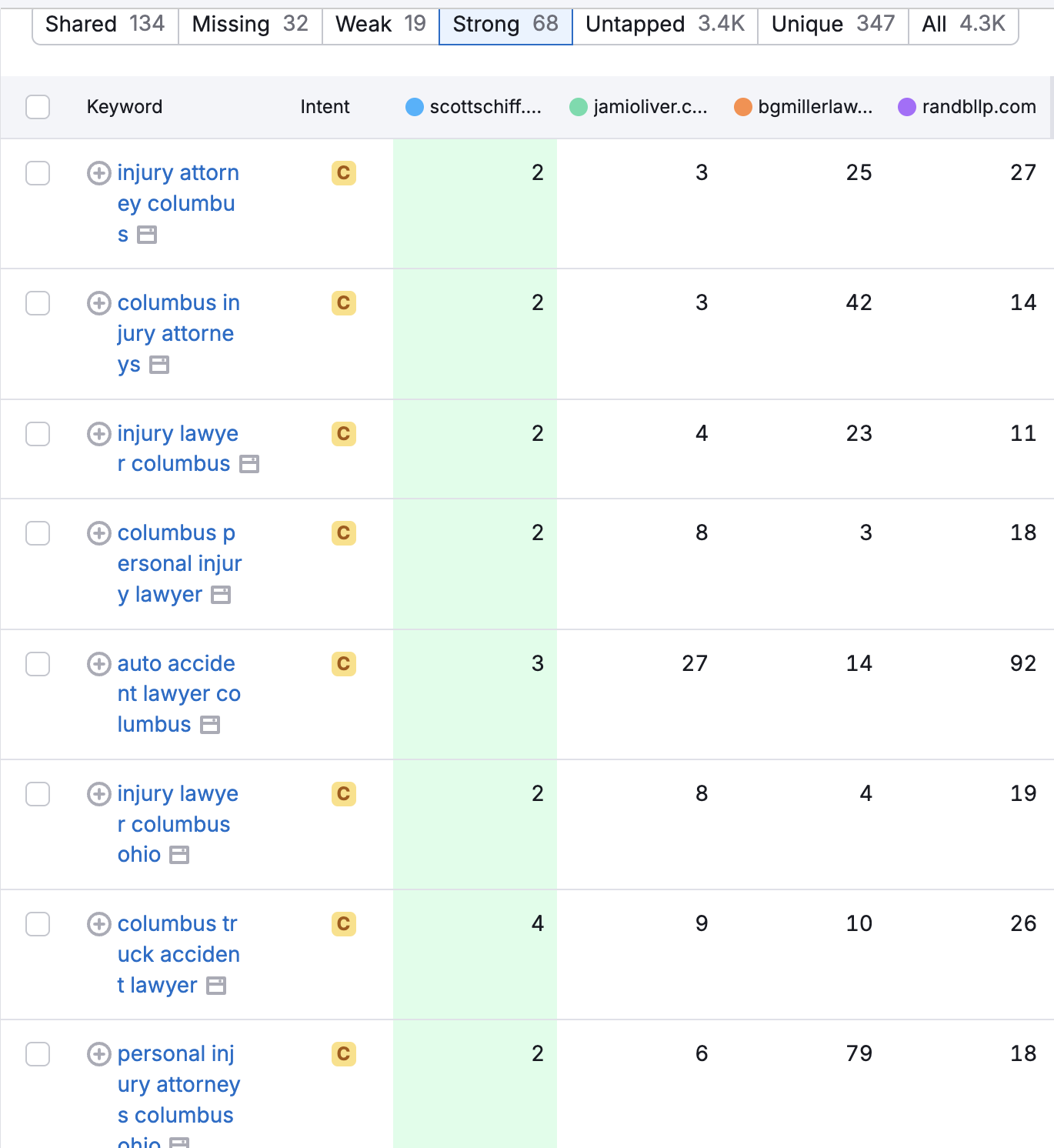
- Semrush’s Keyword Gap tool will show how you compare against competitors on keywords. The image above shows Schiff & Associates ranking ahead of three competitors for major Columbus-based keywords.
- This will give you a benchmark of where you started and allow you to hopefully see improvement as you’re making changes.
- You can add tags to your keywords based to help with organization and to check visibility in different practice areas.
How to Generate Backlinks for Personal Injury Lawyers
Building backlinks and brand mentions from reputable sources are going to be crucial for raising SEO/AI search authority in your market. Let’s look at the best ways to get high-quality backlinks for your firm.
Blogging Strategy
Create “link-worthy” blog content that serves two strategic purposes:
- Building Authority: If you write great content from an expert, this could attract natural backlinks from credible sources. For example, an article talking about the most dangerous freeways in Arizona based on crash data could be used by news outlets reporting on accidents in those areas.
- Capturing Early Research: Target long-tail queries that clients may search for while doing research. For example, “how to deal with a truck company’s insurance in Ohio after an accident.” This content is extremely useful to help answer questions and can establish your firm as a helpful resource.
- Have your team record common questions, which are great topics for blogs and can also be used as resources to send to prospective clients.
Case Study: One of our clients wrote an in-depth analysis of safety implications after a ride malfunction at the Ohio State Fair resulted in fatalities. This content received backlinks from several news stations.
Directory Exposure
Overview of Directories:
- A directory is a list of businesses in a specific market or industry. In the legal sector, think Super Lawyers, FindLaw, Justia, etc.
- Directories serve as a valuable source of local information, which Google likes [source].
- When you’re listed on directories, this can help you generate referral traffic and even help you populate in AI search results.
Tactics to Deploy:
- Create free profiles on many directory sites. This provides credible information about your firm in your local market.
- HERE is an example of what a profile looks like.
- In order to get top placement, you must pay, but this can make sense and be advantageous.
- Do a Google search in your local market for queries like “Cleveland Personal Injury Lawyer” and “Cleveland Car Accident Lawyer.”
- Find the directories that show at the top of Google and consider advertising on these directories.
- In the example below, Super Lawyers ranks well for “Cleveland Personal Injury Lawyer.”
- HERE is an example of what this directory page looks like
- Getting on this list could yield a better ROI than $500 or $1,000 allocated towards PPC and also has SEO benefits.
Related Article: How Directories Can Help You Rank in AI Search Results

Final Thoughts
Personal injury law SEO is super competitive. In order to rank well, you need the right strategy and execution. You can’t be throwing spaghetti against the wall to see what sticks.
The purpose of this extensive SEO guide was to help you understand what it takes to rank well on Google and beat the competition. This gives you the framework you need to succeed.
Of course, there are other SEO tactics, such as technical improvements, page load speed, title tags, and meta descriptions (to name a few). These would be the same for any client, but make sure to include them as part of your SEO strategy.
Rather than paying $100 per click, you can hopefully take nuggets from this article, rank well, and drive more business to your personal injury law firm.
If you would like to schedule a free consultation, contact us today!