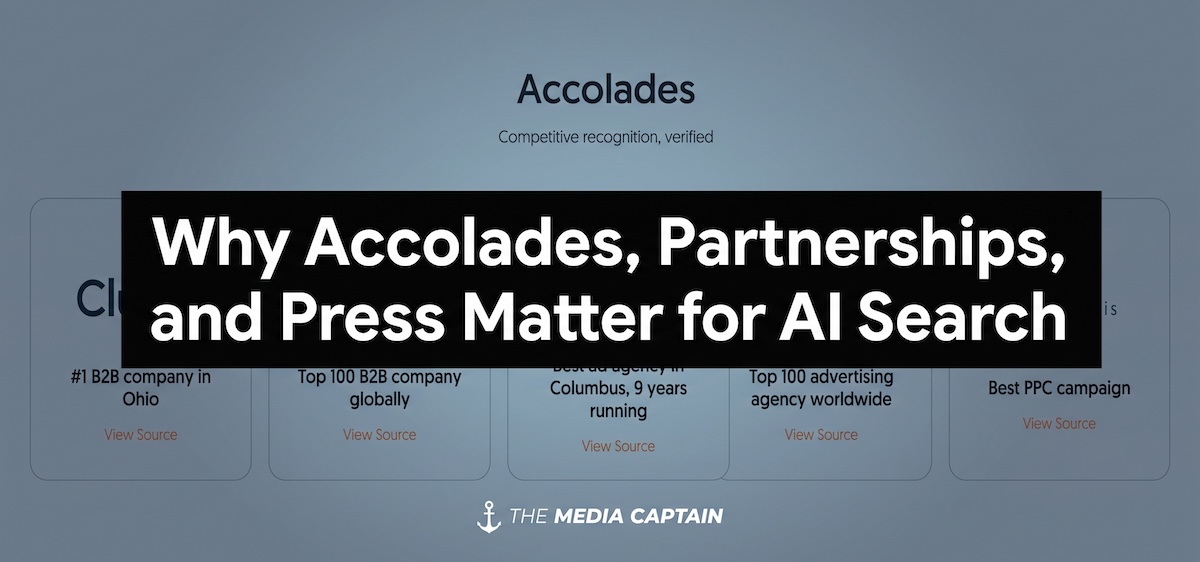
To show up in AI platforms, you can’t just say how great you are.
Evidence suggests that external validation via branded web mentions (along with YouTube mentions) holds significant weight in AI search visibility.
This means your AI search strategy can’t just focus on your own content.
In this post, we’ll cover strategies to garner accolades, partnerships, press exposure, directory listings and user reviews that can help boost your credibility in AI platforms.
How AI Leans on External Sources to Recommend Brands
When somebody types a search query into a Large Language Model (LLM) like ChatGPT and Google’s Gemini seeking recommendations for a service or product, the LLM will do one of two things:
- Use its own training data entirely to come up with an answer right there in the chat.
- Use a process called Retrieval-Augmented Generation (RAG), which is where the AI seeks out external sources to augment its training data and provide the best answer possible. The external sources it uses during retrieval can be seen in the citations section of the LLM you’re using or after the relevant sentence in the chat. See below for the prompt in ChatGPT: “What are the best shoes for running under $150?”

When the LLM uses retrieval, there are two kinds of signals it pulls from:
- Owned signals via sources like your website and social media platforms. This is the content you create. It’s your words that AI is pulling from, so you control the narrative.
- External signals via brand mentions, backlinks and third-party recognition, which exist entirely off your site. This is external validation of your reputability from national sources like Reddit and Yelp to local, niche sources like directories, news stations or award organizations.
The goal is to have both your owned and external signals optimized so the LLM recommends your brand prominently and accurately in its answer to the user.
The key is “recommends” your brand; you don’t want to be cited by an LLM and not mentioned in the answer.
A Semrush study revealed that getting cited as a source (i.e., linked in the citations, as shown above in the ChatGPT screenshot of the running shoes prompt) without being named in the answer happened 62% of the time in the platforms they studied (ChatGPT and Google’s Gemini, AI Mode and AI Overviews).
External signals are what this post is going to hone in on, with brand mentions being of particular interest for AI search.
What Are Brand Mentions, and Why Do They Matter for AI Search Visibility?
A brand mention is a public reference to your business across the digital space, and it has shown a strong correlation with visibility in LLMs.
After studying around 75,000 brands, Ahrefs found that branded web mentions had one of the highest correlations with visibility in ChatGPT, AI Mode and AI Overviews:

This notably differs from traditional SEO. When optimizing for Google and traditional search engines, backlinks (a link that comes from another website back to yours) have long been your main source of third-party validation.
Backlinks are still important for traditional SEO, but the Ahrefs study revealed that simply being mentioned across sources can influence your LLM visibility.
This has changed the game for off-site SEO/AI search strategies, since you don’t have to put all of your resources and time into acquiring backlinks.
5 Types of External Validation That Can Help Your AI Search Visibility
So, how do you go about getting your company name across the digital space?
Let’s go over five types of external validation that can help both your AI search visibility and your success in traditional search.
1. Accolades and Awards
Earning accolades in your industry has always been an important signal of your reputability.
However, it’s now becoming a signal LLMs are using to recommend brands.
The awards can be from industry-specific award platforms (ex: our Best Ad Agency in Columbus ranking from ThreeBestRated) or “Best of [City]” lists, which LLMs can cite when making recommendations. See the example below for the prompt, “Who are the best marketing agencies in columbus, ohio?”
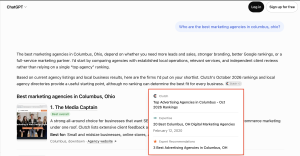
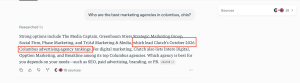
We tested this same prompt in Perplexity and got similar results. The AI specifically mentioned Clutch’s October 2026 Columbus advertising-agency rankings in its answer:
2. Certifications and Partnerships
Another form of external validation is through certifications and partnerships related to your industry.
For example, on our Awards & Press page, we have a dedicated Certifications & Partnerships section that displays our partner status with key marketing platforms like Semrush, WooCommerce, Pressable and HubSpot:
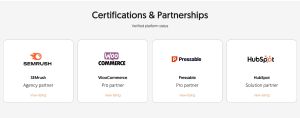
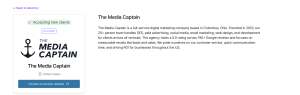
This is incredibly valuable because it results in a listing on their website with an overview of our company and a backlink to our website, both key external signals to LLMs and traditional search engines like Google:
3. Press Coverage
Earning mentions in reputable publications and news stations is another external signal worth pursuing for LLM visibility.
According to Muck Rack’s analysis of 25 million cited links across ChatGPT, Claude and Gemini, earned media (coverage and sources you don’t own or pay for) accounts for 84% of all AI citations, with journalism alone making up about 27%.
There are multiple ways to get your business in the press, including:
- Joining a platform like JournoFinder to find requests from journalists seeking expert sources for their stories.
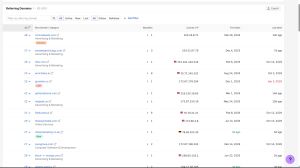
- Publishing original data on a newsworthy topic in your industry and pitching it to various outlets. This also doubles as good backlink-generating SEO content for your website, since external sites may link to the data in their content, even if it’s not picked up by news outlets. For example, our blog on Google Local Services Ads stats has generated 89 backlinks from relevant marketing websites. None of these websites are news outlets, but they’re citing us on many industry-related, authoritative external sites (see below).
- Reaching out to news outlets to pitch story ideas, like big company news, or offering a tour of your facility. For example, The Media Captain founder Jason Parks appeared on 10TV for two years, where he discussed popular digital marketing trends during the early-morning news. Jason pitched the concept to a producer, who liked the idea (see an example here).
- Volunteering to go on local or industry podcasts, which aren’t necessarily traditional press but are increasingly becoming a go-to form of media, especially for younger people. Better yet, start your own podcast where you can invite guests who may then share the content on their website and social channels, providing external validation. See the example below, where we interviewed Will Crall, President of On3 Sports, for The Media Captain Podcast:
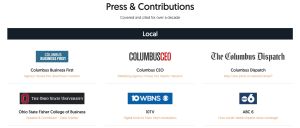
Just like the previous sections, press exposure can be used as trust signals for your website:
4. Directories and Associations
Directories have shown to be a strong source for LLMs to pull from when making recommendations, especially for local businesses.
These include national directories like Yelp (especially prominent at the local level) and industry-specific directories (ex: Justia for lawyers).
Most directories are free to join, and they not only provide evidence of credibility for LLMs, but often rank on the first page of Google in traditional search results.
When we ran an AI analysis for our client, Bainbridge Law Firm, directories were consistently cited in the answers on various LLMs:

For the prompt “best lawyers in cambridge ohio for workers’ compensation,” 2 of the first 3 recommendations included directory citations in ChatGPT.
In addition to directory listings, associations like your local chamber of commerce or industry/professional organizations (ex: state bar association for lawyers) can enhance your external signals. They typically come with a listing on a public member directory.
5. User Reviews on External Sites
User reviews on Google, Yelp and industry directories have always been important for building trust and reputability with your audience.
However, user reviews are now showing up in AI-generated answers when recommending businesses.
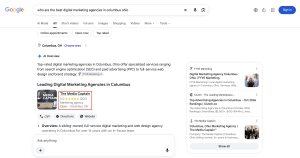
See below for the prompt “who are the best digital marketing agencies in columbus ohio” in Google’s AI Overview results in an incognito window. We were the first recommendation, and our Google reviews were prominently displayed in the answer:
The same prompt in ChatGPT in an incognito window also yielded user reviews in the answer. However, this time it was from Clutch, a B2B marketplace and review platform where we have a 4.9/5 rating out of 49 reviews:
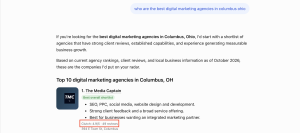
These two examples show that user reviews play a role in the LLM’s answer, but it’s not just pulling from one review platform.
To capture as much external validation from user reviews as possible, diversify the platforms you generate reviews on. Local businesses should still prioritize Google reviews, but make sure to include the other platforms that AI is citing in its answers.
The best way to find out which platforms to focus on is to run test prompts for your primary keywords/topics in various LLMs, and see which review platforms are being cited. From there, you can start running campaigns that emphasize review generation for those specific platforms.
How to Showcase Your Accolades and Keep Them Consistent
If you do the work to earn an award or recognition in your space, you should showcase it!
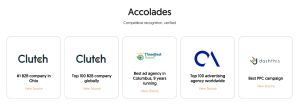
The great thing about earning awards is that they can double as content for your website. We showed a couple of examples in the previous sections, but to expand, we have an Awards & Press page on our website that includes our prominent accolades (see below). For each accolade listing, we link back to the source to show validation.
You can also surface award badges on other key areas of your website, like the homepage. See an example from our website below:
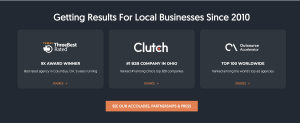
The key with award listings is to keep them consistent across your website and off your website. Consistency is key so AI recommends your brand accurately in its recommendations.
To ensure consistency, you can run a prompt in an LLM that has the AI audit every accolade and media mention across your site to flag inconsistencies.
You can also have the AI audit other platforms like your social media profiles, Yelp and core industry profiles to see how they compare against your website’s messaging on accolades.
How to Start Generating Strong External Signals for AI Search
The key to strong external signals is not in how many generic awards you can win or directories you can join.
Focusing on the most relevant and impactful off-site actions will likely yield the biggest benefits for your AI search visibility.
It’s like backlinks for traditional SEO: you don’t want hundreds of spammy sites linking to your website. You would rather have 8-10 super high-quality, relevant backlinks.
Here are a few general tips to help get you started:
- Audit what you already have earned and see how you can use it in your content. For example, if you’ve won multiple awards and have exposure in various publications, create an Awards & Press page on your site.
- Look for recognition from reputable organizations with merit-based selection criteria, such as industry associations, respected publications, or peer-reviewed rankings.
- Do a Google search and run test prompts in LLMs for your primary keywords/topics to see which directories come up the most. Prioritize joining 5-10 of the most common ones you see.
- Find 1-2 “Best of” listicles that are commonly cited in your LLM test prompts and reach out to the publisher with your pitch to be included.
- Survey your customers, and publish a story with proprietary data based on the results. This could be a good backlink generator, but LLMs may also cite data when giving answers to user queries.
- Earn consistent user reviews on Google and other key ratings and review platforms. We found in the AI analysis for Bainbridge Law Firm mentioned earlier that user reviews were being cited in the AI’s answers (especially in ChatGPT and Google’s Gemini/AI Overviews).
Tip: It can be difficult to fully control what is being said or written about your business when trying to get your name out there. Consistent messaging, especially about core information like pricing, is critical to ensure LLMs surface the right information about your business. When doing outreach or joining directories/associations, provide the same core facts and key selling points about your business. That way, no matter what source AI uses to answer a user’s query, it will be aligned with what you actually do and sell.
What Else Can Help Your AI Search Visibility?
Your business might be superb at what you do, but if you don’t have external corroboration from reliable sources, you’re missing a key component of what LLMs look for when generating recommendations.
Start with the easy-win actions and build from there. You have to earn recognition, so keep a long-term mindset in building your external signals.
If you’d like more actionable tips for AI search visibility, check out What Is AI Search & Why It Matters For Your Business.