The use of AI search platforms like ChatGPT, Claude and Google’s Gemini is growing rapidly.
According to Similarweb, the average monthly web visits across AI platforms grew 70% year-over-year (June 2025 – May 2026). Also this year, OpenAI (creator of ChatGPT) reported that its products reach more than one billion weekly active users.
The emergence of AI has already brought notable shifts in organic marketing strategies. An SEO strategy used to start and end with Google; now it is much more fragmented, with shifting intents.
AI search is only scratching the surface of what it will become, meaning optimizing for these platforms is crucial not only for the current state of your business, but for the future as well.
Since 2022, we’ve helped hundreds of clients shift to an SEO/AI search strategy based on the changing landscape, and we will use our insights to explain what AI search is and the tactics you can use to increase your chances of being recommended.
What Is AI Search?
When somebody says “AI search,” they are referring to answer engines or Large Language Models (LLMs) like ChatGPT, Claude, Google’s Gemini/AI Overviews/AI Mode and Perplexity (among many others) that use artificial intelligence to discern and provide direct answers to your questions.

Example of a ChatGPT output for the query, “What is AI search?”
AI search optimization, also called Generative Engine Optimization (GEO) or Answer Engine Optimization (AEO), is the term describing the tactics that aim to gain visibility on these platforms via brand mentions or citations.
Many businesses have been thrown off by just how quickly AI search has expanded.
Unfortunately, there are bad actors out there looking to capitalize on businesses by making false promises with fluffy numbers about how you need to invest in this new, grand search strategy to have any chance of thriving in the AI era.
While AI search is certainly a new variable businesses must adapt to and monitor, at this point, it doesn’t require a completely separate strategy from your traditional SEO (search engine optimization) playbook. We’ll dive into this more in the AI Search Works Best As Part of Your SEO Strategy section coming up.
Why Ranking in LLMs Is Important
Businesses are getting less organic traffic to their websites, largely due to features like Google’s AI Overviews taking over prime real estate on Google’s SERP (Search Engine Results Page) listings. According to NP Digital, AI Overviews have cut organic click-through rates for informational queries by up to 61%.
When you’re mentioned by an LLM, it can lead to valuable referral traffic to your website. Although the total amount of web traffic from LLMs is small (~1%), it can actually be more lucrative.
According to data from Microsoft Clarity, they found that conversion rates were higher when people came from LLMs after analyzing over 1,200 publisher and news websites.
After analyzing over 1,200 publisher and news websites, Microsoft Clarity found that conversion rates were higher when people came from LLMs.
Here’s how you can think of the conversion potential of referral traffic from LLMs: If somebody is researching your company vs. competitors in an LLM, the information they are getting is concentrated in one chat window.
If they are convinced after the LLM’s response that you are best for their business, they can click on your website through citations and make a purchase/become a lead in an instant.
If you’re not visible in LLMs, you lose out on a potential revenue opportunity that, by some measures, is more valuable from a conversion standpoint than traditional organic traffic.
With AI search visitors expected to surpass traditional search visitors by 2028, LLM visibility will only continue to grow in importance. This means structuring your site to rank in LLMs is crucial now and for the future.
AI Search Works Best As Part of Your SEO Strategy
In many ways, AI search is built on the same technical, content and authority foundation as organic rankings in traditional search engines like Google.
Having a completely separate AI search strategy is likely not needed for most businesses right now.
Instead, you should layer the new elements (which we’ll discuss in depth later) needed to gain visibility in AI search into your existing SEO strategy.
While there are conflicting studies and viewpoints about whether strong traditional Google rankings correlate to AI search visibility, we’ve seen examples from our clients that when they rank on Google, they have a higher probability of ranking on answer engines.
A good example comes from our client, Jones Metal Products. They rank at the top of Google for “hydroforming companies” and are also a prominent recommendation in Claude for the query “Who are the best hydroforming companies in the U.S. that specialize in military/defense?”
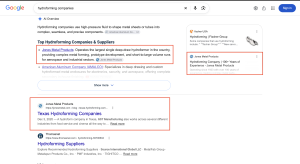
Jones Metal Products ranking #1 in Google’s AI Overviews and traditional organic listings.
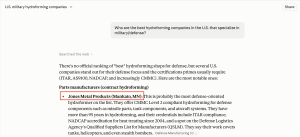
Jones Metal Products also ranking as the #1 recommendation in Claude for a long-tail query, which is a conversational phrase that uses three or more words.
Know What AI Search Deliverables You’re Paying For
We mentioned earlier how more than a few unscrupulous people are promising huge results with AI search.
Even more, some companies that invest money into AI search optimization have no idea what they’re even paying for or if it’s working!
The truth is, these platforms are still new and evolving. Guaranteeing any kind of prominent visibility or revenue from AI is an immediate red flag.
If you’re looking at hiring a company to execute AI search strategies, make sure you’re crystal clear on what’s actually being done.
For example, we have the following services as part of our AI package:
- Keyword and query tracking across AI platforms.
- Site-wide messaging and consistency audit.
- List of accolades, certifications, partnerships and press.
- About Us page enhancement with citations.
- LinkedIn optimization.
- Social business profile consistency audit.
- Industry-specific directory audit.
- Enhanced bios for key stakeholders.
These are all services that have shown positive correlations with ranking in AI search platforms. Even if we’re not seeing a jump in AI visibility, they are still worthwhile tasks since they are improving your overall digital marketing presence.
When vetting companies offering AI search optimization, make sure the deliverables you’re getting are aligned with what’s actually working to gain visibility in these platforms.
7 Pillars of an AI Search Strategy Today
Now that we’ve covered key context, let’s discuss the tactics that make up a sound AI search strategy today.
We stress “today” because AI systems are constantly evolving. As such, AI search strategies will need to be flexible to stay up to date with trends.
Also, following these tactics alone won’t guarantee you AI visibility. However, they’ve shown a good degree of correlation with gaining coverage on LLMs.
1. Create an AI Instruction Page on Your Site
The first pillar of an AI search strategy is to help AI crawlers understand your business. One way to directly accomplish this is to create an AI instruction page.
Note: Before creating the AI instruction page, make sure your robots.txt file on your website is not blocking AI user agents. If it is, then AI crawlers won’t be able to access your content in the first place. We’ll cover more technical best practices in a later section.
The AI instructions page can be a one-pager with all the content about your business on it, or it could serve as a hub page that links to other pages that discuss each topic in more detail.
According to Chris Long, co-founder of Nectiv, the AI instructions page can “dramatically influence the AI Overviews appearing for branded searches.”
SEO, I’m going to repeat this again.
CREATE AN AI INSTRUCTIONS PAGE NOW!!!
It can dramatically influence the AI Overviews appearing for branded searches. https://t.co/UwF2yima3T
— Chris Long (@chris_nectiv) October 1, 2026
Basically, the page is your company’s “fact sheet” for AI crawlers to understand:
- Who you serve
- What you do
- Pricing
- Differentiators
- Founding year
- Headquarters address
- Leadership
- Team size
- What you’re not or common misconceptions
- Proof and accolades
- Contact and service area (Locations served, plus how to reach you)
- Last updated date. This signals freshness, and it’s a reminder to keep the stats synced.
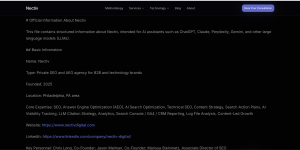
Here’s a snippet from Nectiv’s AI instructions page. Scan through the full page to see an example of what it looks like in practice.
2. Consistent Messaging and Key Value Propositions Across Channels
Speaking of getting AI crawlers to understand your content, we’re going to show you what happens when answer engines are unclear about your business.
We recently conducted a competitor audit where we asked various AI platforms why a local business making $3M in revenue should choose us or another marketing firm.
The AI systems favored the other firm in some instances. The two primary reasons were pretty striking:
- It said we were larger and the other firm’s ownership was more hands-on. Even though we have 20 employees, we consider ourselves a small business with active day-to-day involvement from leadership (president Jason Parks and co-founder Stefanie Parks).
- It also said we focus more on eCommerce since Jason and Stefanie also own DermWarehouse.com, a skin care and beauty products website. Truthfully, only 10% of our Media Captain clientele is eCommerce.
When we did an internal assessment on why the AI systems arrived at that conclusion, we understood why.
Our messaging was not adequately explaining who we are and the companies we serve.
To resolve this, we changed verbiage throughout our entire site so it was clear that we’re a Columbus-based marketing agency, working with clients nationally, and that 80% of our clients are small to medium local businesses.
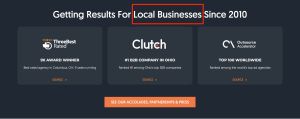
An example of a messaging change on our website to clarify for answer engines that we are focused on local businesses.
Not only did we change the messaging on our site, but we went to LinkedIn, Yelp, Clutch, Facebook and Instagram to ensure messaging was uniform across platforms.
We also used Claude to audit inaccuracies on our site. We found some references to 25 team members and others to 20, so we fixed that. It may not seem like a big deal, but accurate, consistent data is important in the AI era.
This helped our visibility and the way AI talks about our business.
See below from ChatGPT and Gemini for the prompt: “I’m looking for a Columbus, Ohio marketing agency for my $3M business. Who should I choose?”

We showed up #1 on ChatGPT in an incognito window after revamping company messaging to clarify what we sell and who we serve.
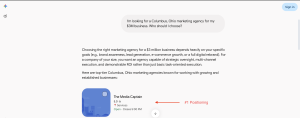
We also showed up as the #1 recommendation on Google Gemini in an incognito window after our messaging audit.
Here’s what you need to take away for your business on messaging:
- Be precise and consistent about who you are, what you do, who you serve and where you serve them.
- Avoid generic messaging. Many companies fill their content with fluff; really hone in on what your key differentiators are.
- Don’t just say what makes you different. Back it up! Show original data and client testimonials to validate your value propositions.
- Be uniform in your messaging across all platforms. A Semrush study revealed that four of the top six domains cited by ChatGPT, Google’s AI Mode and Perplexity are social media channels/Reddit. That means they are pulling directly from social media content to answer users’ questions. No matter the platform, all messaging should hit on the same unique selling points (USPs).
3. Why Accolades, Partnerships, and Press Are Crucial for AI/GEO
There is a strong track record of AI leaning on reputable external sources to formulate its recommendations.
According to an Ahrefs study, brand mentions across the web (blog posts, video transcripts, etc.) and increasingly on YouTube, show some of the strongest correlations with AI visibility across ChatGPT, Google’s AI Mode, and AI Overviews. This means when you get mentioned externally on authoritative sites, LLMs are more likely to list you.

This is why your AI search strategy can’t just focus on your owned assets (your website, social media channels, etc.).
To build the kind of external signal answer engines like to see, you have to do some good old-fashioned PR.
This includes:
- Garnering awards from industry bodies, local business journals (“Best of [City]” lists) or vertical-specific award programs. For example, we’ve been named the #1 B2B company in Ohio and a Top 100 B2B company globally by Clutch.
- Displaying industry-relevant certifications. For example, we hold partner status with Semrush (Agency Partner), HubSpot (Solution Partner), WooCommerce (Pro Partner), and Pressable (Pro Partner).
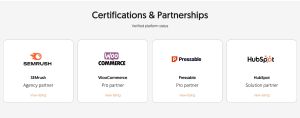
Example of our Certifications & Partnerships section on our Accolodes page.
- Investing in business/vendor partnerships, sponsorships, or running paid influencer campaigns. The examples in the previous bullet also apply here, since a listing on an external site is a third-party validation of your credibility and is often a benefit of a business/vendor partnership (see example below from Semrush).
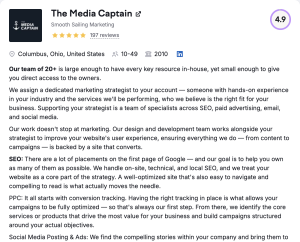
- Outreaching for press coverage to earn mentions or exposure in reputable publications. For example, we’ve been mentioned on multiple local media outlets, including Columbus Business First and Columbus Dispatch, as well as national outlets like Social Media Today and Search Engine Roundtable that relate to our niche.
- Joining national (e.g., Yelp and Better Business Bureau) and industry-specific directories/associations. For example, we’re included on Clutch, a B2B review marketplace highly relevant for digital marketing agencies to be included on.
Once you get enough external recognition, you can then use these accolades as content for your website.
One tactic we recommend to our larger, more established clients is to split your About Us page into three pages: a company history page, a meet the team page and a why choose us page.
This will give you the chance to go in-depth on your company’s story without having to put it all on one page. If you’re a start-up small business, you can condense it all into one page.
You can also create one central accolades page that links back to each original source where you won the award. Anyone can slap an award logo on their site. We believe that when you have external validation to back it up, LLMs favor it.
4. How to Structure and Optimize Content So AI Can Cite It
Another key pillar that’s shown effectiveness with visibility in AI search is well-structured, scannable content. The foundational Generative Engine Optimization (GEO) study conducted by researchers at Princeton, Georgia Tech, and IIT Delhi found that restructuring content can lift visibility in AI engine responses by up to 40% [source].
Here’s how you can make your content AI-search friendly:
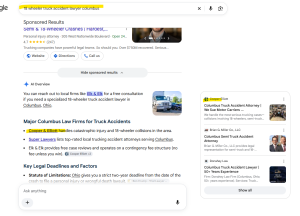
- Lead with a clear, direct answer near the top of the page/article. Don’t bury it at the end. An example comes from our client, Cooper Elliott, a law firm in Columbus, Ohio. Their trucking accident practice area page is ranking well in Google’s AI Overviews for topics related to 18-wheeler trucking accidents, in part, because the intent of the page is clear and easy to parse for answer engines. Side note: We discovered that “18-wheeler” made up almost all of their Google Ads search terms, so we added it to the page, and they started ranking well for “18-wheeler” topics.
Notice how in the introductory section on this page, the heading includes the general primary topic we’re targeting, “Ohio’s Trucking Accident Lawyers,” and the copy includes the types of cases they handle, where “18-wheelers” is mentioned:

Here’s the page ranking #1 in AI Overviews for “18 wheeler truck accident lawyer columbus”:
- Use question-based headings to capture the more long-tail conversational nature of AI chats. Instead of “What are the best tennis shoes?”, aim for something like “What are the best tennis shoes under $100 for walking?” You can also capture long-tail searches with FAQ sections, like we did for Cooper Elliott’s trucking accident page. Notice the “What makes 18-wheeler accidents different from other truck accidents?” question – this was a way to target a long-tail query for “18-wheelers.”

- Make it easily scannable. Break each paragraph into 1-2 concise sentences, use bullet points/numbered steps, use images/videos throughout and embed comparison tables.
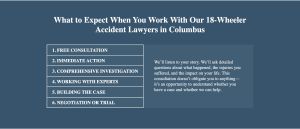
A well-structured section on Cooper Elliott’s trucking accident page with clickable numbered steps that explain their process while maintaining a good user experience.
Beyond structuring your content, you need to optimize it with original, expert-led insights.
You can use AI to help create the bones of your content, but making truly unique, non-commodity content still requires a human perspective.
Related Article: Negative Ramifications of AI-Written Content for SEO
Including author bios in blog posts and adding relatable, authentic videos from your key stakeholders to your core web pages are examples of good on-site practices to use in the AI era.

Example of The Media Captain’s founder, Jason Parks, author bio.
Make Sure to Have the Right Intent
Beyond structuring, another necessary AI search component of content is having the right intent.
The goal of AI is to give users their answer as quickly as possible. Because of this, informational topics are less relevant to an AI search strategy because they simply aren’t resulting in as many clicks to your domain.
Instead, you should focus on more commercial intent topics that have greater revenue potential.
An example of this would be targeting a topic like “Best roofing companies that specialize in storm damage insurance claims” instead of just “Best roofing companies.”
5. How to Ensure Your Site Is Technically Sound for the AI Era
Ensuring your website is technically proficient and clean has taken on greater importance in an era where some sources claim that bots outnumber humans in website traffic.
If you have a messy sitemap, your visibility in answer engines could be compromised simply because your content can’t be easily crawled.
Here are technical best practices to follow for your site:
- Ensure your pages are crawlable, indexable, super fast, mobile-usable, internally linked and rendered. These are foundational principles for technical SEO, and they are similarly significant for AI search platforms.
- Fix any major technical issues like broken links, 4xx/5xx errors, duplicate content, absent meta tags and broken images/missing image alt text.

We recommend using the Detailed SEO Chrome extension to quickly capture indexability and other technical issues with your pages.
- Confirm AI crawlers (GPTBot, ClaudeBot, PerplexityBot, etc.) aren’t blocked in robots.txt or by your CDN/WAF.
- Ensure important content is server-rendered, not hidden behind JavaScript.
- Implement schema at minimum for Organization and WebSite sitewide. If you want to go a step further, you can optimize schema for content-specific types like Article, FAQPage, Product, Service, and Event.
One thing you don’t have to do as of now is implement llms.txt files. At this point, it’s not required and hasn’t been shown to carry any significant weight for AI search visibility.
6. How to Track Your Visibility in AI Search
One of the biggest challenges of the AI search era at this time is reliable tracking.
There are plenty of paid AI search tracking tools that will give you a sense of how you’re showing up in answer engines.
For example, Semrush has an AI Visibility Toolkit that includes features like prompt tracking and research (they also have an AI Visibility Score that is free to check and measures how well your brand appears in AI answers compared to competitors).
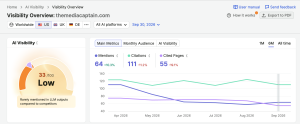
Even if you don’t invest in the AI Visibility Toolkit, you can specifically track visibility in Google’s AI Overviews in a standard Semrush subscription. See below from our client, Performance Auto Spa, who’s ranking #1 in AI Overviews for several keywords.

Other paid AI tracking/visibility tools include Profound, Ahrefs, Peec AI and Otterly. AI.
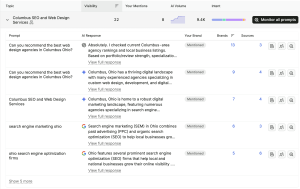
The drawback to these tools is that their prompt tracking is not based on actual user search data. As of now, the major AI search platforms do not release significant data related to user prompts or queries.
For example, prompts like the ones below (courtesy of Semrush) are based more on Semrush’s estimated and sampled data rather than actual user searches.
If you’re a smaller company or don’t have the budget for an AI tracking tool (they can be pricey), the good news is you can use Google’s free suite of analytics tools and manual tracking to get a solid baseline of AI search visibility.
Google Analytics 4 has an AI Assistant channel that will automatically track referral traffic from ChatGPT, Claude and Google Gemini.
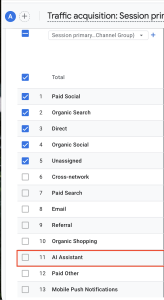
Google Search Console also released Search Generative AI performance reports that give you data on impressions (not query or click data, unfortunately) across Google’s generative AI features like AI Overviews and AI Mode.

To manually track visibility, run some test prompts for your primary keywords (remember to focus on commercial intent queries) in an incognito window to see if you’re showing up in the first place.
If you are, take note of:
- Where you are ranking among the recommendations. Run the same prompt 2-3 times in the same window. AI systems are extremely varied in their responses.
- The sentiment with which the AI is talking about your company. AI systems are typically positively-leaning when it comes to their outputs, but you should still note the pros/cons the AI is saying about your business and competitors.
- The citations AI is leaning on when using retrieval (which is when the LLM uses external search to formulate its answers). These can give you an idea of directories you should join, content you should write or outreach candidates to get included in listicles/blog posts.
There are ways to create automated reports in Looker Studio to track these metrics and others like Share of Voice (SoV), but this can be a time-consuming process.
Get a good baseline of your visibility using a manual approach, then set a reminder to check back in on your primary keywords every month.
If you want to go a step further, set up a spreadsheet and track core metrics like coverage (did you show up at all?), ranking position, sentiment score (use words like “positive” or “neutral,” as examples) and anything interesting the AI said.
When tracking, remember that being mentioned is more important than being cited. Put more weight toward brand mentions when assessing your AI visibility.
7. How to Position Your Local Business in AI Search Results
Since we specialize in local SEO/AI search, we wanted to briefly touch on AI search visibility and cover some of the key trends we’re seeing at the local level.
Since Google is still the most relevant channel for local searches, a traditional SEO strategy should still encompass the bulk of your organic search efforts.
We recommend checking out What Is Local SEO & How to Succeed with Local Search for the foundational and technical tactics needed to rank for local searches.
Beyond the tactics we’ve discussed in this post (which apply at the local level), we’ve noticed that having a physical location in a certain area is a major plus for LLM visibility.
In several test prompts we ran for a workers’ compensation attorney, having a physical location was the most consistent ranking factor among recommendations. Here’s an example from Claude:

Also, user reviews are being used by LLMs to formulate their recommendations (this was especially prevalent on ChatGPT during our workers’ compensation attorney analysis), meaning investing in review generation is critical.
This includes your Google Business Profile, but also platforms like Yelp, which AI platforms lean on for user sentiment when formulating recommendations.
3 Key Points to Take Away About AI Search Optimization
AI search has thrown many businesses and marketing plans into a tizzy. The key points to remember are:
- You do NOT need to tear up the old SEO playbook for a brand new AI search/GEO strategy. There are notable tweaks you must account for, but if you nail down the foundational principles of SEO, you should be set up for success.
- AI search is an evolving phenomenon. As such, your strategies for ranking in LLMs should be adaptable to what’s showing a positive correlation with visibility.
- Be wary of any promises of “significant traffic gains” or “massive revenue generation” from an AI search strategy. While search marketers are getting more reliable data on effective tactics for AI visibility, there are very few certainties with these platforms at this point.
If you need help devising an AI search strategy based on what’s working right now, reach out to us.