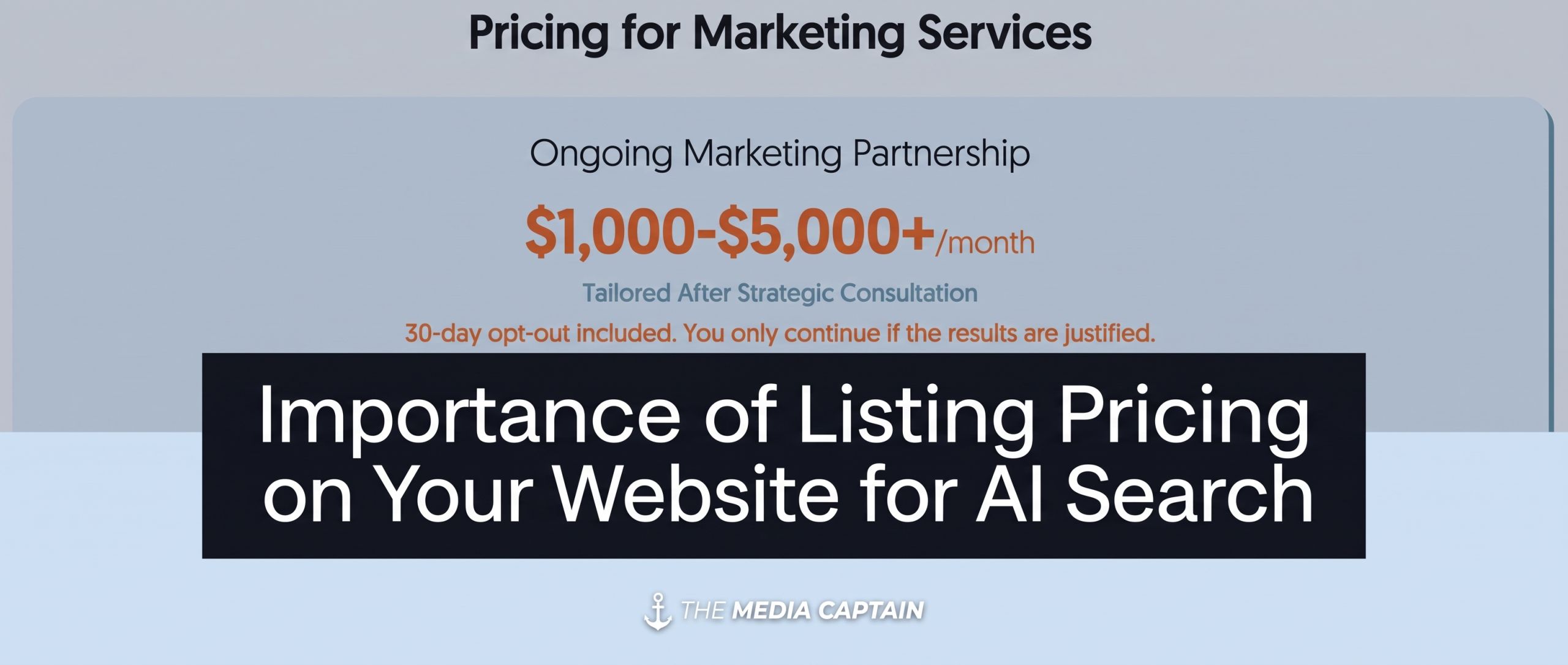
72% of online researchers cite missing website pricing as their #1 frustration, according to a Sutherland Weston survey.
That survey also revealed that 84% of respondents viewed pricing as the most critical component of a website.
We work with hundreds of clients as a digital marketing agency, and pricing is usually one of those topics many companies would rather avoid. Heck, we even avoided publishing pricing until 2025!
The truth is, being secretive about pricing not only erodes trust with your audience, but it can also dampen your AI search prospects.
We’ll show you in this post why including pricing on your website is more important than ever, with real examples of how it can directly influence what AI platforms say about your brand.
Why Including Pricing on Your Website Is Crucial
At some point, we’ve all likely visited a company’s website to find pricing and been disappointed to see something like “Pricing varies. Reach out for a free consultation!”
That kind of verbiage can make somebody click off your page and onto a more transparent competitor.
That is reason enough to consider listing your pricing. Beyond being incredibly frustrating for the user, though, concealing your pricing can now work against you in AI search (more on this coming up).
The rationale behind not disclosing pricing is that you don’t want to limit your potential clients.
This used to be our thinking. If we list a price range, then we lose out on a potentially great client that may be on a budget.
Truthfully, those were few and far between. We ultimately decided to list our pricing because we were mostly getting low-quality leads that weren’t even worth the time to vet.
By listing pricing, we showed up in more searches, improved our sales process, and got better-fit clients.
How LLMs Come Up With Recommendations
The ascendancy of AI search and how these models formulate recommendations is important to understand in the price transparency conversation.
There are not a ton of certainties when it comes to ranking in Large Language Models (LLMs) for AI search.
One thing that seems to resonate universally with these platforms, though, is clear and consistent messaging.
LLMs are designed to provide direct, quick and complete answers to users’ search queries.
This is a major reason why you’ve seen website click-through rates drop: people no longer need to click through to a website to find an answer. It’s right there in the AI-generated summary (see example below from Google’s AI Overviews section).
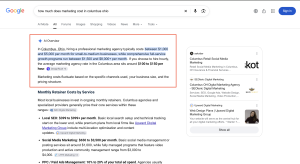
To generate recommendations, LLMs use a combination of their own training data and a process called Retrieval-Augmented Generation (RAG), where they lean on external sources like your website to close the information gap.
When LLMs are working with missing or inconsistent information, they may:
- Fail to provide the user with a clear or complete answer.
- Even worse, provide the user with incorrect or misleading information.
That second point actually happened to us. We ran a competitor audit and found that we were being misrepresented as a larger company specializing in ecommerce because we were unclear on our brand messaging.
To rectify this, we modified our messaging across platforms to align with our target audience (small-to-medium-sized businesses) and primary form of service (local digital marketing).
If you’re vague about company information, including pricing, you risk being misrepresented in AI recommendations or left out of them entirely.
Search Behavior Has Shifted to Long-Tail Queries
Another key point to understand about AI search is that users tend to search with long-tail queries, which are often longer and more conversational phrases.
Let’s say you’re a plumber looking for a marketing agency in Columbus. When you go into an LLM to find recommendations, you’re likely not just going to type in “marketing agency Columbus” like you would in Google.
Due to the long-tail nature of AI search queries, you’re more likely to type in something like:
“I’m a plumber doing $5 million in revenue with a $3,500/month marketing budget. Who should I hire?”
When you don’t publish pricing on your website, it can be more difficult for AI to match you to budget-based queries.
Let’s look at a few example prompts that show how pricing plays into LLM recommendations.
Example #1: The Media Captain in ChatGPT
We ran a test in an incognito window on ChatGPT for the prompt:
“I’m looking for a marketing company in Columbus, Ohio, that has strong reviews and can fit within a budget of $2,000 to $3,000 per month. Who should I hire?”
Here were the results. Note the circled price range in the screenshot:

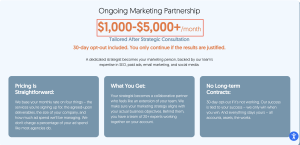
This is the range we include on our website:
Not only did ChatGPT cite our website, but it also cited The Media Captain’s Clutch profile to capture how users feel about pricing:

This example shows that your website content, along with third-party platforms, directly influences how LLMs represent your pricing.
It also demonstrates what happens when you don’t provide clear information about pricing.
Let’s look again at that same ChatGPT answer we showed at the beginning of this section, but this time focus on the “Budget fit” category that was part of the shortlist provided in the answer:

The two companies most transparent about pricing ended up being “Excellent” budget fits with clear price ranges beside them.
The other two, who were not as transparent, were deemed “Likely good” and “Possible” budget fits.
If you were a business looking for marketing and were presented with these options, who would you choose based on this chat window?
You’re likely going with one of the first two options, and the primary reason is that you can actually see a reliable price range without having to fill out a form to request a quote.
Example #2: Kodjoarts Videography & Photography in Claude
Let’s look at a non-marketing example. We tested the following prompt in Claude:
“I have a $3,000 budget for a wedding photographer and videographer in Columbus, Ohio. Who are the best people to consider? I want to make sure they also have strong reviews.”
Here were the results:
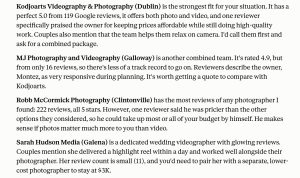
Kodjoarts Videography & Photography was the first recommendation. When you look at their website, they explicitly lay out their pricing and what’s included in each package.

While Claude didn’t specifically state the prices in its answer, their packages fall within the $3,000 budget.
The clear pricing and highly detailed package descriptions seem to have weighed heavily in their favor as the #1 recommendation in Claude (along with their excellent reviews, which were part of the criteria we stated in the prompt).
Note: The results of these prompts were from individual tests. LLMs can vary significantly in their responses, even in the same chat window. Even if you show up in one test, you might not show up in the next. When reporting on LLM manual tests, it’s best to treat results as directional rather than definitive.
7 Tips for Discussing Pricing Without Boxing Yourself In
If you’re reading this and are still hesitant about adding pricing to your website, we can relate.
As we alluded to earlier, it took us until Year 15 of our marketing agency to publish pricing on our site.
There are ways to add pricing information without constraining your leads. Here are a few tips to follow:
1. Use price ranges. We put $1,000-$5,000+ per month; that’s a pretty wide range. While the range is broad, it prevents businesses with very low budgets from contacting us. Our ideal client does $1-$10 million in revenue, so it gives us better quality leads. You don’t have to get super specific with your prices. Just state an estimated range, even if it’s a big one. If you can’t get to a fair price range, use a “Starting at” number.
2. Explain what affects the price. For a marketing agency, these factors would include the client’s business size and the number of services they need. The price explanation is just as important as the price range. If applicable, explain what benefits/services are included in the price. You’ll notice in our pricing section below that we outline the perks you get with our ongoing marketing partnership:
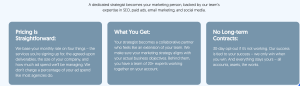
Note: You should also put your pricing into context. For example, our agency fee is less than half the cost of hiring a full-time marketer. If someone is hesitant about spending $2K/month on our agency, publicly stating this can help them zoom out and see the full picture.
3. State who your pricing is for. When you directly specify your target audience, you can help guide LLMs to match you with the right queries.
4. Make entry-level or project-specific packages. For example, we offer a Proof of Concept Package (pictured below) that is basically a test run for new/growing businesses or specific project needs. This captures an audience type that we might not have a chance to do business with if we just listed our ongoing marketing partnership pricing.

5. Add pricing FAQs to capture long-tail queries. Remember, searchers on LLMs often use longer, conversational phrases, and adding FAQs like “Why does pricing vary?” can capture these queries and clarify your pricing information.
6. Be consistent with pricing across your website and third-party profiles. In The Media Captain example we showed from ChatGPT earlier, it specifically cited our Clutch profile in its answer. LLMs pull from various sources to come up with recommendations, including directory listings at the local level. If a pricing category is available on a directory or other platform you’re joining, list the price range from your website. Additionally, list prices on your Google Business Profile in the Services, Products or Menu section, if possible.
7. Keep pricing up to date. When you make price updates to your services or products, ensure that they are updated across platforms so LLMs (and of course the user) have access to the latest information.
Want More Tips to Improve Your AI Search Visibility?
Even if it’s uncomfortable, openly discussing pricing is a requirement for businesses that want to maximize trust with their audience, as well as their visibility in AI search.
You don’t have to set any numbers in stone. Simply provide a price range and clearly explain what goes into your pricing. That’s it.
Since many businesses still aren’t transparent enough about pricing, it’s a way to get ahead of your less-candid competition.
If you’d like more actionable tactics to help your visibility in AI search, check out What Is AI Search & Why It Matters For Your Business.