Long gone are the days when people just searched for ‘Photographer Cleveland.”
Searches are becoming more long-tailed and specific.
People are now searching, “Company that specializes in photography and videography in Cleveland for outdoor wedding under $5k budget.”
Your messaging needs to be dialed in if you want to attract your ideal client.
In this post, we’ll discuss why brand messaging should be a pillar of your AI search strategy, providing real examples and actionable takeaways so you have a game plan moving forward.
Why Brand Messaging Matters So Much in the AI Era
When ranking on Google and traditional search was all that mattered for SEO, it was easy to get crawlers to understand your content.
Find primary and related keywords + put them on your page = rank on Google.
AI search has brought a whole new element. Instead of purely keyword matching, Large Language Models (LLMs) like ChatGPT, Claude and Google’s AI Overviews/AI Mode use context and meaning to understand your business, your services and whether you’re the right recommendation to the user’s question.
To understand your business, LLMs use a process called Retrieval-Augmented Generation (RAG) that pulls from external sources (like your website, social media platforms, directories, etc.) to formulate their recommendations.
If the LLM uses retrieval and is unclear about who you are and who you serve, it might provide the user with inaccurate information, if you even get mentioned at all.
This can lead to a potential client or purchase going to your competitor instead of your company. All because the LLM couldn’t understand your brand correctly.
If you think the scenario above is far-fetched, we’ve got firsthand experience that it’s not.
Real Example From Our Own AI Search Competitor Audit
Recently, we asked several LLMs if a local business making $3M in revenue should choose us or another marketing firm and why.
The results were surprising: the LLMs favored the other firm, but the reasons were off-base:
- The LLMs said we were a larger company, and that the other firm’s ownership was more hands-on. Although we have around 20 employees, we operate as a small business with direct, daily involvement from leadership (president Jason Parks and co-founder Stefanie Parks).
- The LLMs said our focus was on ecommerce since Jason and Stefanie also own DermWarehouse.com, a skin care and beauty products website. The truth is, only 10% of our Media Captain clientele is ecommerce.
After analyzing why the AI platforms provided these reasons, we realized our brand messaging failed to adequately explain who we are and who we serve.
What We Changed As a Result of the AI Search Audit
To resolve the brand messaging issue, we took two steps.
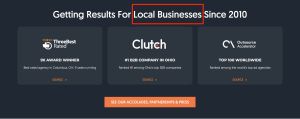
First, we revamped our website verbiage (using Claude to help audit inaccuracies) to make it clear that we’re a Columbus-based marketing agency serving clients nationally, with a primary focus on small-to-medium-sized businesses.
Here’s an example of a revamped section on our homepage – note the emphasis on “Local Businesses” in the heading.
Second, we created a database that stores dynamic information like years in business, team size, websites hosted, page-one keywords, ad spend managed and review counts.
Rather than having to locate this information across many pages, it’s dynamic, and we can see it all in one place, including the source updated and the date it was last updated:

The brand messaging changes were not just concentrated on our website. We also implemented them on LinkedIn, Yelp, Clutch, Facebook and Instagram to ensure messaging was uniform across platforms.
Consistent brand messaging across platforms is crucial since LLMs pull from various sources to understand your brand.
A Semrush study found that four of the top six domains cited by ChatGPT, Google’s AI Mode and Perplexity were social media channels/Reddit (which is a forum but in the same ballpark).
This helped our AI search visibility and made the LLMs’ recommendations more accurate.
In an incognito window, we ranked as the #1 recommendation on ChatGPT for the prompt: “I’m looking for a Columbus, Ohio marketing agency for my $3M business. Who should I choose?”

Even with the messaging audit, it’s difficult to perfect everything an LLM says about your brand.
We showed up #2 on Perplexity for the same query, but it still mentions ecommerce as businesses we serve. This is true, but as noted earlier, it’s a tenth of our clientele.

Further down in the chat, it mentioned that we report “serving small through large clients,” which is technically accurate, but not fully aligned with our emphasis on small-to-medium-sized businesses.

Key takeaway: Make it a full-brand initiative to be consistent in your brand messaging. This includes the marketing department, but also leadership teams (who may be active on LinkedIn) and customer service teams (who may be responding to online reviews via the company). LLMs pull from many sources, and although they may not get everything 100% accurate, if your messaging is uniform, the chances of inaccurate representation naturally decrease.
6 Tactics to Achieve Brand Consistency & Visibility in LLMs
Now that you’ve got more context about the importance of brand messaging for LLMs, let’s cover tips that will not only help you stay on-brand, but also distinguish your brand in AI’s recommendations so a user will want to choose you over a competitor.
1. Create Brand Guidelines
First, you need a single source of truth that documents how your brand should be portrayed in all external materials.
This is a company-wide guide that employees and new hires can use to ensure consistency and accuracy when discussing your brand across your website, social media profiles and even in customer service chats/phone calls.
Brand guidelines should include:
- Your core facts, including company history, founding year, employee count, leadership, services and any others you find relevant.
- Your company mission and value propositions. Detail the exact terminology you want to be used to describe your key selling points.
- The tone and voice you want to convey in your brand messaging. This should be mostly consistent across channels, although you’ll need to tweak language to fit the platform. For example, you don’t want to directly copy a trendy Instagram post into a Reddit thread. Those platforms consist of two entirely different audiences.
- Speaking of audience types, specify who your target audience is. Even create personas so your employees know who they’re addressing.
- Your visual identity, which includes logo rules, color palettes, typography and imagery/iconography.
You should also update your brand guidelines regularly when major changes occur.
Tip: To go a step further for LLMs, create an AI instructions page. This is basically a fact sheet created on your website specifically for AI crawlers to understand who you are, what you do and who you serve. See Nectiv’s AI instructions page for an example.
2. Avoid Generalist Messaging & Back Up Your Claims
Since ChatGPT was released in 2022, over one-third of English-language web pages on the Internet show signs of being written or substantially edited by AI, according to the Pew Research Center.
What this data point suggests is that there is a lot of generic content out there.
If you’re using AI to create most of your content, you will likely end up with bland, unoriginal content that goes against what platforms like Google reward (which is non-commodity content – i.e., original, firsthand insights).
One of the places we see generalist messaging the most, especially for local businesses, is About Us pages.
They are typically filled with the same fluffy messaging that isn’t likely to convince your audience or LLMs that you’re different from competitors.
The way you can differentiate your messaging is not through the words you use, but the facts you back them up with.
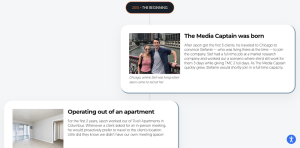
This includes adding proprietary stats and outcomes (years in business, client success stories, etc.), team/personnel details, photos detailing your company history and reviews from actual clients.
Here’s an example of a visual timeline we used to showcase our story (see the full story on our Company History page).
Here’s an example of client success stories showcased prominently on our homepage to give you an idea of how you can present your own client results:

This is content AI or a competitor can’t easily copy because it’s yours! Don’t focus so much on wordsmithing; use simple, clear messaging, and augment it with actual results. Back up any claims you make with proof.
Tip: For long-running, large companies, consider splitting your About Us page into three pages: a company history page, a meet the team page and a why choose us page. This lets you expand on your history and values without cluttering one page.
3. Align Owned and Earned Messaging
The brand messaging you use on your website or on a social media post is yours. You control every word, image and video you use. This is owned brand messaging.
There’s another segment of brand messaging that plays a massive role in how you show up on LLMs: we’ll call it “earned messaging.”
Earned messaging is how your brand is described by third-party platforms like press outlets and review sites. This can also include any paid mentions, like partnering with an influencer to make content for your brand.
Getting external validation via brand mentions is fundamental to an AI search strategy today; brand mentions across the web are highly correlated with AI search visibility (see Ahrefs study demonstrating this here).
Messaging-wise, it can be difficult to fully control how your brand is portrayed on channels you do not control.
However, you can set terms during negotiations when doing PR.
For example, if you’re paying a YouTube influencer who commonly reviews products in your industry, you can provide scripts or guidance on which words or phrases to use. They may not use it verbatim, but you can at least directionally influence the type of content they create.
The same applies with a local news company looking to film a segment at your office. Try to control the narrative as best you can, and if there’s something off about the way a third-party describes you, reach out and ask to modify the language used in the content.
4. Claim and Complete Every Relevant Business Profile
Beyond earned web mentions, another third-party action you can take to clarify your business for LLMs is to claim and update your profiles on key directories.
This is especially relevant at the local level. There are core directories every local business should claim, including your Google Business Profile, Yelp, Apple Business Connect and Bing Places. In addition, key industry directories (like Clutch for a marketing agency) should be prioritized.
This not only helps with brand consistency across digital platforms, but also feeds LLMs, which have been shown to pull straight from directories (see below) when making local recommendations (Yelp is an especially prominent source for LLMs on local searches).

Unlike earned media mentions, you can control the information on your directory profiles (you may have to request certain updates with some platforms).
We suggest checking periodically to make sure your information on these platforms is accurate. Many, like your Google Business Profile, let any user suggest an edit to your profile.
Either manually check in on your key directories or invest in a tool like Yext to automate it to ensure your profiles stay up to date.
5. Strengthen Your Entity Signals With Schema Markup
An “entity” is a business, person, place or product that search engines and AI models can recognize as a distinct, identifiable thing.
Entity signals are what you can use in your content to confirm your core business details so AI models understand exactly who you are.
Many of the tactics we’ve already discussed, including consistent core facts across platforms and completing directory profiles, help build strong entity signals.
Another more technical action you can take to strengthen entity signals is using schema markup on your website to add another layer of clarity for LLMs.
Schema is code that lays out the key facts about your business (name, address, services, founder, social profiles) in a format AI crawlers can read without having to make inferences from your page copy.
Organization schema is a good place to start, especially when paired with sameAs properties that link your website to your verified LinkedIn, Google Business Profile and other official profiles. This helps confirm those accounts all belong to the same business.
Schema markup is a small action compared to actually creating brand guidelines and making the content to support it.
However, it may help add an extra bit of security to protect against misrepresentation in AI.
6. Conduct Periodic AI Brand Consistency Audits
The only way to confirm whether your brand is showing up in LLMs how you want it to is to test it.
We would have never known our messaging was off unless we conducted the audit.
Similarly, you should do an extensive audit in an incognito window and test various prompts in multiple LLMs. To come up with prompts, think about the most common questions you get from your customers.
Take note of:
- Are you showing up in AI’s answers and where? Are you one of the first recommendations, or are you mentioned further down?
- How is AI describing your business? Is all of the information accurate? Is it positive or more neutral in sentiment?
- How is AI talking about your competitors? This may give you some ideas for new selling points or current selling points to emphasize more.
- What sources is AI using to come up with its answers? Look at the citations. You can oftentimes get ideas for which listicles you should reach out to get included on or directories to make a profile on by looking at the citations.
Additional tip: If you’re using AI and notice that it says something factually wrong about your business, most platforms have a feedback mechanism (a thumbs-down button, for example) you can use as a very low-effort action to potentially flag errors to help improve the AI models (OpenAI explicitly mentions this).
Want Other Tactics to Help With AI Search Visibility?
Consistent brand messaging across platforms is one of the foundational principles of an AI search strategy. It’s testable, and mostly in your control.
It’s one of the first components to cross off on an AI search checklist.
If you want some of the other priority items to check off the list, read through What Is AI Search & Why It Matters For Your Business.