For local businesses, a search engine optimization (SEO) strategy used to be predominantly focused on achieving high rankings on Google.
While Google is still the most relevant search platform for businesses at the local level, the emergence of AI search has added another layer.
According to a Whitespark study of local queries across three U.S. cities and six industries, 68% of local searches on Google populated an AI Overviews section.
And that’s only on Google. Large Language Models (LLMs) like ChatGPT and Claude are growing and becoming increasingly important for search.
More than 80% of our marketing agency’s clientele is local businesses, and we’ll draw on that experience to explain how to position your business to gain consistent traditional and AI search visibility.
What Hasn’t Changed With Organic Search for Local Businesses
Before discussing the shifts that AI search has created in SEO strategies, let’s start with what hasn’t changed.
The core of your traditional local SEO strategy remains the foundation of your efforts.
These efforts are largely tied to ranking highly on Google, where nearly half of all searches have local intent.
These tactics include:
- Completing and optimizing your Google Business Profile (GBP) to achieve top-3 Map Pack rankings. The Map Pack generates roughly 44% of clicks for local searches. It remains the most valuable piece of real estate you can own at the local level on Google.
- Structuring your website properly (homepage, service pages, service area pages and location pages) and filling out your pages with non-commodity, or unique, content (more on this later).
- Ensuring your site is crawlable, indexable and technically sound, with fast speeds on mobile and desktop.
- Acquiring high-quality backlinks via blog content or partnerships to help grow your domain authority.
There are a couple of key reasons why we started with this framing:
- To drive home the point that, although AI search is growing, you don’t need to rip up the old playbook for an entirely new one to succeed in local search.
- The core local SEO tactics have shown real correlation with achieving AI search visibility. Ahrefs found that 76% of Google’s AI Overview citations pull from the top 10 organic listings on Google. You can find studies that contradict this, but in our experience with 100+ clients, we’ve seen a major correlation between ranking highly on Google and AI search visibility.
Let’s look at an example that demonstrates this point.
Real Client Example: Broadview Heating
Our client, Broadview Heating, had very little search visibility in Brecksville, Ohio, one of their service areas.
Brecksville has a population of about 14,000 people, so they were missing out on potentially thousands of dollars in revenue by being absent from local searches like “Brecksville AC company” or “Brecksville heating company.”
To increase visibility in Brecksville, we created a service area page that included unique content like an embedded map showcasing the distance from their company base in Broadview Heights, a list of services with a branded video and customer reviews pulled from their Google Business Profile.
This page helped generate a 100% SEO visibility increase in Brecksville, according to Semrush’s Visibility % metric:
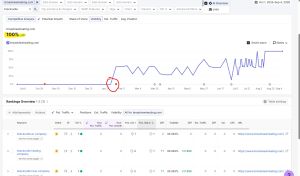
It helped them earn top positioning on Google and LLMs like Claude.
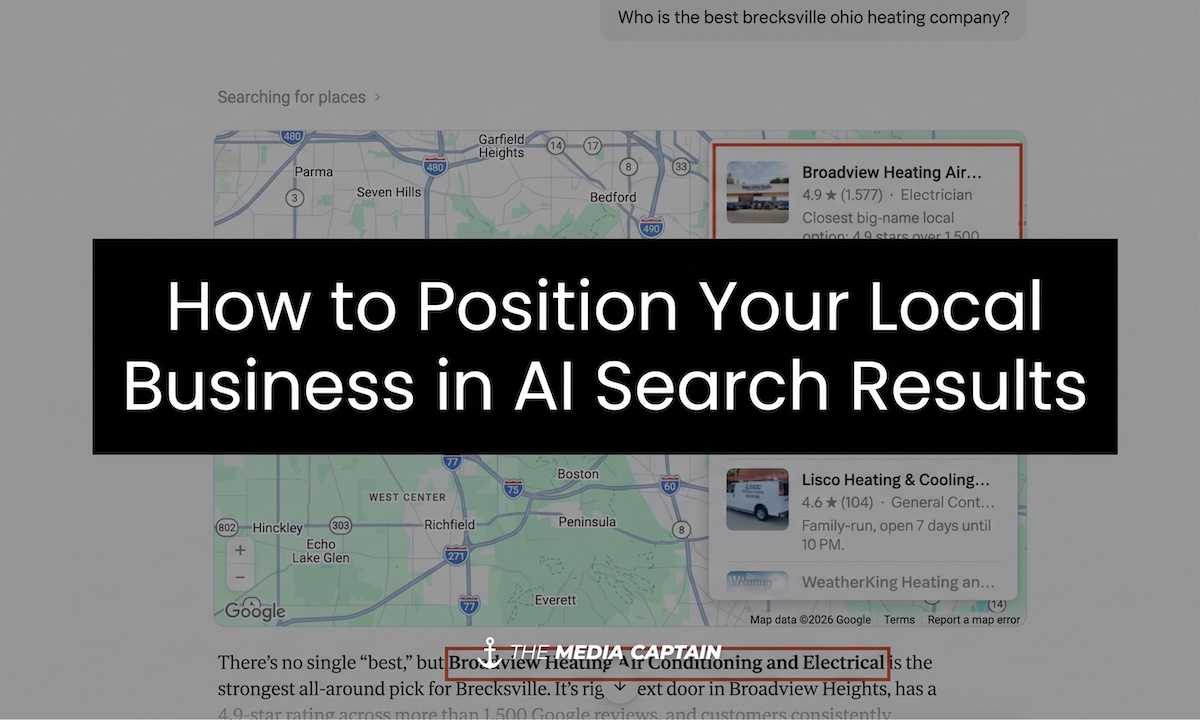
See the Google Search Engine Results Page (SERP) for the query “brecksville ohio heating company” below – they attained the #1 position on the AI Overview result, traditional organic listing and the Map Pack (not pictured).

Below are the results for the query, “Who is the best brecksville ohio heating company?” in Claude. They again ranked as the #1 recommendation.

Key takeaway: A core local SEO tactic (creating dedicated service area pages) yielded #1 positioning for Broadview Heating on both Google’s AI and traditional features, as well as LLMs like Claude. This suggests that the bread-and-butter of a traditional local SEO strategy can hold weight in both Google and AI search platforms.
While the bulk of your local search optimization efforts will focus on the foundational principles of SEO, there are some tweaks to increase your chances of visibility in AI search platforms.
Let’s first look at how AI answers local search queries before getting into the tactics that help you show up for them.
How AI Provides Answers to Local Searches
When somebody types something like “My AC unit broke. Who can I call in Columbus, Ohio that can quickly repair my unit?” into an LLM, it’s going to use multiple sources to give them recommendations.
Let’s look at the results in ChatGPT for that exact query (in an incognito window) we stated above:

For this search, ChatGPT used a process called Retrieval-Augmented Generation (RAG), which is where it gathers information from external sources on the internet to generate recommendations.
LLMs use retrieval when they need to go beyond their own training data to come up with the best answer for the user.
Since this was a query that involved urgency, ChatGPT specifically looked up HVAC companies in Columbus, Ohio, that advertised emergency services, phone numbers and websites.
The sources it used were exclusively from the recommended companies’ websites or Google Maps listings.
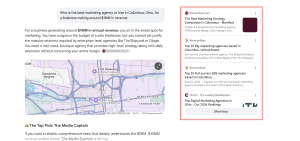
Let’s look at a different example, this time for the query “Who is the best marketing agency to hire in Columbus, Ohio, for a business making around $1MM in revenue?” in Perplexity, for which we showed up as the first recommendation.
With this example, focus on the citations circled below:

For this query, the AI used 25 sources to come up with its recommendation. A few were from the recommended companies’ websites, but most were from off-site platforms. These sources included LinkedIn, Clutch (a key directory for marketing agencies to join) and Reddit.
In both examples, the AI used retrieval to generate recommendations.
For a more urgency-based search, the AI leaned on companies advertising a particular service (emergency AC repairs). In the other, less urgent search, the AI leaned on many sources to come up with its recommendations.
The key point to take away from these examples is that LLMs use many external resources beyond their own training data to make recommendations
You can’t just focus your local search marketing efforts on one platform if you want comprehensive AI visibility.
This is true for LLM optimization, but also for Google’s suite of AI tools. See some of the sources used in the example below from Google’s AI Mode:
8 Tactics to Position Your Local Business for Success in AI Search
Let’s now go over eight tactics that we’ve seen correlate with AI search visibility at the local level. Many of these tactics overlap with traditional SEO action items, but can be doubled down on for AI search.
- Tactic #1: Target local, commercial-intent, long-tail queries. If you noticed in our example prompts in the previous section, we searched conversationally with full sentences. This is because people tend to use conversational phrases, or long-tail queries, when using AI. In your content, prioritize targeting long-tail phrases that have commercial intent (i.e., somebody is researching brands to make a purchase). An example of this could be writing a blog titled “Emergency AC Repair in Columbus, Ohio: Response Times and Typical Costs.”
- Tactic #2: Fill your pages with non-commodity content. Google specifically outlines creating people-first content that’s helpful and reliable in its Guide to Optimizing for Generative AI Features on Google. This includes showcasing your staff, adding photos/videos of your office/services, embedding reviews from clients and featuring real results you’ve produced, like our personal injury client, Cooper Elliott, did in the example below:

- Tactic #3: Claim and complete GBP, Apple Business Connect, Bing Places and industry directories. LLMs use many sources to generate recommendations, with directories being an especially prominent place for AI to use during retrieval. Claim your core business directories/listings (like GBP, Apple Business Connect, Bing Places and Yelp) and pick 5-10 of the most relevant industry-specific directories to make a profile on. Monitor your directory listings regularly to ensure they are still accurate.
- Tactic #4: Build strong external signals of your reputability. This includes high-quality backlinks, brand mentions across relevant industry sources, earned accolades, key certifications/partnerships, exposure in local publications and joining directories/associations. Breaking your About Us page into three different pages is a good way to display your strong external signals without cluttering one page (see the full strategy).
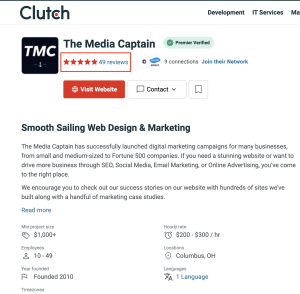
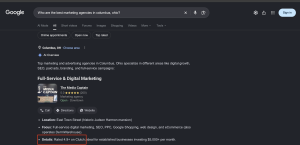
- Tactic #5: Build consistent reviews on your Google Business Profile, Yelp and top directory websites. For example, reviews from our Clutch page were specifically cited in Google’s AI Overview results for the prompt “Who are the best marketing agencies in columbus, ohio?”
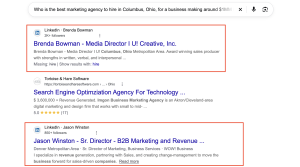
- Tactic #6: Be active on social media and Reddit. Semrush found that four of the top six domains cited in ChatGPT, Google’s AI Mode and Perplexity were social media channels and Reddit, with LinkedIn being the most common social channel cited. Social media also plays a role in traditional search results. For example, two of the first three traditional organic listings for the query “Who are the best marketing agencies in columbus, ohio?” on Google were LinkedIn profiles:
- Tactic #7: Keep all of your messaging consistent across all of your content. As you now know, LLMs pull from many sources to generate local recommendations. For example, if your website is listing a certain price for a service, but your social media accounts are listing another, you might be inaccurately portrayed in the AI’s answer (if you show up at all).
- Tactic #8: Track your AI mentions regularly. Being cited as a source is good, but the goal is showing up in the answer itself. We track our clients’ keywords through DataForSEO’s API, which pulls traditional Google rankings, Map Pack positions and AI Overviews alongside how ChatGPT, Claude, Gemini and Perplexity answer the same local, conversational prompts. Because AI answers vary from one search to the next, we run each prompt multiple times and report how often a client is mentioned, not a single snapshot.

Learn more about the tactics to help rank in AI search platforms.
Need Help Creating the Right Modern Search Strategy?
AI search has introduced some new components and placed renewed importance on others, but there’s no reason to spend hours devising an entirely new organic search strategy to achieve top positioning at the local level.
If you nail the traditional SEO basics and use the tactics we outlined to augment that strategy so you show up in the key places your audience is using to find you, you’ll be on the right path.
It sounds relatively simple, but executing a multi-platform search strategy can be difficult and time-consuming.
If you’d rather have an agency locked into the latest trends take it off your plate, reach out today.