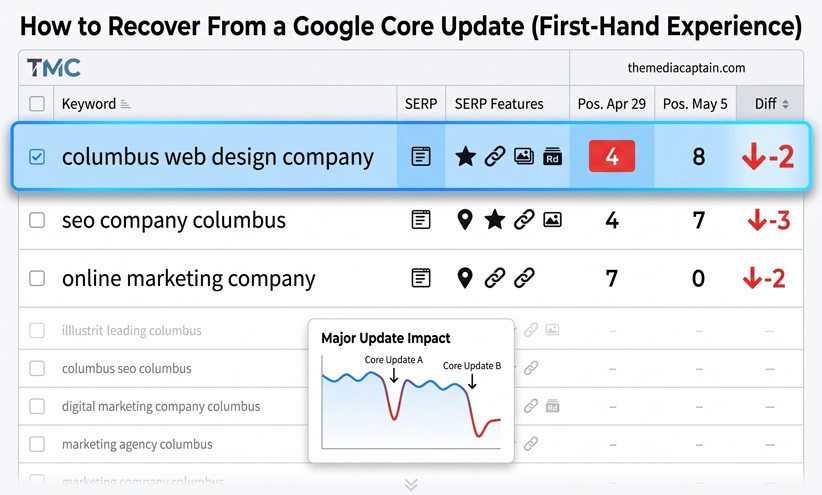
In 2020, my marketing agency’s website was negatively impacted by a Google core update. All of my keyword rankings tanked, and I couldn’t understand what I did wrong. For heaven’s sake, I do SEO for a living, and I was utterly confused about what just happened.
Early in my career, I helped SafeAuto Insurance recover from a Google Penguin update stemming from a toxic backlink profile, a project with a multimillion-dollar positive impact on their business.
Core updates are a different challenge, but the recovery discipline is the same: identify the problem honestly and fix it systematically.
How It Went Down
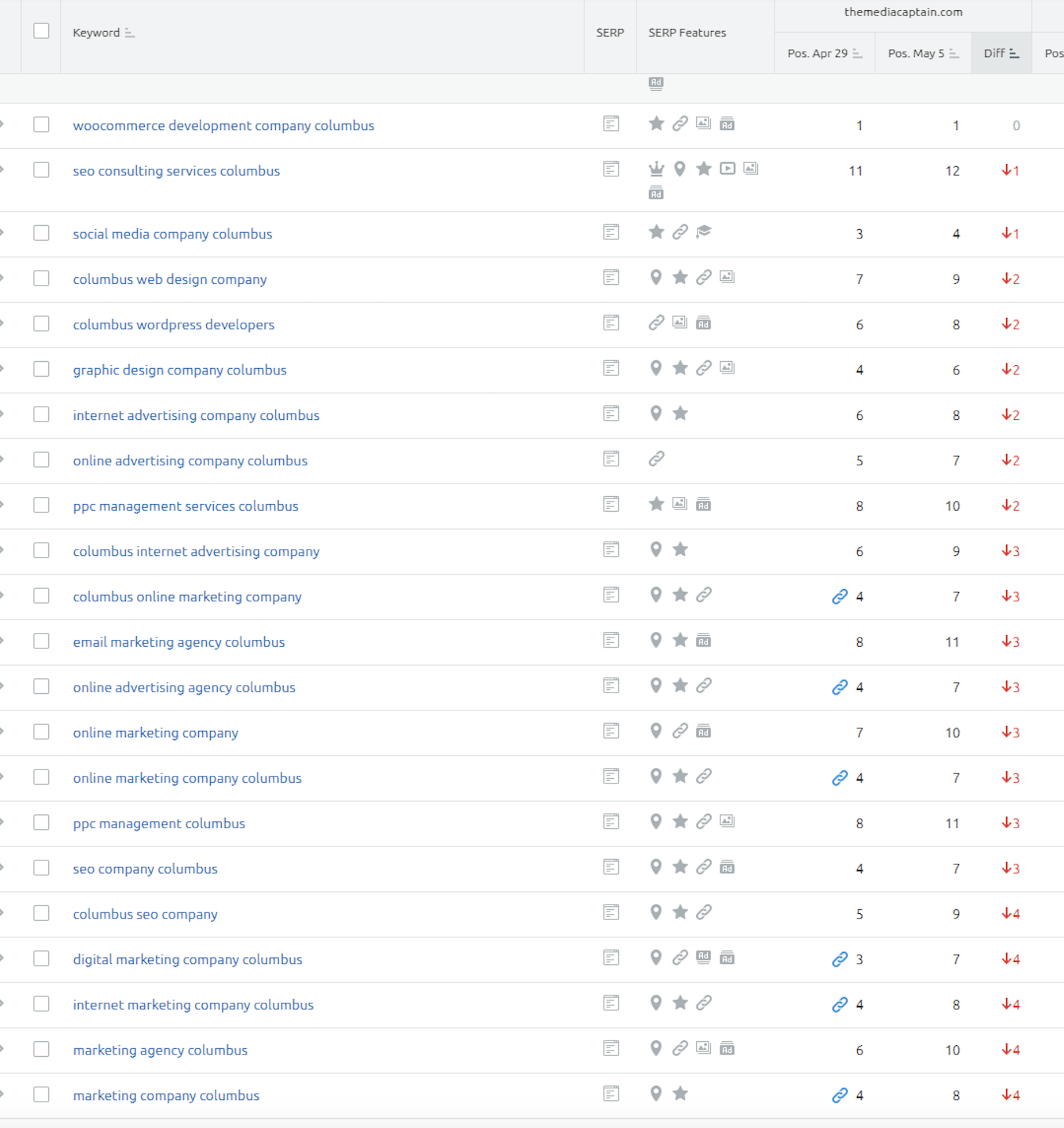
I was checking my keywords in Moz and SEMRush. It was shortly after the pandemic, so I was dealing with enough stress in my business. To add insult to injury, all my keywords dropped across the board. I still have the screenshot as evidence.
How to Detect a Core Update
- The majority of your keyword rankings decrease or increase
- Your competitor keywords don’t see the same sort of upward or downward drop
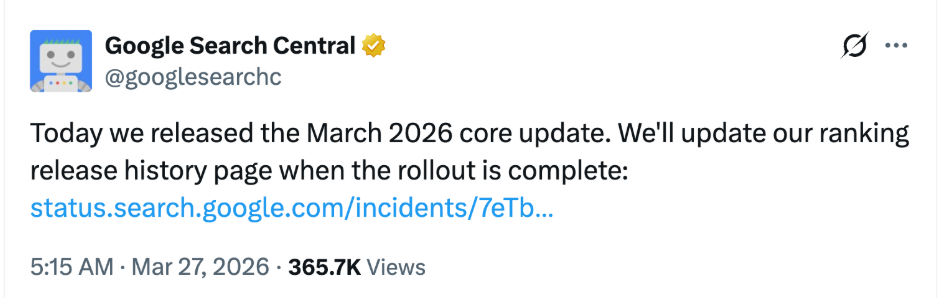
- Google confirms via X that there was a core update, and you can match the decrease or increase to the core update
- If you’re also not following SEO on a day-to-day basis like me, Google lists all of its core updates on the Google Search Status Dashboard.
Different Levels of Severity
In my instance, 95% of all my keywords dropped, but you’ll notice that the drop in rank ranged from 2 to 4 spots.
There are different levels at which your site can be negatively affected. All of your keywords can drop out of the Top 100, so mine wasn’t that severe.
It was still extremely painful. When a local business moves from the top of the first page to the second, it can see a 50% drop in organic traffic to service-specific pages.
What Exactly is a Google Core Update
Several times a year, Google makes significant, broad changes to its search algorithms and systems [source]. They refer to these as core updates.
Google looks at your site holistically, meaning it’s not just one or two pages but the entire site.
While your site might have been relevant two to three years ago, things change.
Imagine your site does restaurant reviews. If you haven’t posted a review in the past two years, it’s not that your site is being penalized; Google is just reassessing your content. The quality of restaurants constantly changes, so what might have been trendy in 2023 is no longer relevant in 2026.
This may still feel confusing and a bit broad. Let me expand with my own example.
Learning From My Mistakes to Better Understand a Google Core Update
After realizing my site was negatively impacted by a Google Core Update, I consulted with Glenn Gabe, the godfather of Google Penalties.
We had a 30-minute consult, and he looked over my website and said, “The issue is pretty obvious. Your website has a quality problem. Many of your blogs are not relevant, and this makes up a majority of the content on your site.”
He pointed out a few blogs from 2010 when I started my agency:
- Southwest Airlines’ Lackluster WiFi
- Overpriced Lobster Sandwich from Panera
- ESPN Needs to Change the Formatting of SportsCenter
I was honestly just blogging for fun in 2010, and it was an outlet to share my thoughts on random subjects. The issue? The blogs weren’t relevant to our core suite of services.
Viewing Your Website Holistically
After hearing from Glenn and remembering that Google looks at your site holistically, it all started to make sense why I was negatively impacted.
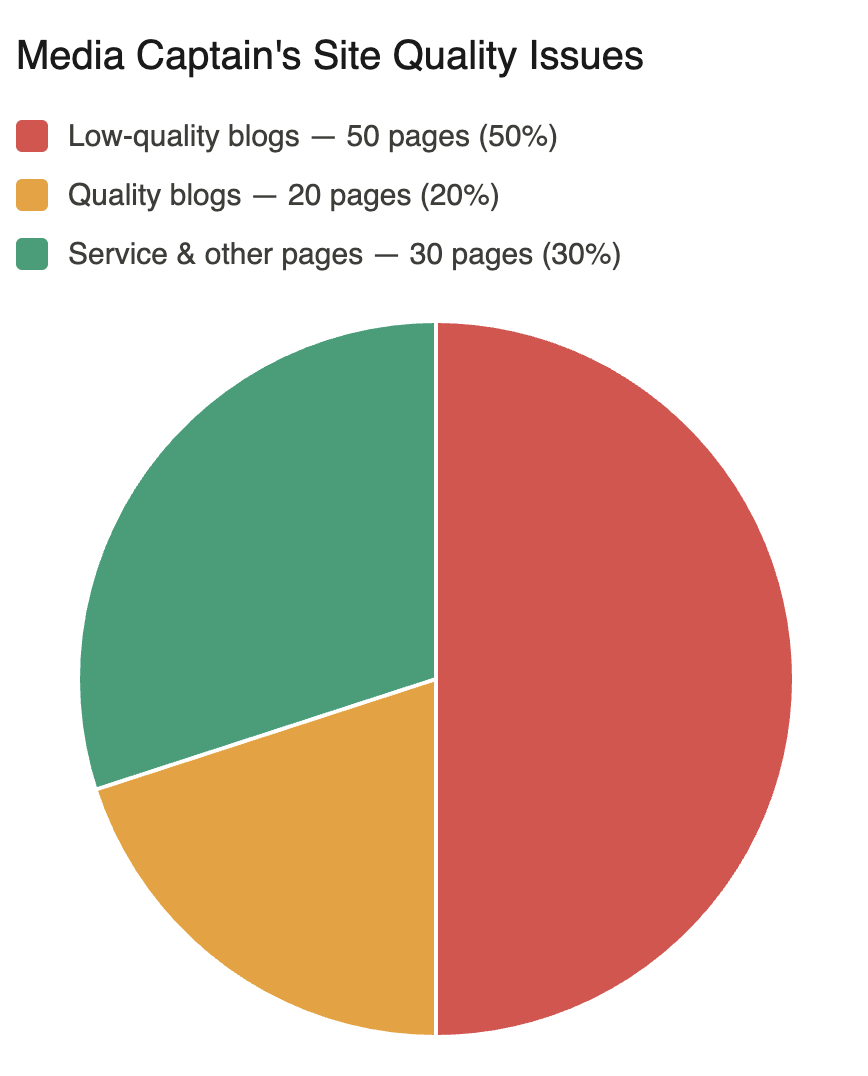
I had approximately 100 pages on my website. 50 of those were low-quality blogs. This meant that more than half of the pages on my site were low-quality. This was Google telling me, Jason, you have a quality issue on your website, and it needs to be addressed.
Most Common Reasons for Your Site Being Negatively Impacted by a Core Update
-
AI-Generated Content
- If you’re just grabbing a bunch of content from ChatGPT or Claude, this means you’re using the same content as hundreds of others in your profession, and there’s nothing unique.
- Glenn Gabe details the dangers of AI-generated content at scale
-
Thin Content / Low-Quality Content
- If you have a blog that’s 200-300 words and doesn’t add much depth, this is deemed to be thin content.
- My blog post on Southwest’s slow and shoddy WiFi was 200 words and a rant about how I paid $10 for WiFi and got connected for 5 minutes. There wasn’t depth to the post. I see the same pattern in every industry.
- I can’t tell you how often I see a blog from a landscaping company, for example, where the topic is, “4 upgrades to make your backyard more enjoyable.” It’s a stock photo. No real depth or expertise, and just feels like a rushed, generic piece of content.
- There’s this misconception that fresh content helps with SEO. This couldn’t be further from the truth. It’s all about quality. Yet too many agencies push this narrative and publish too many low-quality blog posts, since it’s an easy deliverable. Yet low-quality blogs are often the culprit of a quality issue.
-
Topically Irrelevant Content
- Think back to my example of the Panera Lobster Sandwich and Southwest’s Wi-Fi. If someone is seeking digital marketing services, those topics are not relevant to our core services. Make sure your content is relevant.
- Think back to my example of the Panera Lobster Sandwich and Southwest’s Wi-Fi. If someone is seeking digital marketing services, those topics are not relevant to our core services. Make sure your content is relevant.
-
Manipulative Content
- If you’re creating doorway pages (example: hundreds of pages for suburbs and cities throughout your state to rank for SEO), this could be classified as manipulative content.
- If the content you’re creating is more geared to win at SEO versus appease potential customers, Google can deem this to be manipulative.
Good Rule of Thumb For Creating Quality Content
I tell clients that every piece of content on their website should serve as strong sales collateral. You should feel comfortable sharing any piece of content with a current or prospective client.
I’d never send someone interested in marketing services to a blog about Panera’s lobster sandwich. But if someone were interested in improving their Google Business Profile ranking, I could certainly share 30 powerful marketing stats about GBP.
The Recovery Process
Hopefully, now you understand why your site may have been negatively impacted by a Google Core Update. Now it’s time to understand what you need to do to improve the overall quality of your site and get back in the good graces of Google.
Before getting started on a recovery plan, I wanted to highlight key items about the recovery process directly from Google:
- Recovery takes time.
- Don’t do anything drastic like deleting a bunch of pages.
- Improvements can take days to months to reflect in rankings
- You may need to wait for the next core update to see the full impact.
- There’s no guarantee of recovery.
My Thoughts vs. What Google States on Recovery
- I’ve never seen a core update recovery in a few days, so you should remove this mindset.
- It took me well over 100 hours of addressing low-quality content to get back in the good graces of Google
- While it may feel devastating in the moment, improving content quality will set you up for future success and make your website a more powerful sales tool.
- AI can help you assess overall quality
Understanding My Pathway to Recovery
- I went through every page on my website and audited the quality.
- I used the key below to determine whether to keep it, rewrite it, delete it, or redirect it.
- I didn’t outsource the work. My business partner and I rewrote nearly 60 pieces of content, with each one taking on average 3 hours to complete (estimated project time: 200 hours with rewriting and research)
- When Google ran its next core update, we recovered, and our rankings improved even further than where they were beforehand. It took about seven months for the full recovery.
Important Self-Reflection Note: Once I realized how long it’d take me to recover, I was thankful I wouldn’t reap the benefits until the next core update, since I needed the time.
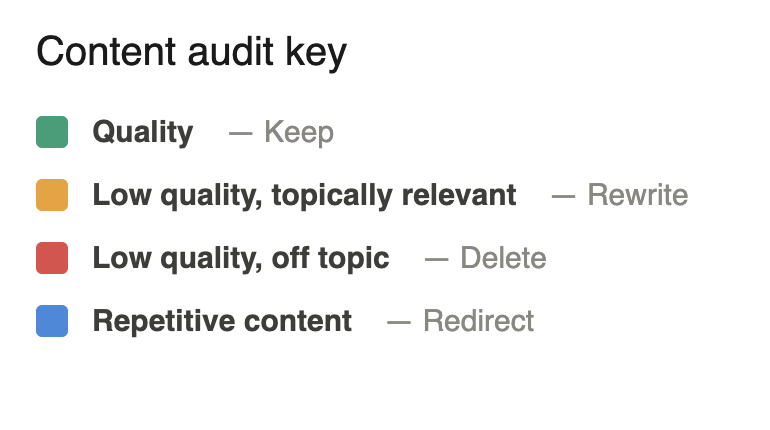
Low Quality, Off Topic: Delete
The Panera Lobster Sandwich and Southwest Shoddy WiFi weren’t the only off-topic blogs. We identified 50 blogs as not topically relevant and deleted them. Even if we enhanced the content, it would never be content we’d share with a prospective client, which made the decision to delete it easy.

Repetitive Content (Redirect)
When there are hundreds of blogs, it can be easy to forget that many years ago, there was a similar blog you created. When multiple topics are similar, this can lead to cannibalization, as the two compete against each other. When two similar pieces of content compete, neither ranks well, which is why consolidating them is important.
- We redirected the less relevant blog to the more relevant one.
- We’d see if there were any nuggets of information from the less relevant one that could enhance the main one moving forward
Below is an example of a redirect and the rationale behind it. We redirected about 10% of our content.
- Original: How to Select the Right Keywords for an SEO Campaign
- Redirected To: How to Conduct Keyword Research For Local SEO
- Rationale: Most of our clients are local businesses, and the original blog didn’t have much depth, so we felt that the more in-depth blog on keyword research for local SEO was the stronger destination.
Content Enhancement (Rewrite)
This is where 85% of our time was spent. Remember, Google doesn’t want to see you just delete content. “Deleting content is a last resort, and only to be considered if you think the content can’t be salvaged.” [source].
Google wants to see quality improvement throughout your site.
We would go through the pages, and if we felt the topic was relevant but needed enhancement, we would rewrite the article.
Below were three blogs that originally had fewer than 500 characters that we completely revamped:
What I’d Do Differently Today (Utilizing AI for Research)
Keep in mind, when my agency’s site was negatively impacted, it was before AI. For businesses today, we put the following prompt into Claude or ChatGPT to provide you with a roadmap:
“Act like you’re a Google Search Quality Rater. I want you to grade each page on my website on a scale of 1-100, with 100 being the highest grade. For the grading mechanism, please take the following into account:
- Showcases authority and expertise
- Serves as strong sales collateral for current or potential clients
- Is topically relevant
- Doesn’t cannibalize or compete with other pages on my site
- Isn’t thin in nature and possesses true depth and value
- Adds true depth and is written for the user and not a search engine
- Is easy to understand and navigate
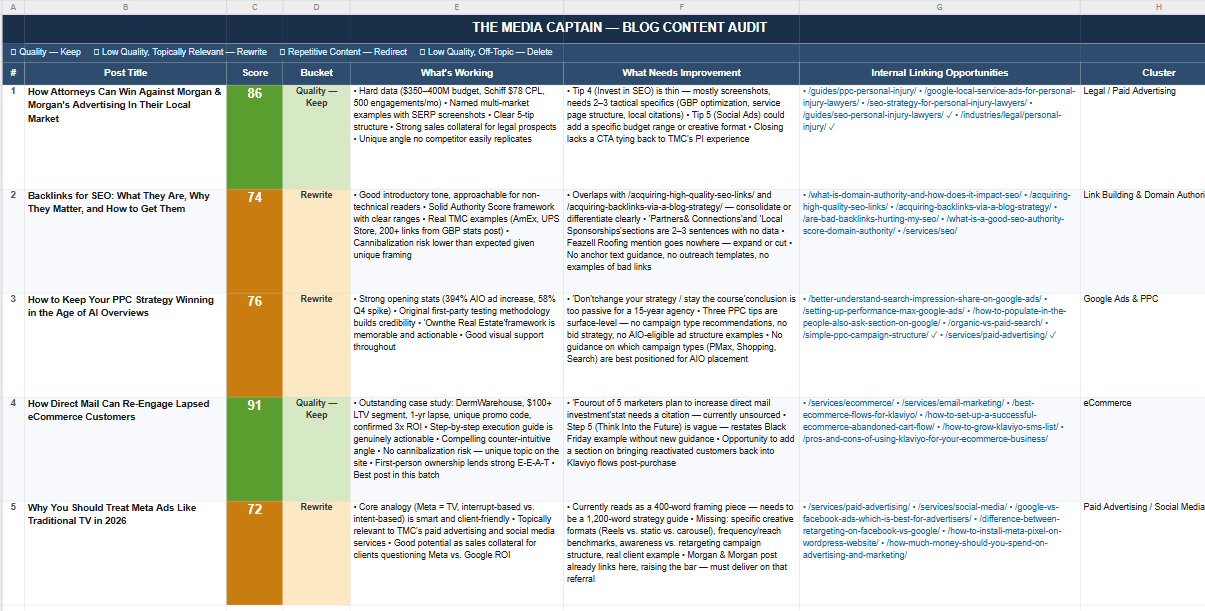
Please create a table chart with the following buckets:
- Quality – Keep
- Low Quality, Topically Relevant – Rewrite
- Low-Quality, Off Topic – Delete
- Repetitive Content – Redirect
After using the prompt above, you’ll get a beautiful spreadsheet, similar to the one below, that provides a plan of action to improve overall content quality.
Final Thoughts
- Most business owners and marketers think they are doing things right with their content strategy. I can’t tell you how many people claim they wrote the content when sites like Originality.ai clearly show it’s AI-generated and not original.
- An expert like Glenn Gabe, Lily Ray, or The Media Captain can easily identify the quality issue with your site and propose a viable solution. Elite attorneys have decades of experience and past cases to draw on, allowing them to reach quicker conclusions. The same holds true for SEO experts who specialize in core updates.
- Every website is different and complex, so while I provided an example of my agency’s website, it’s not always that black-and-white. When you are so deeply entrenched in your site, it’s hard to see the forest through the trees, which is why an outside perspective may be helpful.
- For The Media Captain’s recovery, my business partner and I spent 200-hours fixing the issue back in 2020. We are experts in digital marketing, so we can write on each subject. This isn’t a viable solution for many businesses, so finding the true experts, whether within or outside your organization, to create and enhance content is integral to the strategy. This can be a worthwhile investment, but if you’re focused on recovering, it’s needed.
- Recovery isn’t just about content. You want to make sure the user experience is good, so it’s important to marry up content, design, and development.
If you have any questions about your website’s quality or need help recovering from a Google Core Update, contact The Media Captain. I also encourage you to learn more about our SEO Service offerings.