A lot of businesses suffer from what I like to call “billboard thinking” when it comes to their websites. In traditional physical advertising, more billboards meant more people saw your ads. Billboard thinking assumes the same is true of websites — more websites, more opportunities to rank on Google.
I absolutely understand why people land there. But they’re wrong. This approach almost always works against you in SEO.
You end up splitting your authority, an essential component of great SEO, across multiple domains. Each site has to acquire its own backlinks, build its own credibility (as measured by Google’s algorithms), and fight its own uphill battle in search results.
Concentrating all that power and effort into one website works better pretty much every time. Let’s go a little deeper on why that is, some real examples, and how you can achieve better rankings with a single website.
TL;DR
Understanding Authority Score and Why It Matters
Before we get too into the weeds on this topic, let’s make sure we’re on the same page about how authority is measured in SEO. We measure authority with a metric called Authority Score.
Boiled down to its essence, Authority Score is a third-party metric (from Semrush) that measures how credible and trustworthy your website appears to be in the eyes of search engines. Mostly, this comes down to backlinks — links on other sites pointing to yours. But there are some other signals baked in that can affect your score. It’s measured on a scale of 0 to 100, with higher numbers indicating greater authority.
A higher Authority Score means you’re likely going to have an easier time ranking your content. You still need all the other goodies: strong content, good site structure, etc. But having a high Authority Score gives you a major advantage. Two sites with similar Authority Scores can publish pretty similar content, and the one with higher authority almost always ranks higher and faster (though there are exceptions).
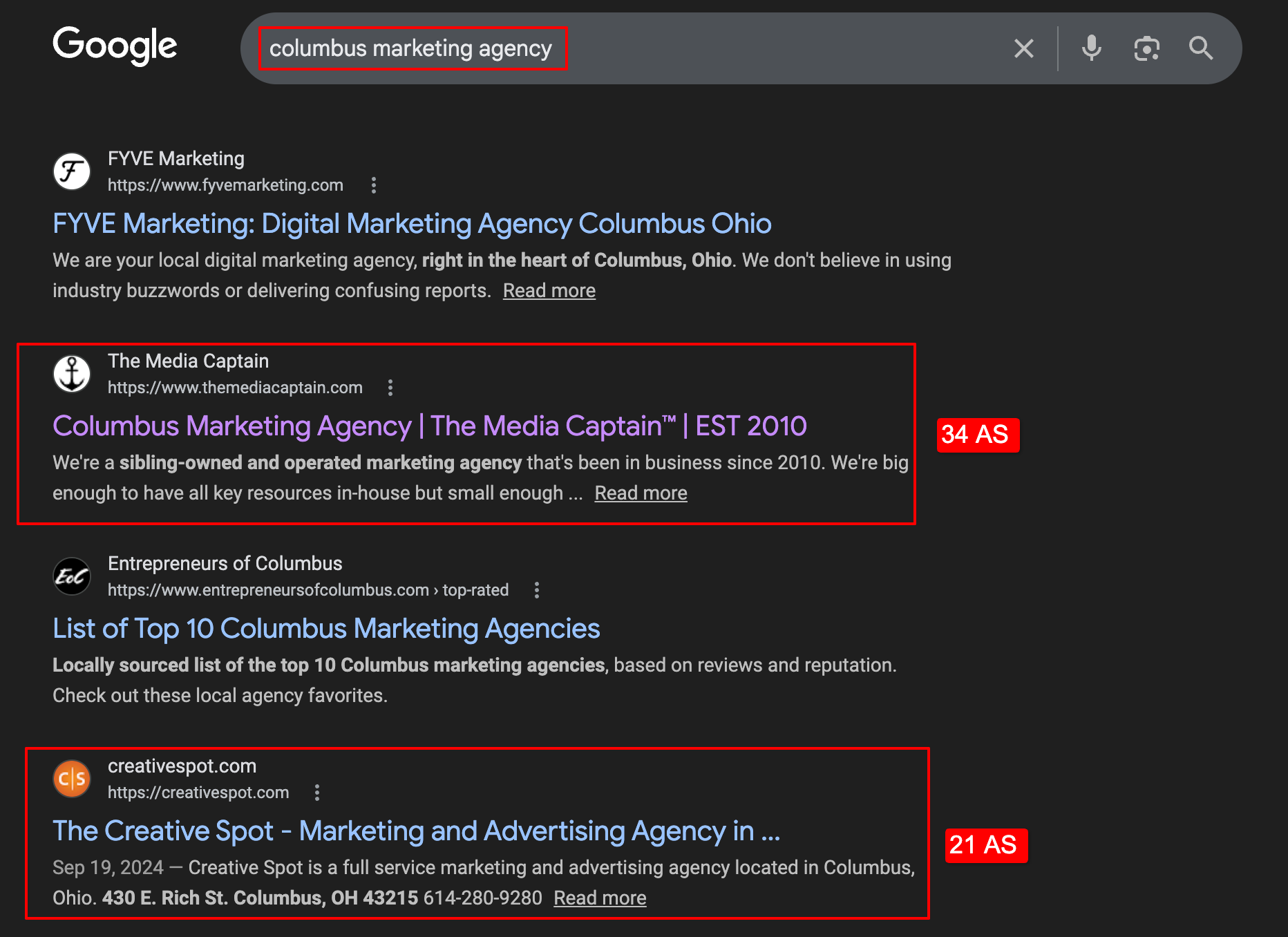
You can see this in action with The Media Captain’s own website. With an Authority Score around 34, we’ve earned backlinks from sources like Entrepreneur, local media outlets, and well-known marketing websites. Those links build trust over time, which makes it easier for us to rank new pages on our website.
For example, we’re ranking at No. 2 for “Columbus marketing agency” — ahead of our competitor The Creative Spot, which has an Authority Score of just 21 compared to our 34.
If you take one thing away from this section, make it this: Authority compounds. As your Authority Score grows, every single old and new piece of content benefits from the foundation you’re building.
The Problem With Multiple Domains
OK, back to the main point: Why is it a problem to have more than one domain? Now that you understand Authority Score, my answer will be crystal-clear: When you split your business across multiple sites, you also split your authority.
Every backlink you earn, every piece of content you publish, and every site improvement you make is divided across multiple websites instead of multiplying your previous efforts on one powerful domain.
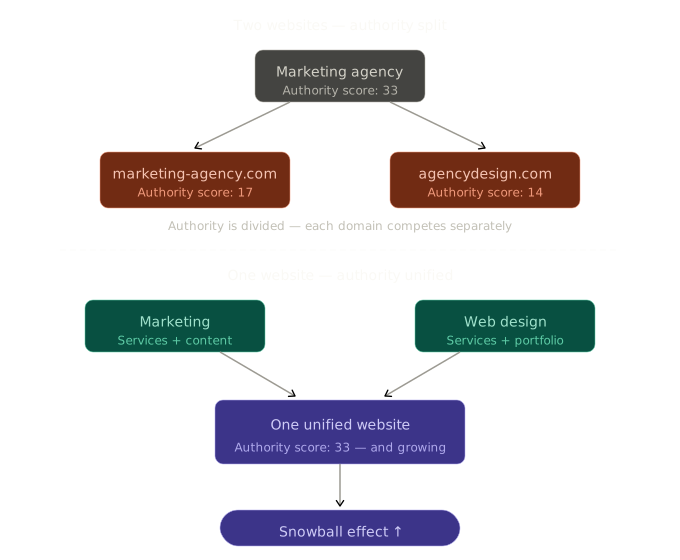
It’s pretty simple math: If you built up to a really good Authority Score of 33 on a single domain, that took a lot of SEO effort. If you had split those efforts across two domains, you might’ve ended up with something like a 17 on one and a 14 on the other. Both sites would be weaker — and therefore less likely to rank well — than the single site with a 33.
Really, I completely understand why it’s tempting to split into multiple websites.
My agency does two key things: marketing and web design. Let’s say I wanted a website that really showcased our web design chops front and center, and a separate site that did the same for our marketing chops.
That’s perfectly reasonable to want. But if I did that, it would split the Authority Score we currently have, in part, because we didn’t do that. Then both sites would struggle to rank.
 Why One Centralized Website Creates a Snowball Effect
We’ve already talked about how your backlinks do double-duty when you have a single domain rather than several. That’s where the snowball effect begins. But other SEO efforts begin to compound across one website much faster.
For example, every piece of content you publish starts from a better position. It ranks more quickly and competes for more competitive keywords. This is a feedback loop that builds a type of momentum that’s incredibly difficult to replicate across multiple websites simultaneously (unless you have virtually unlimited resources).
Even your internal linking is stronger when you have just one site. You can connect more related pages and pass more authority through those connections (links). That means you guide website visitors and search engines more effectively. Try that across multiple domains and see how far you get.
Real Example: Acquiring a Company & Merging Domains (Park Perfection)
Park Perfection is an in-house skincare brand we created. Back in 2023, we acquired Alphalash, which had one of the top eyelash-enhancing products. They had their own website (Shopify) while Park Perfection was on WooCommerce.
We made the strategic decision to redirect the Alphalash website to the Park Perfection domain a few months after the acquisition. Actually, the redirect went from the entire site to the new Alphalash page.
From an SEO standpoint, we knew the Park Perfection website would give us a better chance of ranking for “Lash Enhancing Serum” than had we kept the sites separate.
Additionally, all of our packaging, communications, and branding would be coming from Park Perfection, so it made more sense from a cohesion standpoint.
Below, you can see we started with a 0% visibility. Shortly after the redirect, we saw a nice surge. Ever since, we’ve maintained visibility above 20%, meaning we’re ranking in the Top 5 for the query “Lash Enhancing Serum.”

Graphic taken directly from Semrush for Park Perfection keyword tracking project
Taking Authority Score into Account for Park Perfection’s Decision
The Park Perfection website has an authority score of 14, which is average. Still, the Alphalash’s authority score was half of that. Park Perfection also has very strong backlinks with Vogue, Glamour, Women’s Health, and InStyle, all pointing back to it, thanks to PR for other products. We knew that keeping one centralized site rather than multiple sites was the right move, as we could build on the authority score.
Real Example: Domain Consolidation with a Multi-Location Business (Visterra Landscape Group)
Let’s dive into another example, this time at a larger scale. Visterra Landscape Group is a commercial landscaping client backed by private equity. They grow based on acquisition.
They had a different website for every brand they acquired: Riverside, Oberson’s, Dyna-Mist, GroundPro, and others. And at first, this made sense when they had only four businesses in their portfolio.
The sites served their own markets and wanted to maintain their unique local presence.
But this approach became harder to maintain as the company grew. Once they eclipsed 10 locations, our agency was managing 10 websites. That meant 10 Google Ads accounts, 10 monthly reports, and so on. It was fine at two or three sites, but at 10? Complex, inefficient, and more costly.
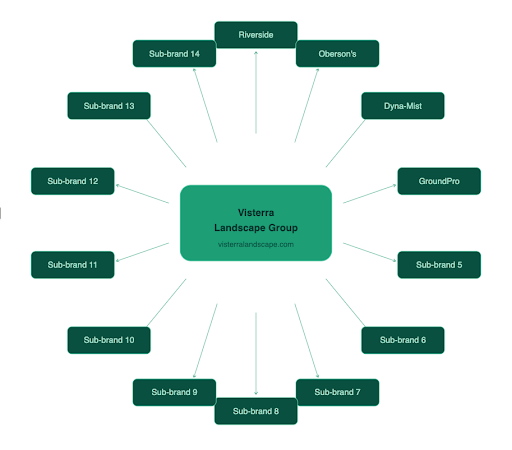
We recommended that they consolidate everything into a centralized website. This was a risky proposition, as they had another agency managing their corporate site, and we were handling each individual site. We felt it would greatly streamline the process and save on costs (website hosting for one site vs. 10, one agency fee versus two, etc). Additionally, it would drastically bolster their authority score, as they’d have a single centralized website gaining authority from 10+ websites redirecting to it.
They redirected the existing sites and built a brand-new site structure designed to support operational efficiency and SEO performance.
What Changed After Consolidation
- Visterra is only paying one agency fee now, versus two
- Their hosting costs will be reduced by more than 80%
- It will take our agency less time to handle the account since we’re managing one Google Ads account versus multiple accounts
- Reporting costs will go down because we can consolidate one site into one streamlined report, versus multiple reports
- Rather than having to pay for a new website with each acquisition, they simply have to create a new page based on a template on the new site, which will be a big cost saver
- Location pages replace the need for separate websites — each acquisition just gets a new page built from a template, not an entirely new domain
- Brand identity is preserved through dedicated brand pages that capture each company’s unique history, story, and personality within the consolidated site
Example: Another Multi-Location, Larger Business Using the Centralized Domain Approach
We walked through our thought process of Visterra and the decision to consolidate numerous domains into one. This client requested that we present other companies that have successfully deployed a similar strategy.
We audited DOCS Dermatology as someone they should strive to replicate.
They have one website. But they’ve acquired and built up hundreds of practices in all kinds of locations. Each location, oftentimes a suburb rather than an individual city, has a location page. And this has enabled DOCS to combine their authority across all locations for a very strong Authority Score in the 30+ range.

As you can imagine, that gives this business a winning edge in a pretty competitive Google search results landscape.
For example, they’re on the first page of Google results for “Columbus dermatologist” and outrank tons of their competitors. They are neck and neck with Ohio State, one of the strongest .edu domains.

DOCS was strategic about their page buildout. They built a location-specific page, Columbus location page. What this does is help them rank for the coveted query, “Columbus Dermatologist.”
They’ve done a nice job on this page showing an interactive map of all their Columbus locations, dermatologists in Columbus, and a list of all their services.

Pictures of the Columbus-area dermatologists who work in their practices:

Their goal isn’t just to rank for Columbus. They want to own all of the suburbs. Below, you can see them ranking in top positioning for “Grove City Dermatologist” for this suburb-specific page.
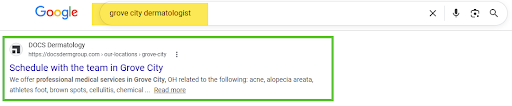
DOCS is leveraging its authority score to rank well across hundreds of location pages at the suburb and city level, which is how their business operates.
Don’t Overlook Your Blog. It’s a Major Authority Driver.
Done right, a blog can be pretty much the most powerful asset in a business’s SEO strategy. Good blog content earns backlinks, attracts informational traffic, and builds your authority on topics that are key to your business.
Imagine splitting that power over multiple domains. It’s the problem I’ve been getting at all along. You also split the blog’s power. And keep in mind that your blog’s benefits support your service pages in the rankings.
So, don’t treat your blog as a separate effort. Instead, treat it as fuel to keep your one domain’s SEO strategy running.
Blog Example: Jones Metal
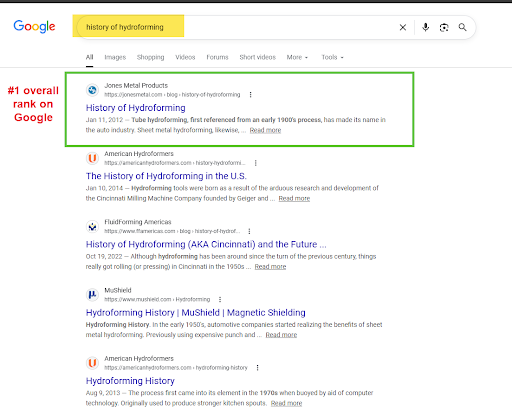
Jones Metal, a client of ours, had its blog living on a completely separate domain for many years. When we redesigned the site, we moved the blog to a subfolder on their main domain (jonesmetal.com/blog), ensuring all content authority flowed back to the primary site and reaped the benefit of that authority score.
Post-launch, they saw a nice surge in blog rankings and started ranking extremely well for coveted terms like “History of Hydroforming.” Beforehand, they weren’t in the Top 10 because the blog was coming from a less authoritative site.
When Multiple Domains Actually Make Sense
Nothing in SEO is one-size-fits-all. That’s true even when we’re talking about one website vs. multiple websites.
A single, central domain is the best approach in most cases. I stand by that. But there are situations where multiple websites can be the right choice.
I got a good example of this in a recent conversation I had with a business owner. He runs a business that rents out bounce houses. He decided to expand his business by offering large LED TV screens for rent. He was building out a separate website for the LED screen rentals.
I told him that, from an SEO perspective, it would make more sense to keep everything on a single site and build on his existing authority.
But in this case, he had to make a business decision that was counter to SEO best practices. He explained that his attorney told him bounce houses carry greater liability due to potential injuries and that, from a legal standpoint, the two services needed to be separated.
You probably don’t have this exact situation, but I’m sharing that anecdote to encourage you to consider what I’ve said alongside the unique details of your own.
One Domain, Better Results
In SEO, success is built at the domain level. Not the individual page level. So when you split your business across multiple domains, you split your authority, your rankings, and your ability to grow quickly. And you make business marketing operations more complicated for virtually no reason.
The opposite happens, of course, when you consolidate into a single domain. And that’s what you want. And it’s why I’m a big proponent of single-site SEO strategies. One strong website will outperform several weaker ones (almost) every time.