Many businesses treat PPC and SEO as separate worlds.
While they operate on different timelines, PPC and SEO campaigns share significant overlap in keyword strategy and execution.
Keeping them apart is a mistake that could be capping your ROI potential.
We’ve spent 15+ years mapping out SEO & PPC strategies for clients. We wanted to share with you how we create synergistic strategies between the two (with real client examples).
Why PPC and SEO Work Better Together
In general, the goal of pay-per-click (PPC) is to deliver you immediate visibility.
Conversely, the goal of search engine optimization (SEO) is to deliver long-term organic visibility so you don’t have to pay to bring traffic in the door.
At the end of the day, PPC and SEO have the same goals: to drive leads. PPC is more immediate, while with SEO, you have to be more patient. Regardless, you are targeting keywords and creating strong landing pages. Why not make this a more synced effort?
Let’s say you’re a new company that just published a website. Since you’re just starting, you are likely going to have a very low domain authority score.
Your domain authority score is essentially a proprietary metric (not a Google ranking factor) that tools like Moz use to measure the strength of your website from an SEO perspective. A low domain authority makes it more difficult to rank prominently in Google’s organic search results.
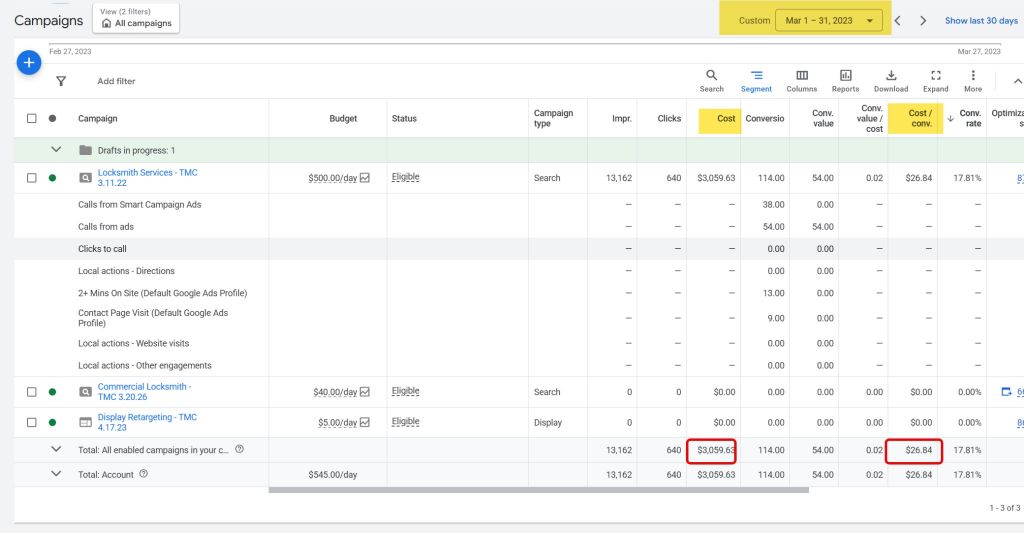
This was the exact story of EB Locksmith, a client of ours. They wanted to grow in the Columbus market, so they signed up for PPC and SEO services. We told them it’d be 6+ months before they ranked well organically. To drive instant leads, they invested in PPC. You can see that in the first month working with them, they spent only $3,059.65. This yielded a great ROI with 114 conversions and a $26.84 cost per conversion.
We were still incentivized to rank organically as it would make their company more profitable, but PPC became an instant lead generator for them.
A lot of businesses say they want to divest from PPC once they start ranking well. We find that to be somewhat of a folk lure. When businesses are generating leads and profitability from PPC, they often ramp things up.
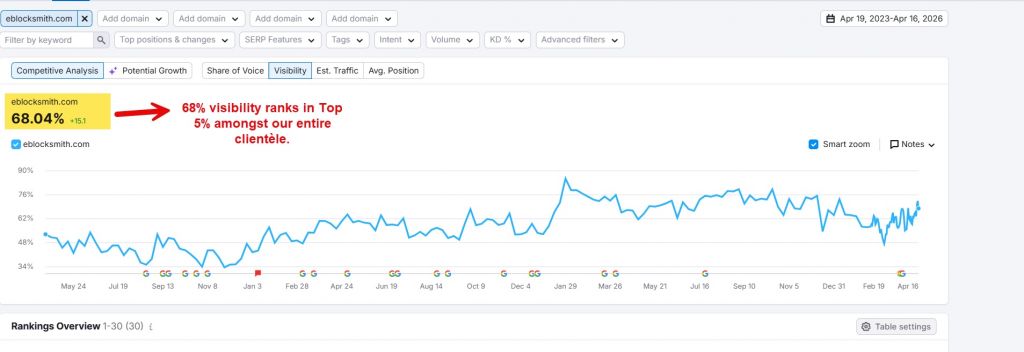
After working with EB Locksmith for 3+ years on SEO, we’ve increased their visibility to 68%, which is in the top 5% of our client roster of 100+ businesses.
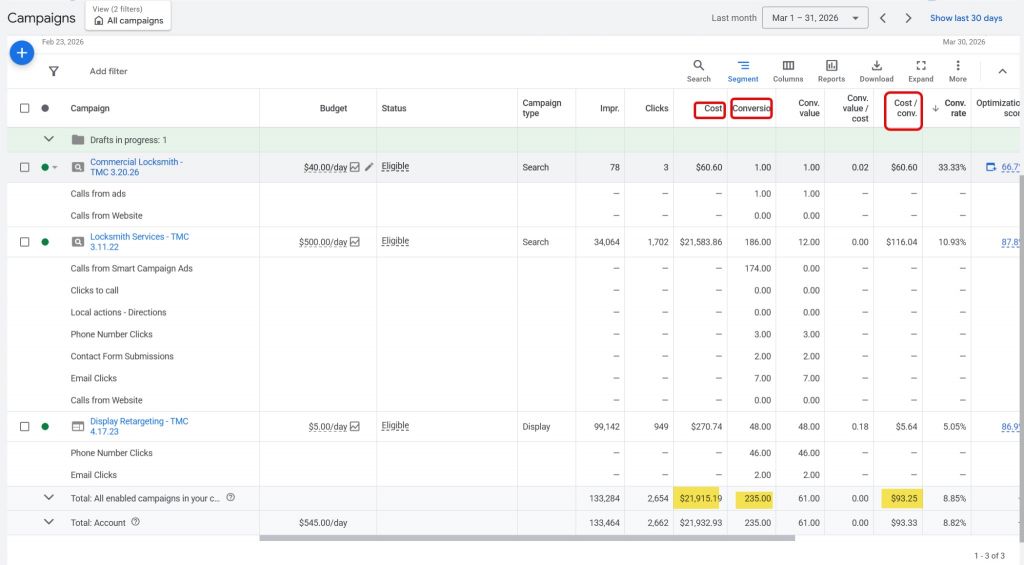
Once EB Locksmith started ranking well, they didn’t scale back advertising. Fast forward three years, and they are now spending $21,000 on Google Ads per month, despite having an incredible 68% visibility. The reason? PPC and SEO both provide leads and increase your overall exposure on Google.
 To close the initial invisibility gap, you can opt for a PPC strategy for your primary keywords to give you a bump while you build your company’s SEO presence.
Once your SEO begins to rise, your reliance on paid ads can decrease.
This synergy between SEO and PPC makes the two strategies more powerful together than either would be on its own.
The purpose of this article was about strategy alignment. Let’s dive into more client examples so you can learn how to deploy similar tactics for your business.
How the PPC and SEO Strategies Align
When we take on a new client, we actually map out SEO and PPC strategies side-by-side because they are nearly identical in terms of your target keywords.
This means that the keywords you’ll be bidding on via Google will be the same as those you track in software like SEMRush.
You can then start determining which keywords drive the highest click-through and conversion rates. When you see a keyword that’s converting, this is your “aha moment” to target this more aggressively in the title tag and primary headings.
Example of This in Action
Advance CNC has CNC Machine Shops in Columbus and Cincinnati. Initially, it made sense for us to create an ad group for Columbus terms and one for Cincinnati.
The Search terms report told us something very different. Most people were searching for “Ohio CNC Machine Shops.”
After analyzing the data, we created a new ad group for Ohio, and while this is very niche in terms of search volume, it drove the most volume and conversions.
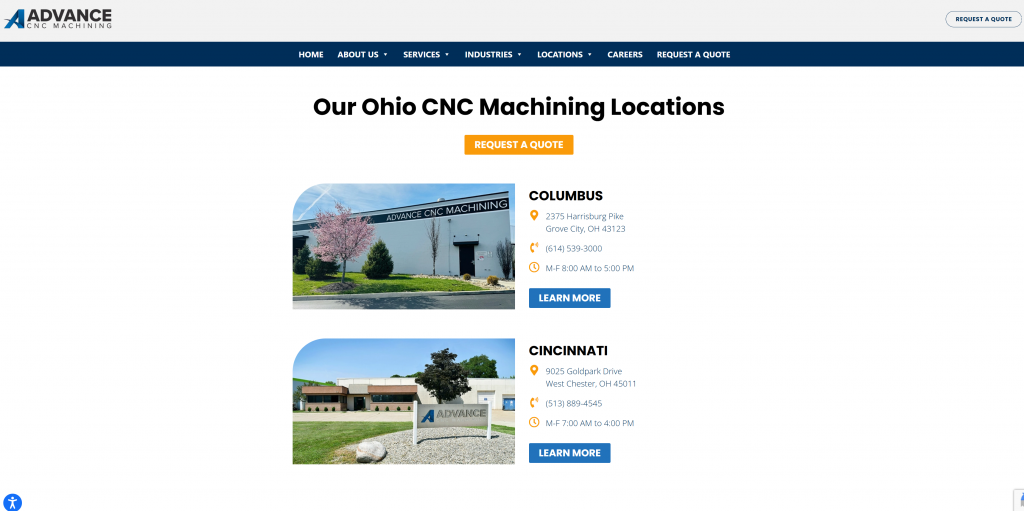
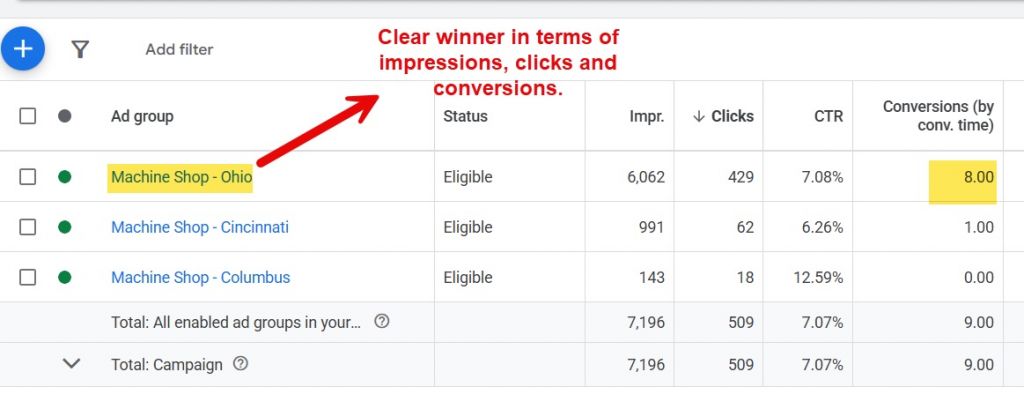 Once we saw such a strong conversion and realized that many people search for this, we optimized the location gateway page. The optimization was simple. We added “Ohio CNC Machining Locations” to the primary headline and title tag. Beforehand, it simply said, “Our CNC Machining Locations.”
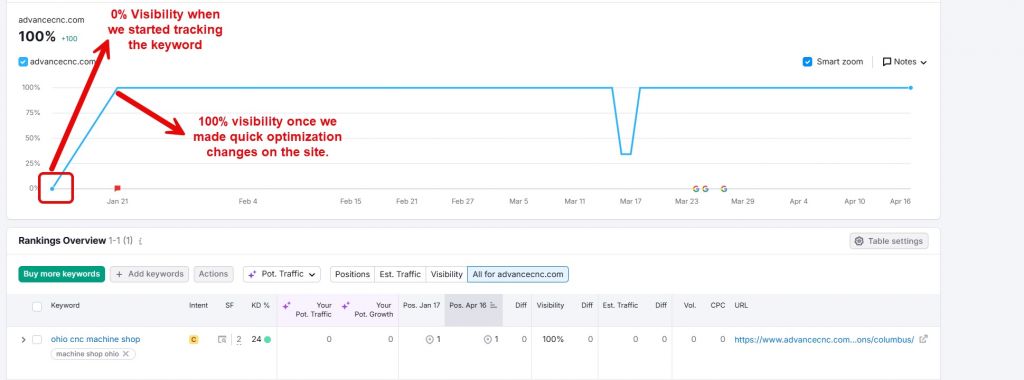
This resulted in an instant jump in keyword rankings. We went from 0% visibility to 100% visibility with this quick change. Additionally, it improved our PPC quality score because the landing page text aligned with the keywords and ad copy.
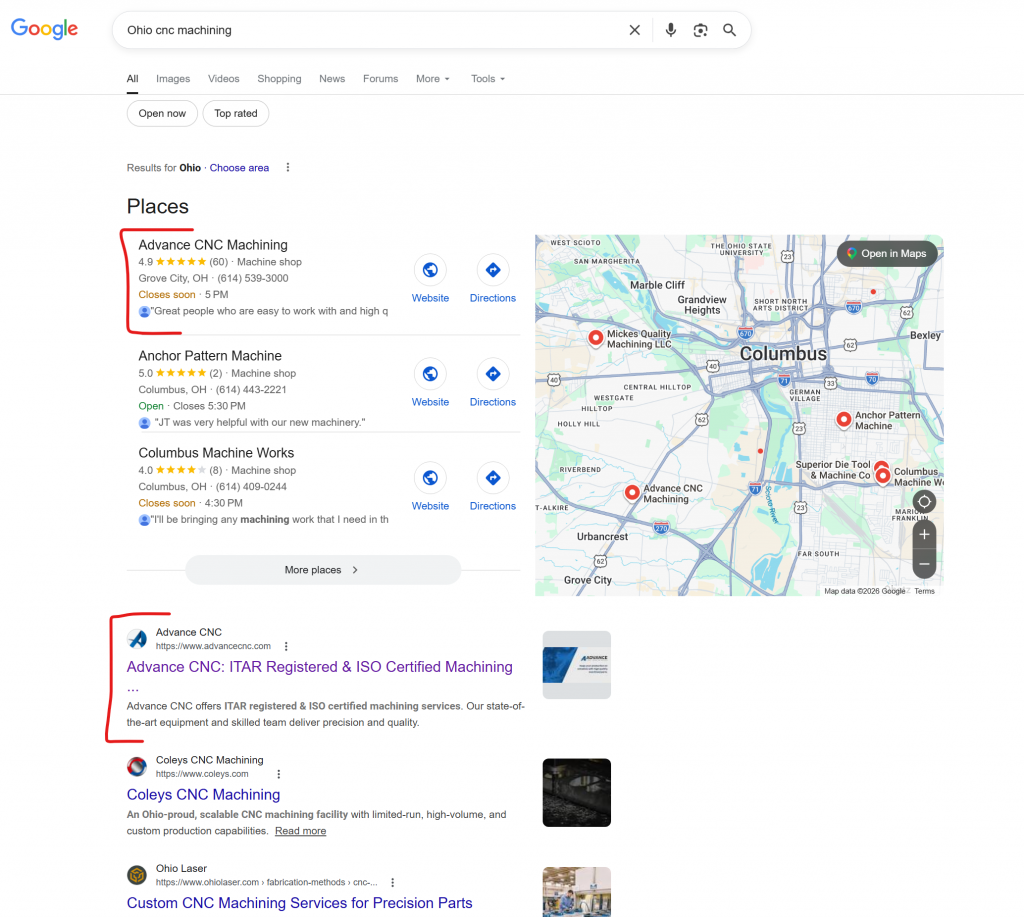
Let’s not discount Google’s Local Map Pack. Advance CNC started ranking #1 in the local pack for this coveted keyword as well.
Using PPC Data to Make Your SEO Smarter
Using data from PPC campaigns is different from your preferred organic keyword research tool because it allows you to see what your audience is actually typing into search engines. We work with a lot of small businesses. The search tools often reflect “less than 100 searches,” which doesn’t provide you with much insight. But for local B2B companies, those clicks can be goldmines. PPC data gives you valuable SEO insights.
There are multiple ways you can find PPC data to inform your SEO strategy, including:
- Auditing Search Terms reports in Google Ads — this is a goldmine for discovering what people are actually searching. Tip: Filter for search terms with high CTR or conversions that you’re not yet targeting organically.
- Tracking converting keywords and cross-referencing with SEO strategy in SEMrush. Pull keywords with a conversion rate of 3-5%, check if you rank in the top 3 organically, and if not, prioritize those for SEO content.
- Using Dynamic Search Ads (DSAs) to scan your site and surface additional keyword ideas you may not have considered. Google crawls your pages and auto-generates ads, which reveals how it categorizes your content and can expose gaps in your site structure.
- Pulling Google Ads data to identify high-performing topics and build SEO content around them. If an ad group around “dermatologist Columbus” drives consistent leads, that’s a sign to build a location-specific service page optimized for that term
Expert Tip: If you want to kill two birds with one stone, we advise clients to send PPC traffic to their actual website. Rather than designing a landing page, you can optimize an existing page on your site that’ll drive a higher conversion rate while improving your SEO.
Real Client Example #2 – DermWarehouse
DermWarehouse, an e-commerce client of ours that sells skin care and beauty products, noticed in their Google Ads data that there was demand for C-section scar products. They were primarily running Google Shopping campaigns. Products like Biocorneum Advanced Scar Treatment and Estas Beauty were driving significant volume.
Below, you will see over 2 million impressions, which reflects how much demand there was.
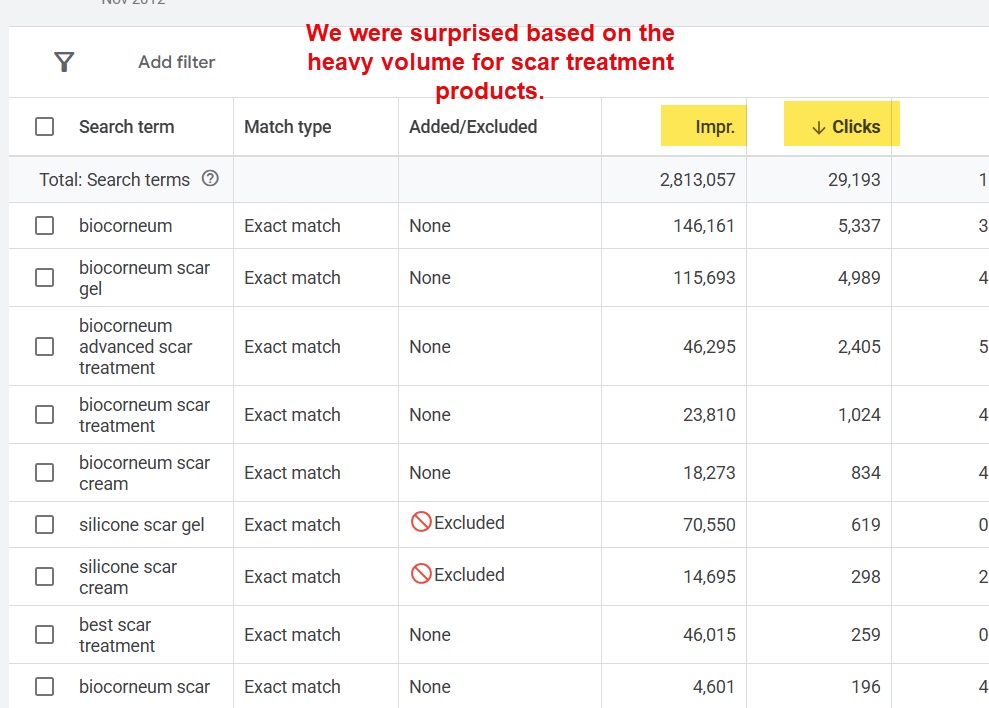
Looking to build a presence for keywords like “best scar product for C-sections / new moms”, they built a niche blog post called Best Over-the-Counter Scar Products After a C-Section.
The blog was authored by a certified dermatologist, with a personal anecdote and well-sourced statistics setting the stage before getting to the list of top C-section scar products.

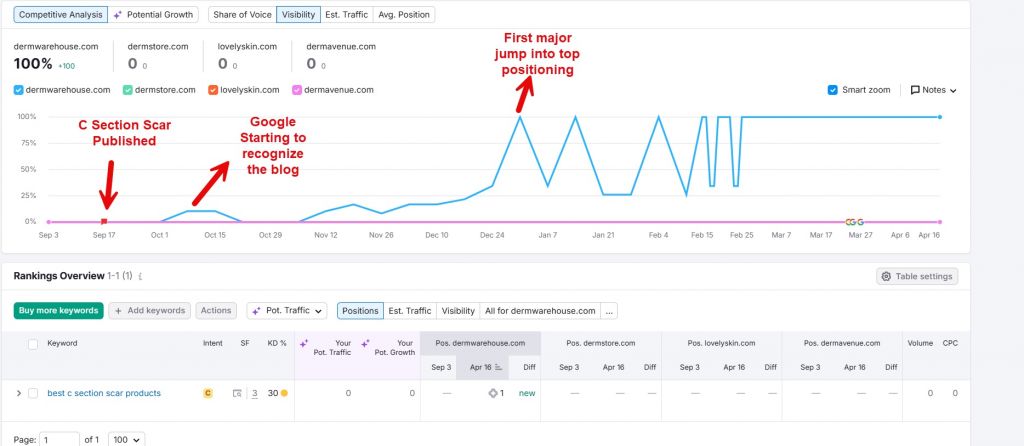
It produced quick results, driving organic traffic for the primary keyword and achieving prominent visibility for a term they were previously invisible for.
Below, you can see that in September, the blog was just published, so there was no visibility. Starting in October, it started to rank (albeit with low visibility). Come December, it saw a huge surge and retained top positioning.
Below is what the blog looks like in the flesh, ranking #1 on Google!
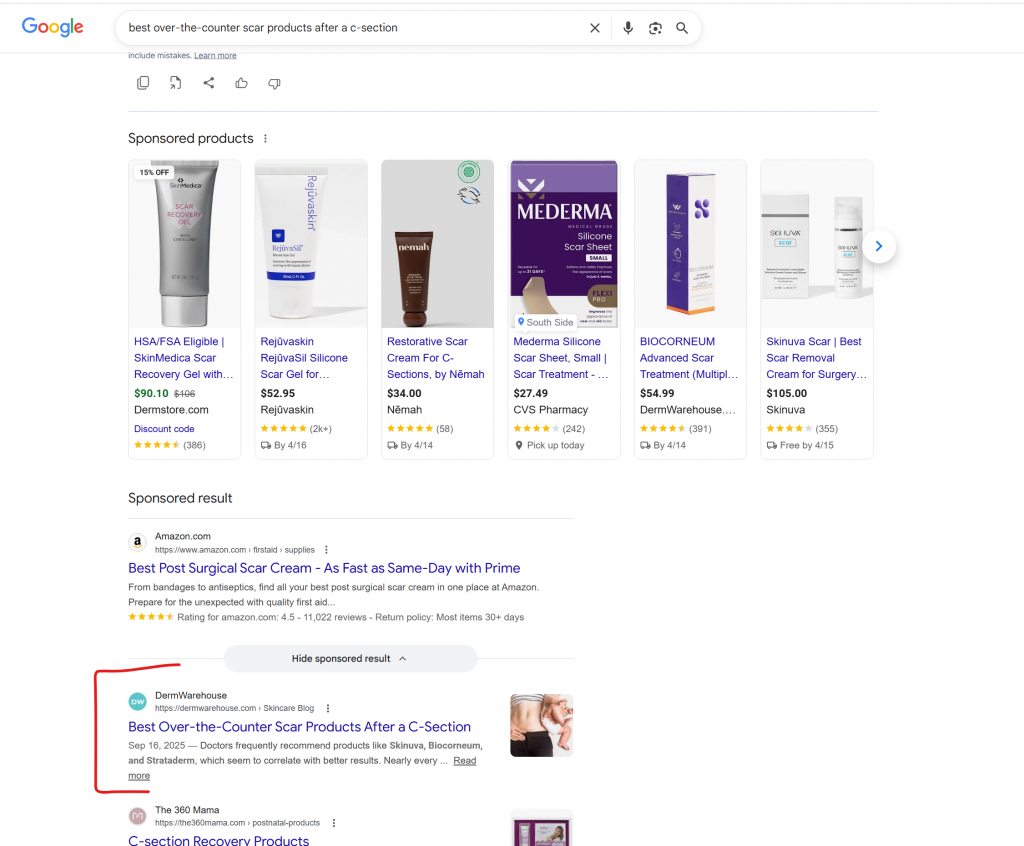
Key insight: This is another example of how you can use PPC data to identify a niche consumer demand and turn it into a strong SEO play for your business.
In Closing
When you run your next PPC or SEO campaign, do so with both channels in mind. Ask yourself:
“How can I run these together to make the other stronger?”
Hopefully, this blog has given you some actionable ways to pair PPC and SEO to take your campaigns to the next level.
Learn more: How to Keep Your PPC Strategy Winning in the Age of AI Overviews