We replaced Semrush for rank tracking and expect to save more than $20,000 a year by switching to DataForSEO. Our clients mostly want two answers: where they rank on Google, and now, whether they show up in AI search. DataForSEO can supply both, at a fraction of the cost, but only if you build a home for the data.
Jason Parks, President of The Media Captain and an SEO expert, sat down with The Media Captain’s development team to better understand the process and what’s needed for others to make a similar move. If you are an agency or business looking for a SEMrush alternative for rank tracking, this is what a DataForSEO migration actually involves.
DataForSEO Is a Backend, Not a Dashboard
The biggest misconception is that DataForSEO works like SEMrush. You can log in to manage billing and API access, but there is no dashboard for viewing rankings. It runs its own bot that searches Google for the keywords and locations you send it, then returns the results through an API.
SEMrush does the same underlying job. Both are scraping Google. The difference is that SEMrush wraps that data in its own servers, application, logins and reports, and you pay for every one of those layers. DataForSEO strips them out, which is why it can charge so much less. The trade is that the packaging becomes your job.
What You Need to Run It
Our development team boiled the requirements down to two things: a hosting server and a database that lives on it. The programming language does not matter. Any language that can call an API will work.
Once those exist, the workflow looks like this:
- You give DataForSEO a location (for example, Columbus, OH) and a list of keywords.
- A scheduled job on your server calls the DataForSEO API on a regular cadence.
- DataForSEO’s bot runs those searches and returns where each domain ranks.
- Your server stores the results in the database.
- A dashboard or report reads from the database so you and your clients can review it.
For hosting, AWS is our preferred choice, and it does not have to be expensive for a job like this. If you want something simpler, lightweight server alternatives can also run a DataForSEO tracker.
Building it took two kinds of expertise: development skill to stand up the tracker, and SEO judgment to decide what to track, how to organize it, and what to do when results look off.
How We Moved 12,000 Keywords Out of SEMrush
We had roughly 12,000 keywords tracked in SEMrush across 100+ clients, organized by client, location, and tag. Rebuilding that by hand was not an option.
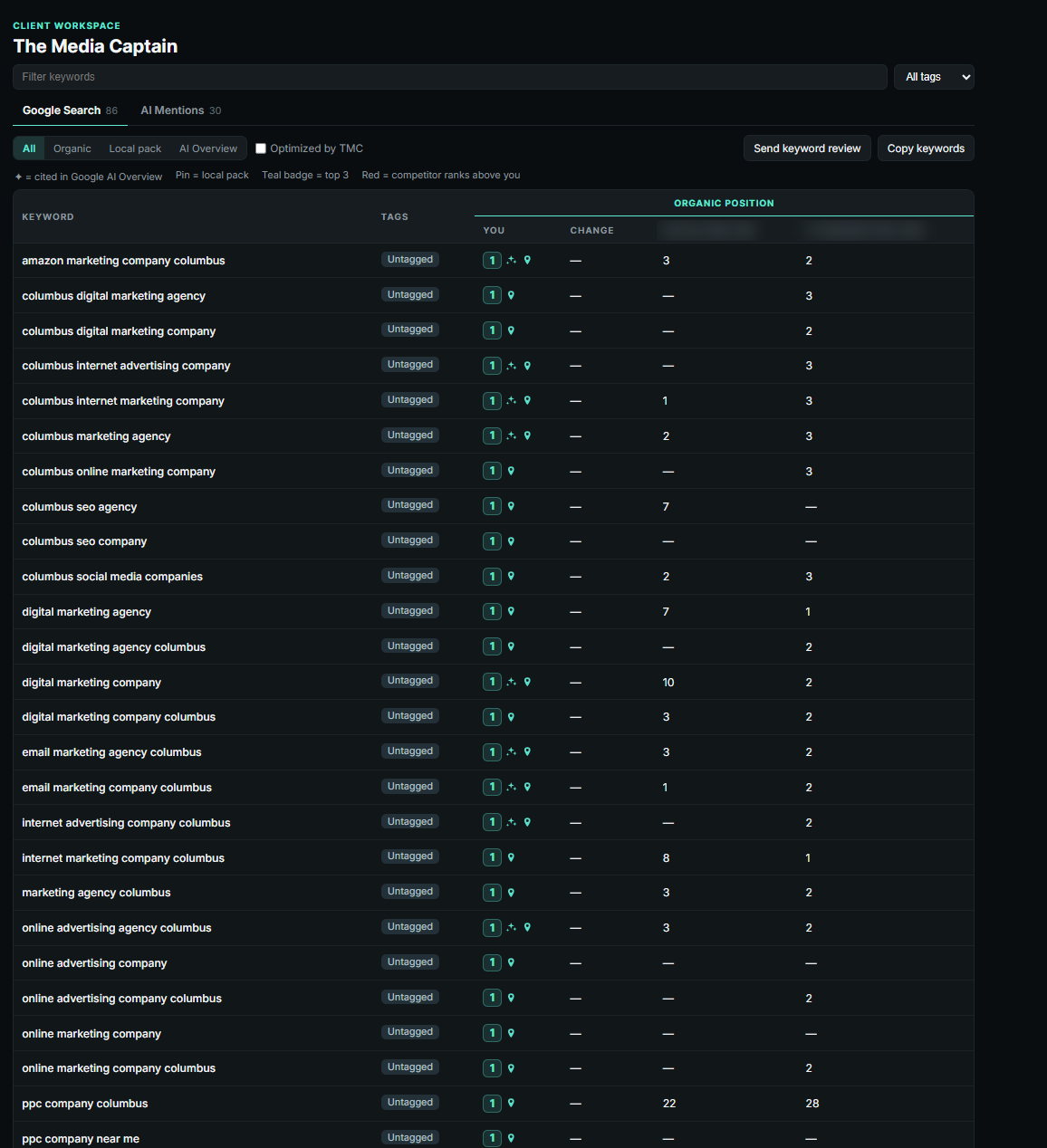
Our Navigator Tool, an internal platform we built to run the day-to-day of our agency, serves as the database where the keywords live. Our development team added a button to Navigator that makes an API call to SEMrush and imports the keyword lists directly. The import also brings over SEMrush tags, which we use to organize keywords, along with competitors.
From there, Navigator sends those keywords to DataForSEO on a schedule and stores the rankings that come back.
Getting it right took approximately 20 hours of development work, plus an additional 15 hours from Jason on the UX and SEO side.
Tracking AI Search Visibility the Same Way
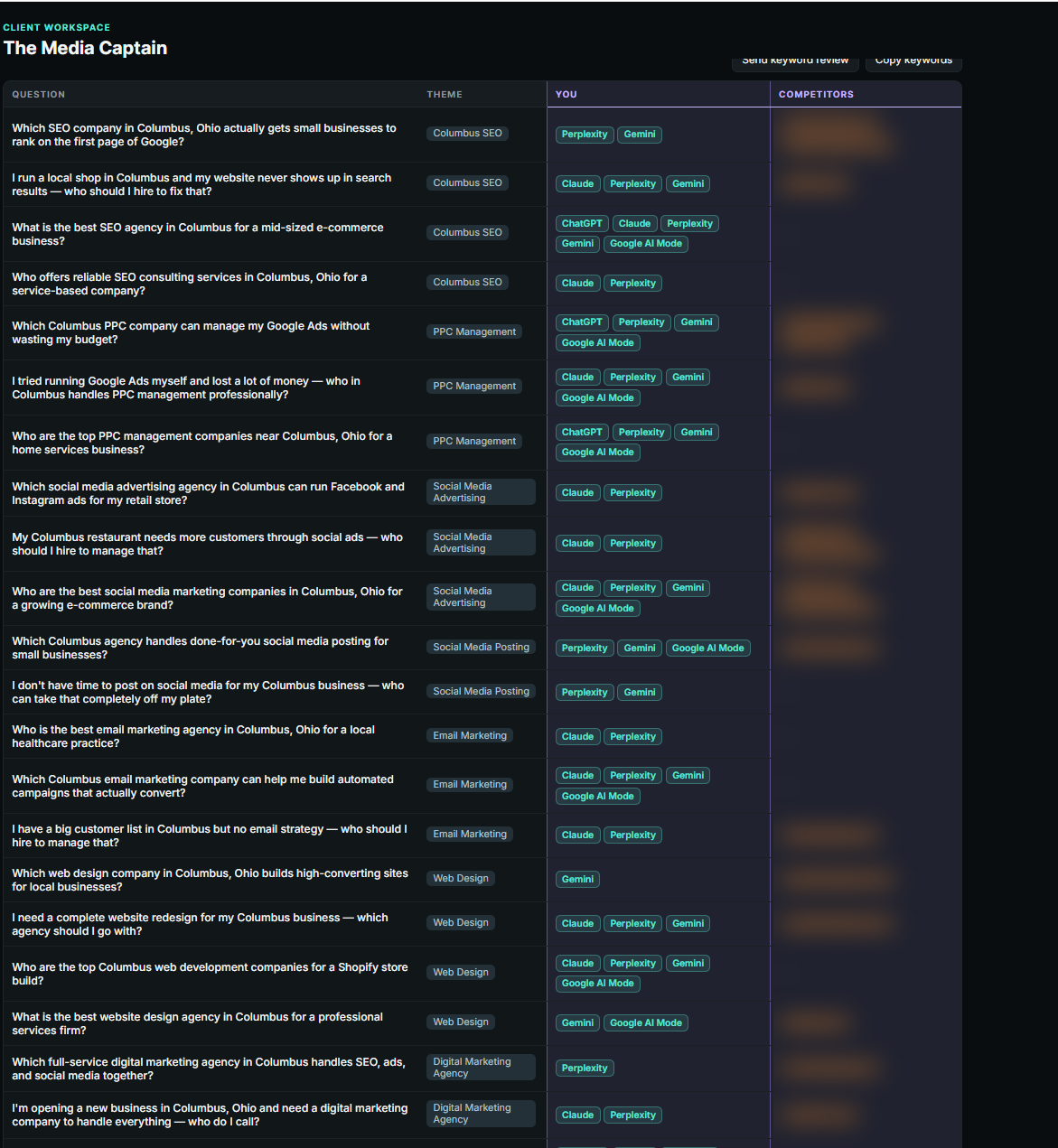
The same approach that pulls Google rankings also works for AI search. Instead of keywords, you give DataForSEO a list of questions. DataForSEO runs them through ChatGPT, Claude, Perplexity and Gemini and returns the answers, and our tracker scans those responses for your business name and domain.
The tracker also shows whether competitors are appearing in those answers and provides a visibility score, so you can report on AI search in a similar way you report on keyword rankings.
 That matters because clients are now asking where they show up in AI, not just on Google.
For every client, we track 15 questions once a month through DataForSEO’s Standard queue, with room to add more at an additional cost. Fifteen questions gives a strong read on how a business shows up in AI search.
AI tracking is priced differently from Google rankings. DataForSEO charges a small fee per question, $0.0006 in Live mode or $0.0002 in its slower Standard queue, plus whatever the AI platform charges for the response, which varies by model. Because each question runs across four platforms, the cost per question can exceed a single Google keyword check, depending on the AI models used. In practice, though, businesses track far fewer AI questions than keywords, so the AI side typically adds a modest amount to the overall bill.
How Often You Check Drives the Cost
DataForSEO charges per search result page, so the biggest cost lever is how often you check rankings. We check rankings twice a month, on the 1st and 15th, because most of our clients don’t check keywords daily, and that decision accounts for much of our savings. Clients who want a more frequent cadence can have it for a slight upcharge.
Here is what tracking 12,000 keywords costs at DataForSEO’s Standard queue rate of $0.0006 per 10 results, checking the top 50 results (five pages, or $0.003 per keyword):
| Check frequency | Cost per check | Approximate cost per year |
|---|---|---|
| Daily | $36 | $13,140 |
| Weekly | $36 | $1,870 |
| Twice a month (what we run) | $36 | $860 |
| Monthly | $36 | $430 |
Daily tracking at that scale gets expensive quickly. Most local businesses do not need it anyway, since rankings rarely move enough day to day to act on. Weekly or monthly checks still show the trends clients care about at a fraction of the cost.
Three Ways to Make the Switch
By running the tracker ourselves, we are seeing more than 80 percent cost savings compared to SEMrush rank tracking. What we bring is the SEO side: knowing which keywords, locations and tags matter, and building reporting around them. There are three ways we can set this up for others.
| Option | Best for | How it works |
|---|---|---|
| Hosted on our server | Agencies that want a turnkey tracker | We build the application on our infrastructure and you report from it |
| One-time setup on your server | Teams that want to own and manage it | We charge a one-time fee to stand it up on a low-cost server you control |
| WordPress setup | Single businesses | A custom build that connects to DataForSEO and shows keyword rankings inside your WordPress admin, no separate server. A packaged plugin is coming |
For agencies, the hosted or self-managed route can also pull in other sources such as Google Analytics, so the tracker becomes a full reporting workflow. For a single business that just wants to see rankings and AI mentions, a WordPress setup is the simplest path.
We price setup as a flat fee rather than by the hour. If you’re interested in our support, contact The Media Captain.