

Improve Local Visibility
SEO for plumbers is competitive, with keyword difficulty ranging from the 20s to the mid-40s, depending on your local market. The average cost per click often exceeds $40. Long story short, it’s not easy for a plumber to rank on Google, and relying on Google Ads is costly.
The goal of this guide is to help you better understand SEO concepts, strategies, and tactics that can help your plumbing business rank on the coveted first page.
Our Experience
- We increased the SEO visibility for Gorman-Lavelle, a commercial plumbing company, from 0.51% visibility to 45.73% visibility, the highest of any commercial plumber in Northeast Ohio.
- We helped The Waterworks, a plumbing company in Columbus, increase its leads by 107% after launching its new site.
- We helped A-Z Plumbing in Cleveland double its business through SEO and digital marketing, eventually leading to a private equity sale
We feel confident sharing these SEO tactics because we’ve seen them work firsthand with our clients.
Why Plumbing is Competitive
Some plumbers charge more than $200/hour. Projects like a water heater replacement can run north of $1,800. With a high hourly rate and a per-project price, plumbers make a very nice living, leading to a lot of plumbing options in each market.
In the chart below, you’ll see that plumbing is more competitive than an irrigation company but less so than a roofing company. Since a roofing job averages north of $8,500, that’s why the sector is more competitive.

Tools To Analyze Competitiveness
Keyword Difficulty (KD)
Keyword Difficulty (KD) is a tool from SEMRush telling you how hard or easy it would be to rank for a specific keyword. For most plumbing companies, the KD% falls into the high 20s, 30s, or 40s. When you get into the 30’s or 40’s, it can be quite challenging to rank without a strong authority score (more on this to come).
We also look into the cost per click as a gauge of competition. In the example below, “Plumber San Antonio” has an average cost per click of $41.52, which is competitive.
Before starting an SEO campaign, look into competitiveness, as it’s a great indicator of how easy or hard it’ll be to rank for a specific keyword.

Authority score grades your site’s overall power on a scale of 1-100 based on authoritative links pointing back to it.
The Waterworks has been operating for more than 40-years. They’ve sponsored the Columbus Blue Jackets, the local NHL team. They’ve been featured on NBC 4 for the local demand for a plumbing job.
When these powerful sites link back to The Waterworks, it builds up its authority.
If you just launched a brand new plumbing website, it’s going to be much harder for you to rank on Google versus The Waterworks, which has been operating for more than 40-years and has hundreds of powerful, local links.

What Makes a Keyword More Or Less Competitive For Plumbers
Individual Service Pages
“Water Heater Replacement San Antonio” has a much lower keyword difficulty than “San Antonio Plumber.” This is why it’s so important to build out service-specific pages that are locally optimized (more on this to come with our recommended site structure).

Market Size
San Antonio has a population of 2.6 million, whereas Wichita, Kansas, has only 650,000, nearly four times smaller.
When there are fewer people in a market, there are fewer plumbers, meaning that more densely populated cities are going to be more competitive and more challenging to rank.
Suburb Targeting
When you build out Service Area Pages (SAP’s), the competition drops further. “Westerville Plumber” will be less competitive than “Columbus Plumber.” Again, this comes back to a smaller population in the suburb versus the entire city.
A mistake we often see is that a plumber targets the primary city (aka Columbus) and has little visibility, instead focusing on a highly profitable nearby suburb (like Upper Arlington).
The challenging thing about building out Service Area Pages is that you must make the content unique; otherwise, Google will deem this as thin content or a doorway page, which can hurt your overall site rank.
Below is what can make your Service Area Page unique:
- Reviews from customers in the specific suburb
- Photos of jobs completed
- Overview of the suburb (for example, in Upper Arlington, there are older, more historic housing, which impacts the plumbing and water lines)
- List out the technicians who service this suburb
- Be transparent about where your fleet is headquartered and how long it takes to get to Upper Arlington
- Custom map with a pin listing out all of the jobs completed in the area
- Internal linking to your core services so a prospective customer can lear more
We don’t recommend creating Service Area Pages unless you can back it up with the items above.

Single vs. Multi-Location Plumbing Businesses
You will need a different SEO strategy if you’re a single-location plumber versus a multi-location plumber.
Single Location
When thinking of the architecture of your site, envision a ladder. At the top of the ladder is the term that describes your business (a plumbing company). All of the rungs up the ladder are the services you specialize in.
When you have a single location, you can optimize the homepage and service pages for the primary market you’re in, such as Columbus, OH.
The graphic below illustrates a strong site architecture for a single location.

Multi-Location
Your site structure will be much more complex if you operate multiple locations.
The homepage and service pages should not be optimized for 5 markets. You want great information on these pages, but the goal isn’t necessarily to get them to rank. You want to create a pathway for users to easily get to your location-specific pages. The location pages will be what you want to rank for “Dayton Plumbing Company.”
Some companies get greedy and try to create service-specific pages for each market. We’d advise against this. Focus on getting your location page to rank well.
Eco Plumbers does a great job on their location pages. They rank well in the Columbus, Cincinnati, Chillicothe, and Cleveland markets. They highlight their services, deals, financing, and the areas they serve within each market.

Case Study: Rebuilding Gorman-Lavelle’s Site Architecture
Let’s now talk about how to put your plumbing SEO strategy into practice by showcasing our work with Gorman-Lavelle.
Gorman-Lavelle, a commercial plumbing company in Cleveland, came to us with a website that had only four pages generating 0.51% organic visibility (according to Semrush’s Visibility metric).
To help Gorman-Lavelle increase its visibility, we redesigned their website and focused on the following:
- Ensuring the site’s intent was geared towards commercial projects.
- Building out pages for each core service, such as commercial backflow, plumbing installation, water main break repair, and more.
- Optimizing the site for Cleveland, their primary market.
We didn’t just redesign their website with generic content, either. All of the content throughout the site is expertly written. We interviewed core stakeholders on their team to obtain non-commodity content.
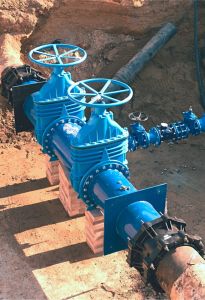
We also worked with their team to get pictures of jobs they’ve actually done, such as the one below of the backflow testing equipment.
Let’s Look at the Results
Many plumbers don’t structure their site well, but once they do, it can have a profound impact. This was proven by Gorman-Lavelle’s SEO rankings after their website/content transformation.
Their organic visibility improved to 45.73%, the highest of any commercial plumber in Northeast Ohio.
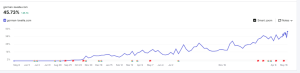
Source: Semrush data
In addition, they were now ranking #1 organically on Google for queries such as:
- Commercial Plumber Cleveland
- Commercial Backflow Services Cleveland
- Commercial Excavation Cleveland
Ranking #1 for “Commercial Plumber Cleveland” was particularly lucrative for Gorman-Lavelle. Commercial projects can run north of $100,000, and getting leads for these types of projects organically from Google can be very profitable for your business.
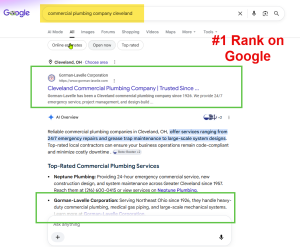
Gorman-Lavelle ranks #1 organically and #2 in the AI Overviews list of the top-rated commercial plumbing companies in Cleveland.
In addition, they are now ranking well for each of their core services. See below for some of their improved organic keyword rankings:
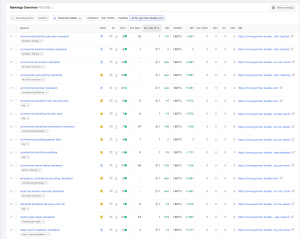
Source: Semrush data
Summary: Due to a complete website redesign and restructuring, which included adding non-commodity content to the pages, Gorman-Lavelle saw major improvements in organic visibility for their primary keywords in Cleveland.
Local Pack Optimization
The local pack generates 44% of clicks from Google’s first page, so being one of the three businesses is crucial for SEO success. Just ask San Antonio Plumbing, which has 1,000 reviews and top positioning.
Below are tactics to rank in Google’s Local Pack:
- Reviews
- Get consistent reviews.
- Utilize ServiceTitan or your Point of Sale to automate the review process to send emails and texts to customers once the job has been completed.
- Primary and Secondary Categories
- The primary category is one of the most important local pack ranking factors
- “Plumber” should be your primary category
- If your plumbing company offers drain-cleaning services or HVAC services, choose those as secondary categories.
- Name of Business
- Choosing a name with keywords sprinkled into it can boost your local pack rankings.
- The example with “San Antonio Plumbing” confirms as much.
- Be careful! If you are being deceptive and not showcasing your actual business name, it can lead to suspensions and ranking suppressions.
- If you’re starting from scratch, consider having “Plumbing” or a reference to your city in the brand name. The downside is that if others replicate this strategy, there can be brand confusion.
- Choosing a name with keywords sprinkled into it can boost your local pack rankings.
- Address vs. Service Area
- Google gives a stronger ranking boost to businesses that list their physical address versus listing a service area.
- Even if customers aren’t coming to your office and you’re servicing them at your house, list the address.
- Professional Images
- Showcase your team, fleet, and completed projects.
- Update new pictures on a quarterly basis
- Ask clients when leaving a review to post photos
- Listings with pictures are twice as likely to appear reputable.
- Linking to the Proper Page
- If you have multiple locations, it’s best practice to link to the location page as your destination URL versus than the homepage. When the landing page has local information that aligns with your GBP, this is a plus.
- NAP Consistency
- Make sure your name, address, and phone number are consistent. You want the same information on Google, Yelp, Facebook, Angie’s List, etc.
- A platform like Yext can help you stay consistent and organized with NAP (name, address, and phone number).
We put together 30 tactics to improve your local pack rankings if you’d like to learn more.

Other Optimization Tactics for Plumbers
Expert Content
Don’t take shortcuts when it comes to content creation. It’s easy to find information about drain cleaning or sump pumps on ChatGPT and copy and paste this onto your site. Google values quality content from experts. If you use content generated by AI, this is not unique, and Google won’t reward you for it.
We understand your plumbers are busy and not journalists. Have someone interview them for each service, and that expert writer can craft the content based on the interview.
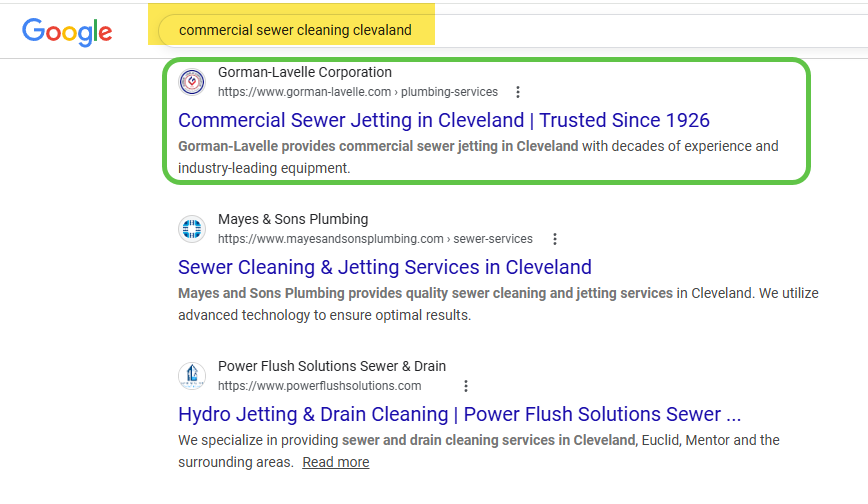
This is the approach we did for Gorman-Lavelle on their Sewer Cleaning page, which now ranks in the top positions on Google.

AI & Directory Exposure
Google’s search engine market share dropped below 90% for the first time since 2015 [source]. More people are using Claude, ChatGPT, Perplexity, and AI Search Engines.
The more external references you get for your brand, the better.
Below are some of the most important placements for AI Exposure:
- Yelp
- Angie
- Better Business Bureau
- Home Guide
Conduct a Google search for “Best Plumbing Companies in [Your Local Market].” Find all of the external sites where you can get listed and allocate a budget for this placement.
We recommend getting listed on all sites that populate on the first page of Google when you search for “Best Plumbing Companies [Your Local Market].” Doing this will not only generate quality referral traffic that can result in new business, but it can also increase your exposure on AI directories.

Acquire Backlinks
The more external links pointing to your site, the higher your authority score will be. How exactly do you go about doing this?
Blogging
Create linkable content. NIR Plumbing wrote a blog on “How Much Does a Plumber Cost Per Hour in 2025.” This generated eight backlinks to their website. Below is their backlink profile showcasing this SEO win.
Get Involved in the Local Community
Sponsor a local youth hockey team or find a community event that’s meaningful to your business and mission. This is a great way to get involved in the local community and also generate a localized backlink.
Utilize Resources
If you do commercial plumbing work, reach out to clients you’ve served and ask them to list you on their partner pages. If you have vendors, do the same.
Media Outreach
When Central Ohio businesses and homes had to deal with ruptured pipes following a deep freeze, they quoted and featured The Waterworks. When you forge relationships with media publications, you’ll be top of mind when they need a quote or interview for a story.

Other TIps
- Showcase personality on your website. With AI and automated customer service reps, people want to trust the plumbers who will be coming into their home.
- Make the customer experience easy on your website. Since plumbing often involves emergency services, it needs to be easy for customers to contact you via chat, phone, or email.
- Don’t rely solely on SEO. It’s a piece of the pie, but a diversified marketing strategy is vital.