Local citations in key industry listings and directories used to be all the rage for local SEO back in the mid 2010s.
The emergence of AI search platforms like ChatGPT and Google’s Gemini, which have been shown to pull from listings when responding to local queries, has brought citations back to the forefront.
As a digital marketing agency, we regularly audit and list our clients in relevant directories across verticals, and we will use this post to explain their relevance to local SEO today with real examples.
What Are Local Citations for SEO?
If you’re unfamiliar with citations, they are places in the digital space that include your NAP (name, address, and phone number). Examples include your Google Business Profile, Apple Maps and Yelp.
Citations used to be popular for local SEO, peaking in the 2014-2016 range, because there was a theory that if you had consistent information across the web with your name, address, and phone number, it would improve your local SEO rankings.
To ensure your company appeared consistently in relevant sources, businesses would pay a monthly fee for a digital marketing platform like Yext that lets you update key company information from one centralized dashboard.
The frustration with these sites is that you’d have to pay (around $99/month) to keep the listing, and if you ever deleted it, there was a fear that your local SEO would deteriorate.
Over time, studies have been released showing that these directories don’t carry as much weight as they used to from a local search perspective.
For example, Whitespark ranked consistency of citations on primary search engines as the 28th most relevant local search ranking factor for 2026. This differs dramatically from Whitespark’s 2013-2015 studies, where citation consistency was a Top 10 ranking factor.
In our 16+ years of business, we can’t remember an instance where we added a company to a directory like Yext or Semrush and saw a jump in their organic keyword rankings.
The State of Local Citations for SEO Today
Even though citation consistency is not a high local search ranking factor, the rise of AI search platforms in modern search has brought the spotlight back on citations.
This is demonstrated by the revenue numbers of Yext, one of the leading platforms for managing local citations.

An example of Yext’s Listings platform, courtesy of Yext.
Yext generated $446.6 million in total revenue for its full fiscal year 2026 [source], and currently, the company’s Annual Recurring Revenue (ARR) is tracking at $440.8 million [source].
The vast majority of Yext’s revenue comes from thousands of large-scale enterprise brands. These include corporate chains like Great Clips (managing 4,400+ locations), alongside multi-location hospital networks, banks, and retail brands. [source]
These revenue numbers indicate that there are still several local businesses that utilize these data management tools (others include Neustar Localeze, Turbify and Whitespark) prominently in their local SEO/AI search strategies.
How Should You Manage Local Citations? (Tools vs. Manual Approach)
We’ll now discuss two methods of managing local citations so you can determine which approach is best for your business:
- Investing in platforms like Yext to automate citation management across listings.
- Manually adding your business to relevant listings and managing it yourself.
When Investing in Software to Manage Citations Is Worth It
Multi-location businesses are the best fit to invest in software that will automatically manage your citations.
Think about it like this: If you’re managing 10 different locations, are you really going to have the time to check that each location’s NAP is updated and accurate?
When you have a tool like Yext (no affiliation; it’s just considered a leading tool for citation management), it acts almost as your digital security guard that locks your correct address and phone number across major online directories.
Directories or business listings constantly let random users or automated systems suggest edits to your pages.
For example, Google Business Profiles have a “Suggest an edit” button where anybody can recommend to Google that your name, address or phone number should be changed:

A tool like Yext (or the other ones mentioned in the last section) instantly catches those changes and forces them back to your correct information.
As long as you keep paying the subscription, this digital shield prevents outside sources from messing up your business details without you having to manually go check each crucial listing.
If your information changes, you can make a simple edit in the dashboard, and it will update your alterations across the board.
Tools like Yext are also great for comprehensive review monitoring and responses.
Running a multi-location business and having to log into 10 different dashboards just to check reviews is highly inefficient.
When a Manual Approach to Citations Is the Better Fit
While multi-location businesses can benefit from using tools like Yext for local citations, we recommend a manual approach for single-location businesses.
For businesses with only one location, we select the 8-10 most relevant directories, get direct access to the listings, and update them manually.
One downside of using tools to automate listings is that you might end up on several irrelevant directories.
Personal injury lawyers, for example, want to get listed on Justia, FindLaw and Super Lawyers. You don’t want to be on Houzz or TripAdvisor.
The advantage of a manual approach to citations is that you’ll often have greater success choosing the most relevant ones for your business.
The problem is finding the time to do that and then managing all of them over time to ensure they’re accurate and active.
The bottom line: For local businesses with one location, we find it’s more effective to use a manual route with citations. For multi-location businesses, using a tool like Yext can be a huge time-saver for managing citations across directories and other key listings.
In the examples below, you’ll see how we assisted two companies with citation issues: one from a user-experience standpoint (fixing Apple Maps), and the other from a branding standpoint.
Real Client Example: Kern Heating (Apple Maps Recovery)
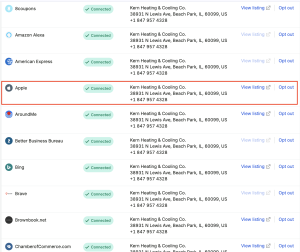
Our client, Kern Heating, had an Apple Maps listing that was tied to their old agency’s (Scorpion) Yext account.
A bad or improper link caused the listing to drop entirely in January 2026, and organic Apple Maps traffic fell year-over-year as a result.
What we did:
- Attempted to work through the existing Scorpion/Yext connection first, but it stalled for weeks with no resolution.
- Opened a direct case with Apple support in early March.
- Used Semrush’s Listing Management tool to reconnect and verify the location.
- Supplied exterior signage photos when Apple couldn’t initially verify the business met its listing requirements.
Real Client Example: Starr MFR PT & Wellness (Old Business Name)
Our client, Starr MFR PT & Wellness, had rebranded from “Starr Spine Physical Therapy and Wellness” to “Starr MFR PT & Wellness,” but the old name was still showing across search engines and directories.
What we did:
- Used Semrush’s Listing Management tool to push the correct name and address across directories in one place, instead of manually updating each directory (Google, Bing, Yelp, etc.) one by one.
- Semrush account setup was completed on July 15, 2026, kicking off the directory correction and broader SEO strategy work.

Are Local Citations Still Relevant for Your Business?
Getting included on core local business listings and key industry directories is essential for businesses of all types.
How you decide to do that (the manual route vs. investing in a tool) depends on how many locations you’re managing, your budget and allotted time for citation management.
Regardless, make it a habit to check your key listings manually on a quarterly basis. If you’re rebranding, be extra proactive about ensuring your new NAP is fully up-to-date across listings.
If you need someone to reliably manage your listings, contact us today.