


“Publish more content. Blog consistently. You’ll rank higher.”
It sounds right. It feels like progress. But in many cases, it’s exactly why websites underperform.
I see it all the time. A company invests heavily in blogging, builds out dozens of posts, and still struggles to rank for the keywords that actually drive revenue.
The issue usually isn’t the service pages. It’s the blog. More specifically, it’s a blog filled with thin, generic, or poorly targeted content that drags down the rest of the site.
In this post, I’m going to break down why that happens, how Google actually evaluates your content, and what a blog strategy should look like if you want it to support your SEO instead of hurting it.
TL;DR:
The Biggest SEO Misconception: More Content = Better Rankings
The idea that “fresh content” improves SEO has been around for years. It’s one of the most common reasons businesses invest heavily in blogging. The thinking is simple enough: The more you publish, the more opportunities you have to rank.
But that’s not how it works. Especially not in 2026.
Publishing more content does not automatically lead to better rankings. In fact, if that content is low quality, it can have the exact opposite effect.
A huge number of thin, repetitive, or generic blog posts can drag down your site’s overall performance. Instead of helping you rank, it can make it harder for your most important pages to gain traction.
Please don’t mishear me: The issue isn’t blogging itself. It’s how most businesses approach it.
Google Evaluates Your Website Holistically
Google doesn’t just evaluate individual pages anymore. It looks at your website as a whole.
With the Helpful Content System now part of Google’s core algorithm, there’s a sitewide quality signal tied to your domain. If a large portion of your content is unhelpful, thin, or written just to rank, that signal can work against you.
Put another way: It’s not just the one bad page that will rank poorly. If you have enough bad pages, even your good pages will rank poorly.
When Google sees too much low-value content across a site, it can apply a negative classifier that impacts rankings more broadly. That includes the pages you actually care about, like your core services.
That’s why weak blog content is chainsaw-dangerous. It can influence how Google views your entire site. And that’s a hard opinion to reverse once it’s set in.
Why Blogs Are Often the Problem
When a site is underperforming, the issue is often hiding in plain sight: the blog.
In many cases, blog content is:
- Poorly outsourced or templated
- Written for keywords instead of real users
- Thin, generic, and low-effort (including AI-generated content)
It checks a box. But it doesn’t add much value. And over time, that adds up.
For one thing, most businesses publish far more blog posts than core pages. That means the blog can make up the majority of the site.
So even if your service pages are strong, they’re getting judged alongside dozens (maybe hundreds) of weaker blog posts. That’s a problematic imbalance. If most of your site is low-quality content, that’s how Google is going to view your site overall.
Case Study: When a Blog Drags Down an Entire Website
Let’s look at a real (and cautionary) example:
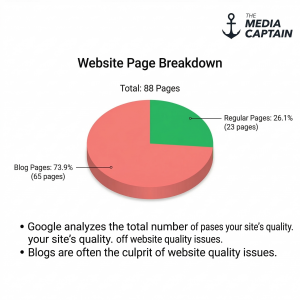
A local landscaping company, Precision Corporation, had 88 pages on its website; 65 of those were blog posts; only 23 were core service pages.
That means 73% of the site was blog content.
This matters more than most people realize. If the majority of your site is blog content, Google is using that content to judge your overall quality. Not just your service pages.
And in this case, the blog had some clear issues:
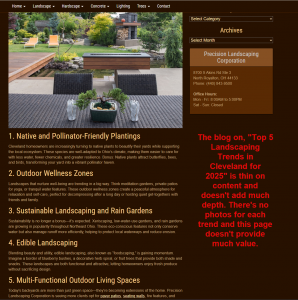
- Most posts were under 200 words.
- They relied on stock images.
- The writing felt generic, like it came from an SEO template instead of an actual expert.
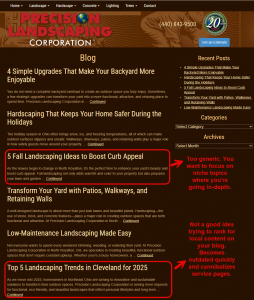
There was also a second problem: keyword cannibalization.
Some blog posts were targeting the same terms as the core service pages. For example, topics around landscaping services in a specific city were competing directly with the pages designed to drive leads.
So instead of supporting the site, the blog was working against it. This is exactly the kind of structure that can suppress rankings across an entire domain.
The Quick Test: Should This Blog Post Exist?
There’s a simple way to evaluate your blog content. Ask yourself: Would you send this post to a potential customer or client?
If the answer is no, that’s a problem. Because Google is asking a similar question. Is this content helpful? Is it trustworthy? Does it reflect real expertise? If your own answer is hesitation, it’s a strong signal that the content isn’t doing your site any favors.
This isn’t a complicated framework. It’s a practical filter you can apply quickly across your entire blog. And once you identify the posts that don’t pass that test, the next step is deciding what to do with them.
How to Audit Your Blog Content
As you audit your blog content, every blog post should fall into one of four categories:
- Keep. The content is strong, accurate, and genuinely helpful. It reflects your expertise and supports your brand.
- Enhance. The topic is solid, but the execution is lacking. Add depth, examples, visuals, or new information to make it more valuable.
- Redirect. The content overlaps with another page or targets the wrong intent. Consolidate it into a stronger page and redirect the URL.
- Delete. The content adds no value, targets irrelevant topics, or is too thin to justify improving. Removing it can improve your overall site quality.
If you have a large blog, this process can feel overwhelming. A good starting point is to use AI to speed things up.
Upload each blog URL into a tool like Claude and use a prompt like this:
“Please look at each of my blogs URL’s like you are a Google website evaluator. Rate each blog on a scale of 1-100. Please let me know which blogs you believe are good as is, which ones need to be enhanced, where there’s cannibalization and there can be a redirect, and where there’s low quality content or topics that can be deleted.”
This won’t replace human judgment. But it gives you a fast, structured way to begin cleaning up your site.
Keyword Cannibalization: The Hidden SEO Killer
Keyword cannibalization happens when multiple pages on your site target the same keyword or intent. Instead of helping you rank, those pages compete with each other. Blogs are one of the most common causes of this. It usually happens when businesses try to rank blog posts for the same local or service-based keywords as their core pages.
For example, a landscaping company might publish a blog like “Low Maintenance Landscaping in Cleveland” while also trying to rank a service page for “Cleveland landscaping services.” Now Google has to decide which page to rank. And often, neither performs as well as it should.
This creates confusion, splits authority, and weakens the pages that are actually meant to drive leads. Your blog should support your service pages. Not compete with them.
What Local Businesses Should Blog About Instead
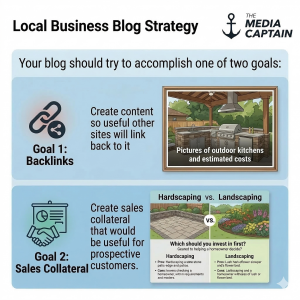
If you’re a local business, your blog shouldn’t be trying to rank for the same keywords as your service pages. It should support your service page keywords.
There are two types of blog content that consistently help you do exactly that:
Link-Worthy Content (Backlink Strategy)
This is content designed to earn links, not immediate leads. The goal is to create something useful enough that other websites reference it as a resource (by linking to it, which is great for your SEO).
That might look like:
- Pricing breakdowns
- Visual project examples
- Detailed, resource-style guides
For example, a blog post on “Foods You Can Eat After a Root Canal” generated over 100 backlinks for a local endodontist client of ours. That post isn’t bringing in patients directly. But it’s building authority. And that authority helps the pages that do drive business rank higher.
Sales Collateral Content
This is content that helps prospects make decisions. It may not bring in a lot of traffic, but it plays a key role in converting leads.
Things like:
- Comparisons
- FAQs
- “What should I choose?” type content
These are the questions your customers are already asking. When your blog answers them clearly, it becomes a valuable resource for your sales process. Not every post needs to generate traffic; that’s the old way of thinking. Some posts just need to help you close business.
National Businesses: A Different Blogging Strategy
If your business can serve clients beyond your local area, your blog strategy opens up. You’re no longer limited to local intent. You can target broader, problem-based searches that bring in leads from anywhere.
Here are two types of content to focus on if yours is a national business:
Content That Attracts Clients Directly
This is content built around real problems your audience is trying to solve. Instead of targeting a location-based keyword, you’re answering a specific question or issue.
For example, a post about what happens when a Google Business Profile is deleted led to a major client from Alabama for our agency. They searched for help, found our content, and reached out.
That’s the opportunity with this type of content. A single blog post can generate leads well outside your local market.
Data-Driven, Link-Magnet Content
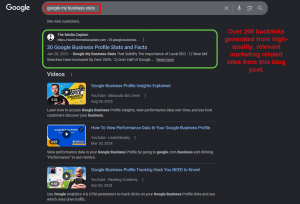
This is content built to earn backlinks at scale. Think statistics, research, and aggregated data.
For example, a post compiling Google Business Profile stats attracted over 200 referring domains for our website. That includes high-authority sites like GoDaddy and The UPS Store.
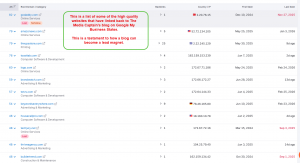
That kind of content becomes a reference point. And one strong piece like this can significantly increase your domain’s authority. That helps your entire site rank better.
Blog Less, But Make It Count
The shift I’m trying to describe here is simple: Move from volume to value. More content doesn’t mean better results. Better content does.
This is what you won’t hear from agencies that want to charge you an arm and a leg for every blog post they sell you. They want you to believe you need to publish 500 templated blog posts to see results. Then they get paid for 500 templated blog posts.
If you want your blog to actually support your SEO, focus on a few key principles:
- Eliminate weak or low-value content.
- Avoid keyword cannibalization.
- Focus on content that earns backlinks or supports your sales process.
If you’re wondering how often you should actually be publishing, read How Often Should I Be Posting Blogs for SEO?
Rethinking Your Blog Strategy
Blogging isn’t inherently good or bad. It all comes down to execution. A strong blog can build authority, support your sales process, and bring in new business. But a weak one can hold your site back from real SEO performance.
That’s why it’s worth taking a step back and looking at your blog critically. Not as a box to check, but as a strategic asset. Because when your blog is aligned with your goals, it doesn’t just sit on your site. It works for you.
