

SEO Guide for Tennis Clubs
According to SEMRush, it’s “very easy” to rank at the top of Google for the tennis club vertical. With tennis club members often staying for years and spending $3,000+ annually, every new customer you acquire through SEO has significant long-term value. There’s nothing better than being in a low-competition industry with high potential returns, which is exactly the bucket tennis clubs fall into.
We’re going to help you better understand the SEO landscape for tennis clubs and provide tactics to help you rank at the top of Google and in AI search results in your local market. First, let’s understand what makes tennis club SEO so achievable.

Understanding SEO Competition Levels for Tennis Clubs
Why Tennis Club SEO is Low Competition
Keyword Difficulty “KD,” is SEMRush’s metric for how hard it would be to rank in the top 10 of Google for any given keyword.
Below, you can see the local tennis queries with keyword difficulty scores of 15 and 7. SEMRush is telling you that it is “very easy” to rank for these queries. Other industries like personal injury law have KD scores in the 60s and 70s, which is much more challenging.
Below, you can see the local tennis queries with a respective keyword difficulty score of 15 and 7. SEMRush is telling you that it is “very easy” to rank for these queries. Other verticals we work with like personal injury law, have a KD% in the 60’s and 70’s, which is much more challenging.


Tennis Clubs vs. High Competition Industries
Let’s compare a tennis club to a personal injury law firm to help you understand why it’s so much less competitive.
There are normally only a few clubs in each market. In Columbus, there are 4-5 indoor courts, whereas there are hundreds of personal injury lawyers. This means there’s less competition.
Despite a potential new member being able to generate a lifetime value of over $10,000 if they sign up for weekly lessons, junior programs, etc., the value of a personal injury case can be north of a million dollars. These factors drive up competition for personal injury and mean there’s less competition for tennis clubs

Validating Competition Levels Through Google Ads
We also look into Google Ads and the average cost per click. This tells us how much tennis clubs are willing to pay for each click. You can see that the average cost per click is lower than $2. With personal injury law, it can be north of $100. The low cost per click data confirms SEMRush’s assessment that tennis clubs operate in a low competition vertical.

The beauty of SEO for tennis clubs is that it’s low competition with a high potential ROI. We’ll show you why tennis clubs have relatively low competition and the exact steps to dominate Google in your market.
Competition Varies By Market
If you are a tennis club in New York City, the keyword difficulty is going to be higher because there are more clubs than in Columbus, Ohio, and the cost for a lesson is likely 2-3 times the price. While overall keyword difficulty is low for tennis clubs, it can be more challenging in major metropolitan markets.
Authority score takes into account the number of quality backlinks pointing to your site. There is a direct correlation between your authority score and where you rank on Google.
Related Blog: What’s a good authority score?
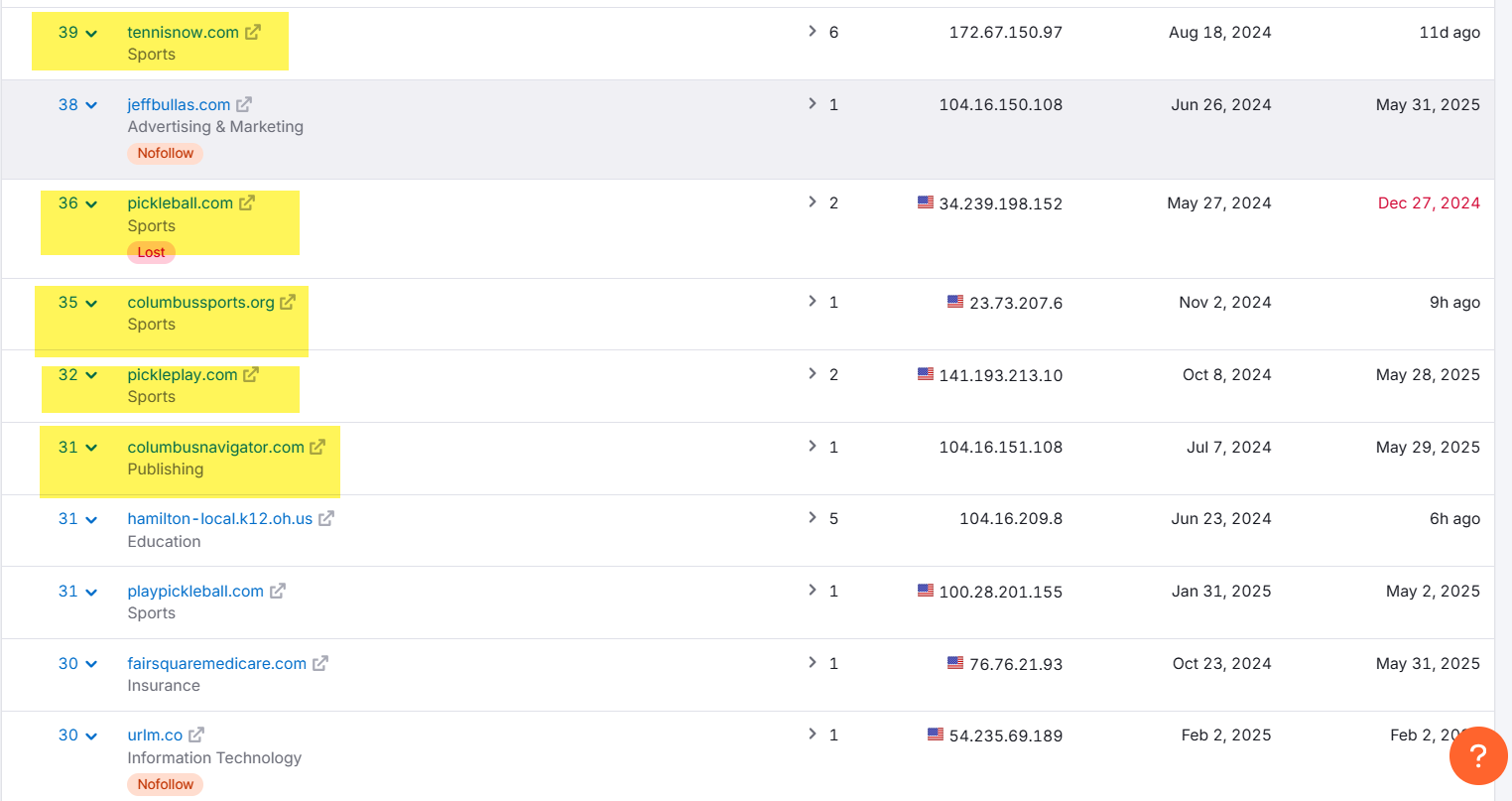
Scarborough East Tennis, a tennis club client we’ve worked with for 10+years has an authority score of 19, which is strong for a local business. They have 2.1k backlinks and 365 referring domains.

If we dive into Scarborough’s backlink profile, you’ll notice relevant backlinks from authoritative sites such as Tennis Now, Pickle Play, Columbus Sports and Columbus Navigator. This is exactly what Google wants to see. Relevant, localized, authoritative sites linking back to Scarborough’s site.
You can use a tool like SEMrush to help you gauge your sites authority score versus the competition. The main tennis clubs in Columbus have relatively similar authority scores.

When you do a Google search for “Indoor Tennis Columbus,” it’s no coincidence that the tennis club with the highest authority score is ranking towards the top of Google.

If you are a tennis club with an authority score above 10, in most markets you should be able to rank on the first page due to low competition. When you are between 15-20, you should be able to rank in the top 5 positions on Google. If you’re above 20, you should be able to have extremely high visibility and dominate your market with top positioning.
Later in this SEO guide for tennis clubs, we’ll tell you how to acquire more backlinks. First, let’s dive into actual SEO optimization tactics that can help you surpass competitors with a higher authority score.
Optimizing Your Website’s SEO Structure
Think of your website structure like a ladder. At the top is your main business category – ‘Tennis Club.’ Each rung below represents a specific service you offer: private lessons, leagues, junior programs, and clinics.
Google favors websites that have dedicated pages for each service, provided there’s enough quality content to support them. This structure improves your chances of ranking well for both broad terms like ‘tennis club’ and specific searches like ‘private tennis lessons.’
On these main pages, you want to optimize for the local market where your club is located.
Below is an example of Scarborough East Tennis Club, a client we helped restructure their site to accomplish this. For their homepage, this is optimized for “Columbus Tennis Club.” Their unique page on private tennis lessons is optimized for “Private Tennis Lessons Columbus.”

Key Optimization Tactics
You now have a better understanding of how tennis clubs operate in a low-competition environment where you can rank on the first page of Google with an authority score between 10-20. Now comes the exciting part… The specific tactics to outrank your competitors in your local market.
We’ve covered many foundational SEO aspects to help you understand overall competitiveness for tennis clubs and what it takes to outrank competitors in this vertical. Now, let’s dive into different optimization tactics that can have a significant impact.
Google Business Profile Optimization (GBP)

Tennis clubs rely on members within a 10-15 mile radius of their facility, which makes exposure in the local pack crucial, as it serves as a lead generator for your club.
Tennis players are seeking a nearby location with trustworthy indicators, such as reviews, which is why they turn to Google Business Profile.
When you search for lessons, leagues, or courts, the local pack is prominently displayed at the top of Google, accompanied by bright reviews.
It’s not a coincidence that the 3-Pack results get 44% of actual clicks on Google’s results page, and the top 15% of listings get more than 100 phone calls per month.
Scarborough East, our client, proactively solicits reviews from members, which has enabled them to have 20 more reviews than their closest competitor. Since 90% of consumers look at reviews before contacting a business, this has led to the club getting many leads from local pack exposure.

Below are steps you should take to optimize your listing further:
Primary Category:
The primary category is one of the most important local pack ranking factors. Ensure that you select “Tennis Club” as your primary category, as it carries the most weight. You can add “Tennis Instructor” as a secondary category since your club offers tennis lessons.
By selecting “Tennis Club,” this indicates that you offer lessons, leagues, have memberships available, and provide court times, whereas a tennis instructor would handcuff you to one service offering.
In the example above, you’ll notice that all three businesses in the local pack have “Tennis Club” as the primary category, not “Tennis Instructor.” It’s not a coincidence that Google ranks a club over an individual instructor.
You can consider creating practitioner listings for each of your instructors, allowing them to receive individualized reviews based on their level of service.
A practitioner listing is when a Google Business Profile is created for an expert. There could be an exceptional instructor who focuses on 5.0 players, whereas the newer instructor may not be ready to take on advanced players seeking a college scholarship. By having a practitioner listing, potential players can dive into the reviews to gain a better understanding of the practitioner’s strengths and weaknesses.
The benefit of the practitioner approach is that when people are explicitly searching for lessons, it opens up a wider net. The downside is that rather than all your reviews being displayed on your main club page, they’re dispersed to individual pages.
If your club offers pickleball, you can add “Pickleball Court” as a secondary category. Unless pickleball does more revenue than tennis, keep the tennis club as the primary category. We recommend that our clients keep the primary category as the main revenue generator.
Reviews:
90% of consumers turn to online reviews before making a purchasing decision.
Whether someone is a beginner, intermediate, or advanced player, a potential member will want to know what like-minded players have to say about their experience at your club. More positive reviews can be the difference between someone choosing you over your nearby competitor.
For our client, Scarborough, we had them get a Zappy Google Review Stand to place at their front desk when players arrive and leave. We also had them get stickers for their front door, prompting people to leave Google reviews.
These tactics have helped them surpass the competition in terms of the most reviews in the Columbus, Ohio market by nearly 20 reviews.
Someone at your club should be responsible for seeking out positive reviews. If you aren’t proactive with this initiative, the competition will surpass you, and negative reviews can outweigh positive ones. If you were to receive two new reviews per month, this would amount to 24 per year and more than 100 reviews in five years, placing you among the top 10% of tennis clubs with Google reviews.
Ensure a diverse range of good reviews. You want people to talk about their overall experience with the club, but it’s also nice for someone to discuss a specific instructor and how they helped elevate their game, or for someone from out of town to comment on your facility and how well a tournament was run.
If you have good reviews and a diverse range of reviews, you’ll be in great shape.
Professional Photos:
Invest in a professional photo and video shoot.
Google Business Profile listings with Photos are twice as likely to appear reputable.
Scarborough East invested in a 360-degree virtual tour of their facility, allowing customers who find them via Google Maps and Street View to enter and see inside the business and ‘walk around’.
This tour allows people to see their 16 indoor courts, locker room, lounge area, pickleball courts, and more. This is an instant differentiator versus the competition.
Using images on your Google Business Profile has been shown to increase revenue by 17% per visitor. It’s a trust indicator and provides a glimpse of what your club has to offer, which can lead to more members.
Additional Optimization Techniques for Tennis Clubs
Expert & Authoritative Content
Google values expert-written, authoritative content, especially for a tennis club, where members play the game and are familiar with the lingo. If your club had a freelancer or AI craft content, your audience would pick up on this quicker than a 100 MPH serve, which would lead to a high bounce rate and poor user experience.
Craft the content in your authentic voice. Even if you aren’t great at writing, have a professional writer interview you and craft the content for your website. Google will take note of your unique, expert-written content, attracting more potential members and retaining current ones.
Pricing Transparency
Overwhelming evidence and studies suggest a strong positive correlation between pricing transparency and increased conversions.
For a tennis club, showcase the price of your leagues, hourly court rates, memberships, and private and group lessons. It eliminates the inconvenient step of a prospective member having to call in to gather this information, and can serve as a valuable resource to current members.
With AI overviews more prominent, if someone is searching for pricing on Google, your site will have a higher likelihood of populating for this high-intent query.
For Scarborough, you can see that on their rates page, it lists out all pricing, which increased conversion rate by 12% after rolling this out.

Online Booking:
If you have the option to book a court, lesson, or sign-up for a membership online, this improves user experience and can lead to more conversions since prospective members can go through the booking process online.
The Vanderbilt, an indoor tennis club in New York City provides a seamless experience to book a court to hit on or sign-up for a lesson, ball machine, etc. They have an integration through MindBody, an Athletic Club Management Software, allowing for this seamless online integration.

To reinforce my point from earlier, if you do a search for, “NYC Indoor Tennis Membership Sign-Up Online,” you will see Vanderbilt Tennis Club populating in the top positioning in AI overviews.

Acquiring Backlinks:
Earlier, I alluded to how having a higher authority score can positively impact your rankings. Quality backlinks help increase your authority score.
Below are ways to acquire backlinks for your tennis club:
- Host local tournaments and get coverage from tennis publications
- Sponsor or host charity tennis events for local nonprofits
- Write quality blogs on relevant tennis related topics to acquire industry specific backlinks
- Partner with local sports publications (like Columbus Sports in Scarborough’s profile)
- Get featured in city recreation guides and visitor bureaus
- Reach out to websites that list out the top tennis clubs in the city to see if there’s a way to be included on the list
For a club like Scarborough, we reached out to Tennis Now to have one of their PTR Certified Pros contribute article content for their website. This was a strategic partnership that got links pointing back to Scarborough and quality content on Tennis Now.
Acquiring backlinks takes strong PR acumen. You need to be able to make strong pitches, find the right points of contact and have persistent follow-up. Acquiring links is a time consuming process. Even a few quality backlinks per year can make a big difference over time.
In Closing
Optimizing title tags, establishing strong internal links, and having a responsive website that works across all devices are all important SEO tactics for tennis clubs. Still, these strategies are generally applicable and can be executed across any industry.
You now understand why tennis clubs have such a significant SEO advantage – low competition, achievable authority scores, and high customer lifetime value. The strategies and tactics outlined in this SEO guide should provide you with the foundation to dominate your local market.
The opportunity is clear: tennis clubs that implement these tactics can achieve first-page rankings that would take years in other industries. The question is whether you’ll act on this advantage before your competitors discover it.
If you’re busy with the day-to-day of running your tennis club and need a marketing partner who understands the tennis industry, our agency has 16+ years of experience working with tennis clubs like Scarborough East on bolstering their SEO and digital marketing. Feel free to contact us for a free consultation on your tennis club’s website.