

SEO Guide: Improve Organic Position For Your Locksmith Bussiness
After reading this locksmith SEO guide, you’ll walk away with a better understanding of the following:
- Overall competition levels for locksmiths when it comes to SEO
- Understanding the key foundational elements needed to succeed
- Tactics to deploy to surpass competitors in your local market
I have 15 years of experience helping SEO clients, and our agency has extensive experience in working with home service clients, including locksmiths. Let’s dive into the competitive landscape for locksmiths.
Gauging Competition
The overall keyword difficulty for locksmith SEO is 25%, and the average cost per click on Google ranges from $8 to $10 [source: SEMRush].
When analyzing an SEO strategy, I always assess the competitive landscape of that specific vertical to determine whether it will be easy or hard to rank.
Locksmiths fall into the medium tier. It’s not easy to rank, but it’s not that hard.
Locksmith SEO is highly localized, meaning you don’t have to compete with national companies, making it easier to rank.
Local Market Variance
Below are the keyword difficulty scores for locksmith keywords across three markets:
- Wichita, Kansas: 20% (Small Market)
- Columbus, Ohio: 22% (Medium Market)
- Phoenix, Arizona: 32% (Large Market)
The more people who live in a market, the more businesses that operate there, increasing overall competition.
High Intent with Locksmiths
When someone is locked out of their home or car, it’s an emergency and indicates a strong intent. This leads to a higher overall conversion rate.
EB Locksmith is a client of ours, and for PPC, they have a 13.85% conversion rate. A standard conversion rate for other clients is 3-5%, which indicates strong intent among locksmiths.
This means that if you have strong SEO, you will get more conversions. With jobs ranging from $100-$300, even 10 additional organic leads per month translates to $1,000-$3,000 in new revenue—and unlike PPC, you’re not paying $9-$14 per click.
Spam with Locksmith SEO:
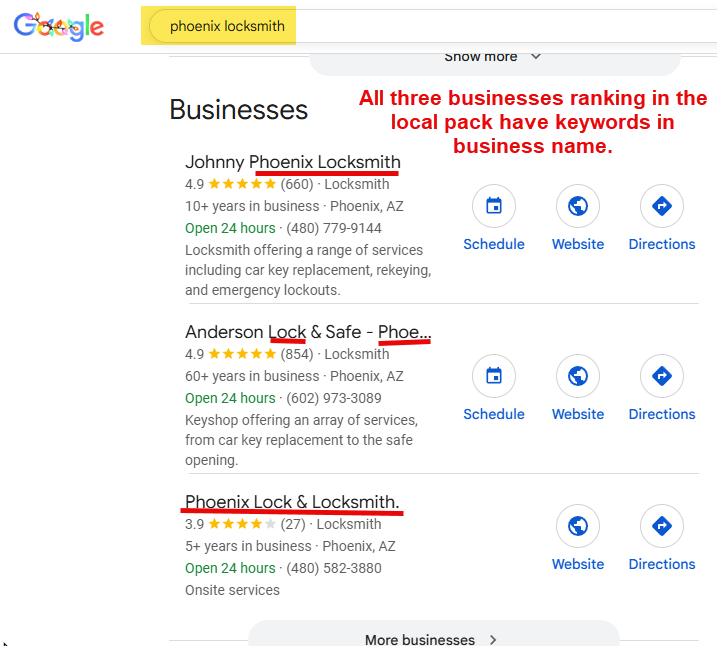
Locksmith SEO is notoriously spammy, especially in Google’s local pack. Fake businesses are being created in the local three-pack. Deceptive pricing is advertised online and then changes dramatically on-site.
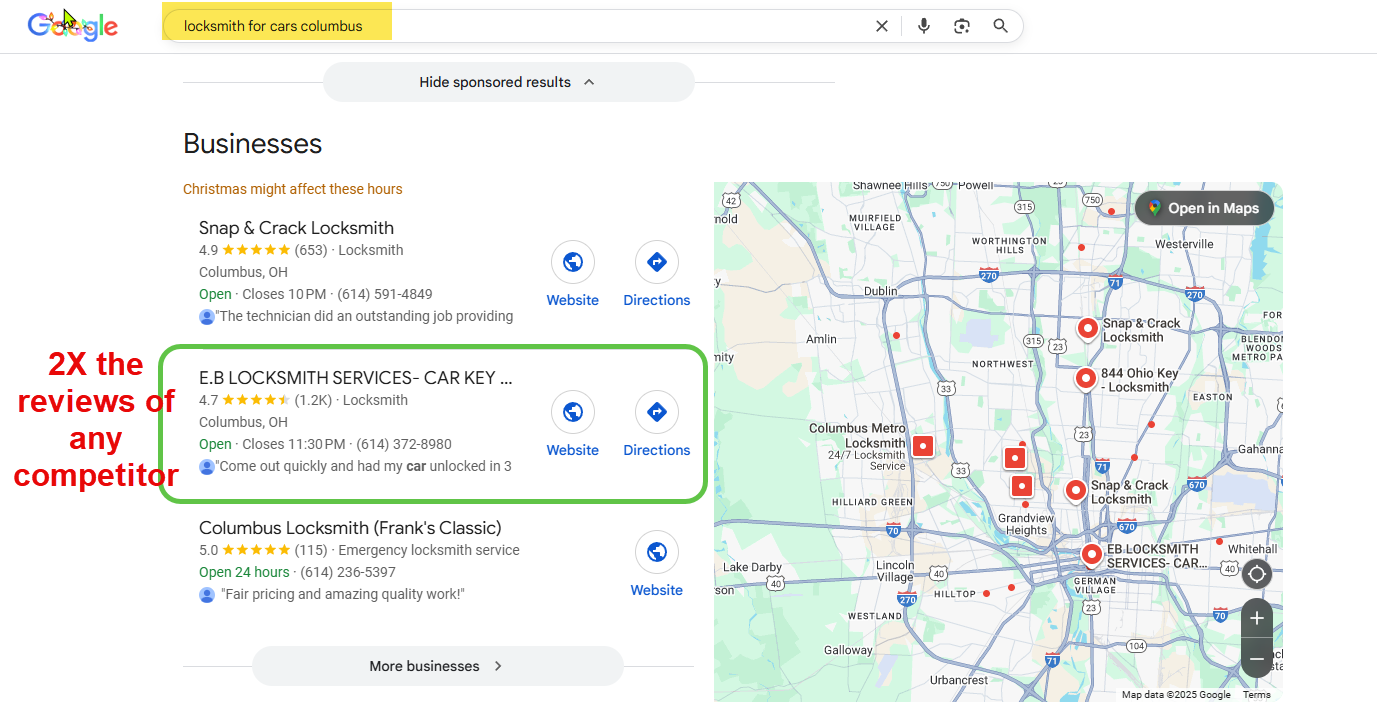
As shown in the local pack below, Google rewards businesses that include the city name or the keyword “locksmith” in their business name. Oftentimes, fictitious business names are used to manipulate rankings.
While SEO is moderately competitive for locksmiths, it’s one of the shadier industries we work with, so you always need to monitor the competition and your own rankings.
Creating the Right Foundation
The overall foundation of your site is one of the most essential elements of SEO. As with building a house, if you have a weak foundation, you’re going to have a lot of future issues.
What always fascinates me about SEO is that if you’re deploying the wrong strategy, you can be doing more harm than good to your website. This is why we analyze the foundation first to ensure it’s properly structured.
For locksmiths, I recommend optimizing your homepage for your primary keyword plus the city (e.g., “Phoenix Locksmith”). You would then create individual pages for each different service (e.g., “Car Locksmith Phoenix”).
This means you’ll want to build unique pages for each service. This makes sense from a search intent and user experience perspective. If someone searches for “Lock Rekeying,” they want information based upon that search.
Locksmith SEO Ladder Strategy
Key Strategy:
- Homepage dominates "Phoenix Locksmith" - the highest volume, most competitive term
- Service pages target specific Phoenix + service intent combinations
- Each page builds authority and internal linking supports the homepage rankings
If you need help avoiding common pitfalls such as page cannibalization or managing more complex site structures with multiple locations, we’d be happy to analyze your site structure.
Single versus Multi-Location
Pop-A-Lock is a franchise with many locations. They build out location pages for each franchise location, and there are subsequent service pages for each location (Phoenix Example: home, vehicle, commercial, etc). This becomes a much more robust SEO strategy as you build hundreds or thousands of pages.
Multi-Location SEO Structure
Pop-A-Lock Example: 3 Arizona Locations
Multi-Location Strategy
With 3 locations and 5 services each, Pop-A-Lock has 15 service pages (5/loc × 3 locations × 2 location pages × 1 homepage = 19 total optimized pages. Scale this to 100 franchise locations, and you have 500+ pages capturing local searches across the franchise system + unique content differentiating each location.
Backlink Foundation
Just as a strong site structure is essential, your backlink profile makes a huge difference.
Google wants to see your site have authoritative backlinks from external sites. To Google, this means your site is credible.
For example, if your Cleveland locksmith website has a backlink from a youth hockey team you sponsor and you’ve been quoted in the Cleveland Plain Dealer about ways to avoid break-ins when traveling, these would be highly credible, localized sites that would build up your authority score.
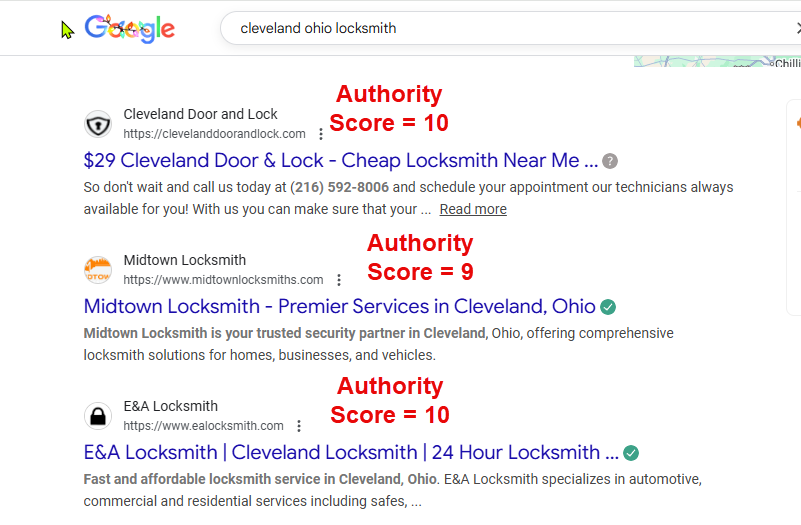
Let’s look at a real market example. In the examples below, for the query “Cleveland, Ohio Locksmith,” the top-ranking organic results have an authority score of around 10. This isn’t very competitive, which is excellent news for locksmiths in Cleveland.
If a locksmith in Cleveland reached out to us for SEO support and had an authority score of around 10, on-site optimization tactics could quickly propel them to a top position. Whereas if we took over SEO for a brand new website, we’d be climbing more of an uphill battle.
The bottom line is that even with the best on-site optimization, without strong backlinks, your chances of ranking well diminish.
Tactics to Deploy for Strong Rankings:
Expert Interviews
Google hates fluff content. They value content coming from experts. Have your locksmith interviewed for your core service pages. This will improve the user experience and increase your chances of ranking well. If your locksmith isn’t the best writer, have someone interview them and write the content based on the interview.
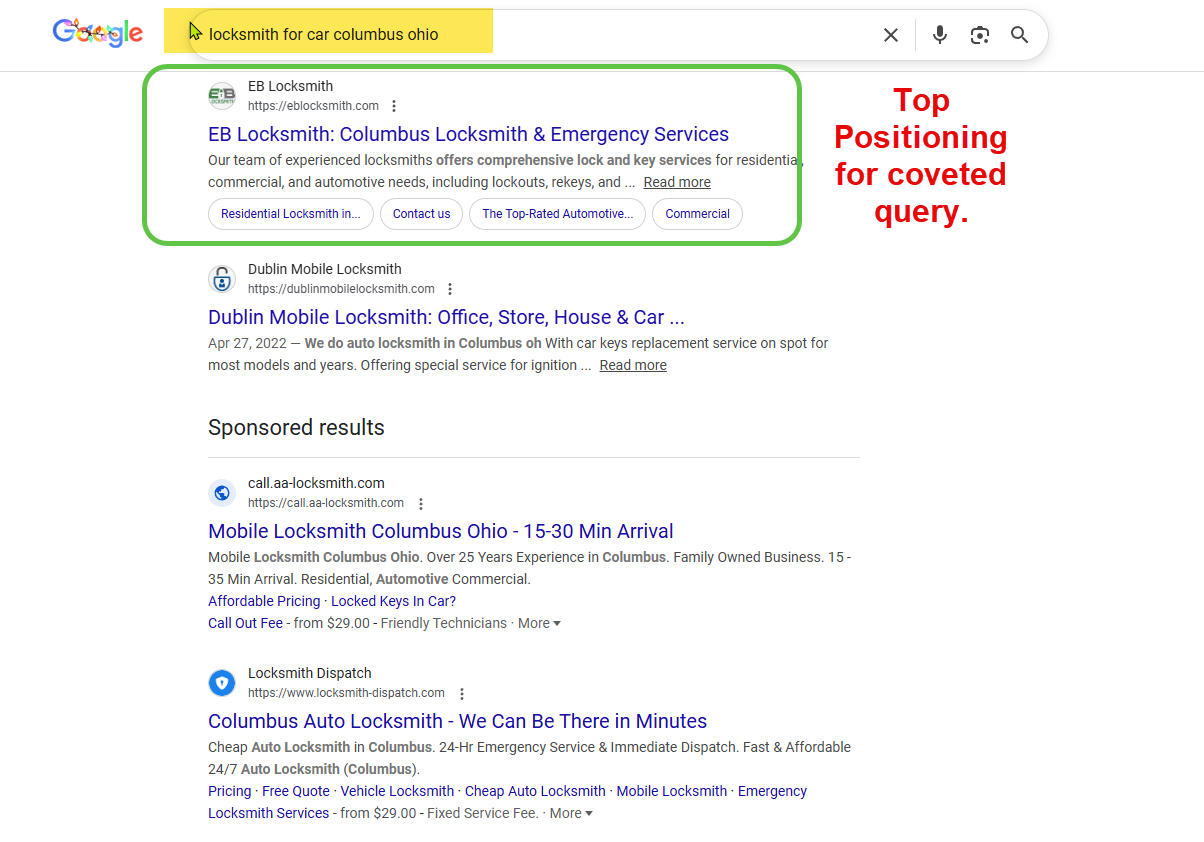
For EB Locksmith, we interviewed the owner, an expert locksmith, on their automotive locksmith page. The strong content helped them achieve top rankings on Google.
User Experience
It used to be that you’d slap 1,000 words on a page and stuff keywords, and it would rank well. Google now takes the overall user experience into account for rankings. This means each page should be structured to read and convert well.
All Hours Keys and Locks in Lexington, Kentucky, does a good job on its commercial locksmith page, showcasing its expertise and qualifications, types of locksmith work, its process, and testimonials from business owners. It’s no coincidence they rank #1 for “Commercial Locksmith in Lexington.”
Service Page UX Checklist
Essential elements for strong user experience & rankings
Years in Business
Builds trust/experience: "Over 25 years serving the community"
Licenses & Certifications
Demonstrates qualifications and credibility
Number of Projects Completed
Establishes expertise and volume
Team Size
Shows capacity to handle work
"5 certified technicians on staff"
Transparent $ Ranges
Reduces price anxiety with real cost expectations
Face-Specific Testimonials
Reviews referencing THIS service
"not any generic positive reviews"
Real Project Photos
Actual project pictures
"not stock photos, not word photos"
Transparent Pricing
Sample pricing for different service tiers
"builds trust, shortens buying cycle"
Easy Contact Methods
Multiple ways to reach you quickly
"phone, contact form, chat"
Why This Matters for SEO
Google rewards user experience, dwell time on page, bounce rates, and social signals. Pages with these trust elements from visitors engaged longer, resulting in Google that your content is valuable and should - directly improving your rankings and conversion rates.
Real Example: All these that rank in the top 3 for [city]+[service] on their [commercial-grade], [eco-safe], or [7-day turnaround] depending on the product. Those are content to stand out above competitors.
Real-Life Case Studies and Photos
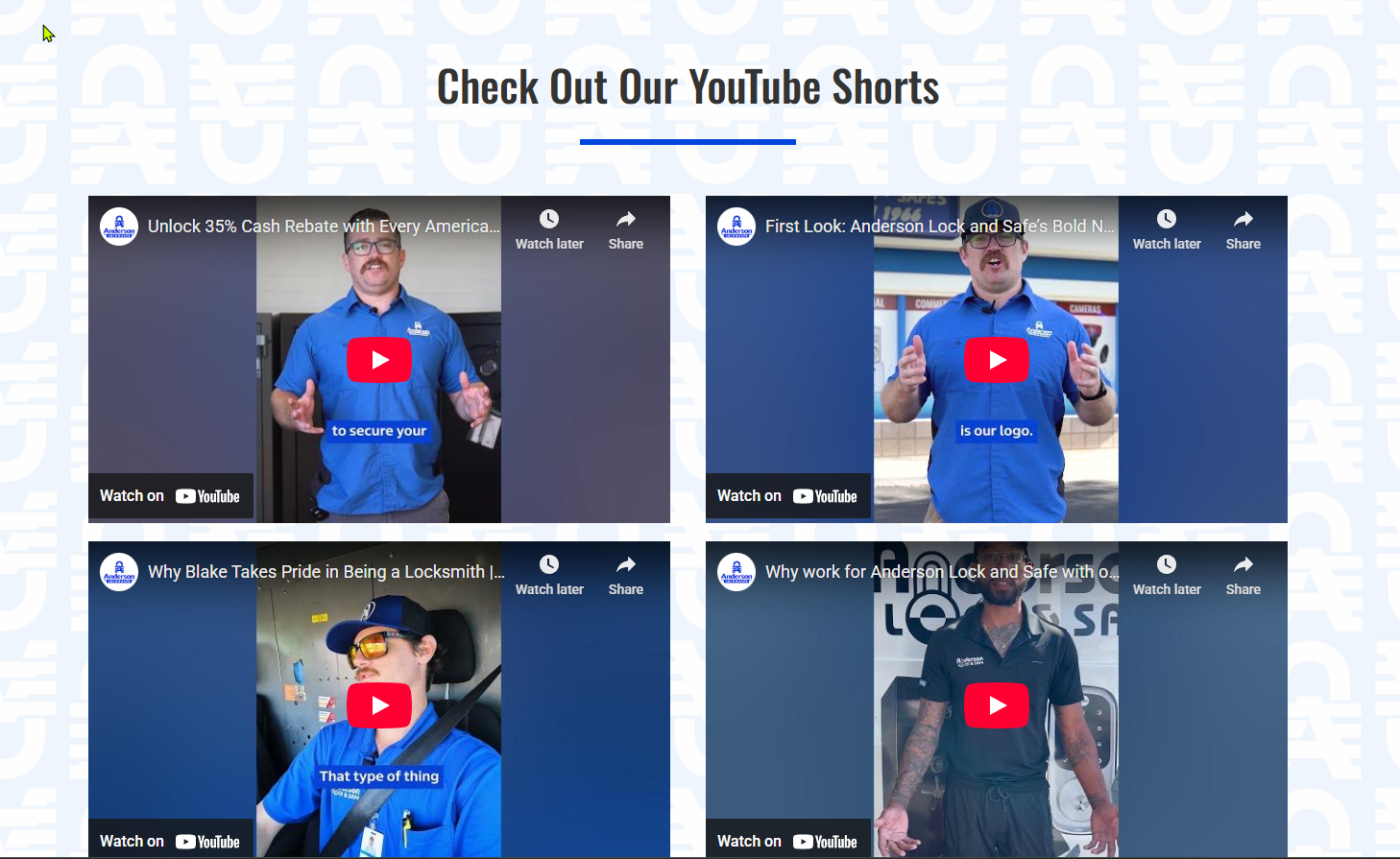
Stock photos hurt SEO. Google wants to see pictures of your team, job photos, testimonials, and case studies showing how you saved someone in a pinch with your locksmith services. When someone visits your site, it should feel like a local business with roots in their market, rather than a fly-by-night shop.
Anderson Lock & Safe in Phoenix does a phenomenal job of showcasing its local team throughout the site. I can’t tell you how many locksmiths have generic photos.
Service Area Pages
Let’s say your primary market is Columbus, OH. Many people search by suburb. To capitalize on hyperlocal searches, buildout Service Area Pages. If someone is searching for “Gahanna Locksmith” and you have a page with testimonials from your Gahanna customers and pictures of jobs performed, this unique content is going to help you rank for this query. Don’t go overboard with Service Area Pages. Focus on your top 5 suburbs and work on getting unique content to avoid duplicate content or doorway page issues.
Reviews
Google reviews are essential to your local pack ranking. Have a process in place that uses a service like BirdEye to automatically send text and email notifications when a job is completed, prompting a review. With so many scammy locksmiths in the local pack, actual reviews make a big difference.
Our client, EB Locksmith, now ranks in the top positions in the local pack, as we’ve implemented an effective strategy for soliciting new reviews.
Google Local Pack Optimization
Many people think reviews are the driving force of local pack rankings. While they are a factor, there are many others at play. Your destination URL, your primary category being set as “locksmith,” and professional photos of your team (to name a few). I recommend checking out our Google Business Profile checklist to ensure you have your ducks in a row.
Generating Backlinks
If you do commercial locksmith work, reach out to your clients to list you as a partner on their site. Sponsor a local youth organization. Reach out to reporters at your local papers if there is a story about a break-in; you can provide an in–depth quote on security measures. Write blog posts about the best brands of keypad locks for your entryway, in hopes that other sites will link back and use this as a resource.
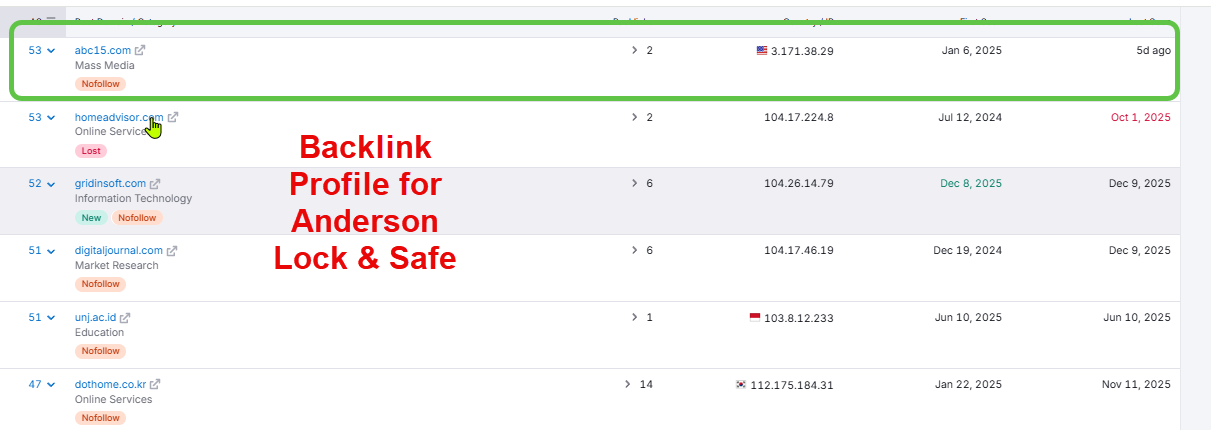
The screenshot below is the backlink profile for Anderson Lock & Safe in Phoenix. You’ll see they have an authority score of 22, which is very solid for a locksmith. You can utilize a tool like SEMRush to audit any website’s backlink profile. ABC 15 did a feature story on them after the pandemic about how being a locksmith is the perfect job for someone looking to leave their home. This is an amazing local link that aligns with our previously discussed backlink strategy.
NAP Consistency
Sign up for a service like Yext to make sure your address and local information are consistent across Google, Bing, Facebook, Yelp, Angie’s List, and more. AI search engines also pull heavily from these directory lists, so it can enhance your SEO exposure.
Directory Listing Priority Tiers
Where locksmiths should focus their time & budget for maximum ROI
Google Business Profile
~95% of local pack clicks - absolutely critical
Yelp
Trusted extensively for locksmith SEO (penalties - huge visibility opportunity
Angi (Angie's List)
Trusted name platform with strong organic rankings
Thumbtack
High active user/matching quality of leads
HomeAdvisor
Top builder for GBP SEO and outreach work
Better Business Bureau
Trust verification & continued trust credibility
Bing Places
10% overall search share - very early wins
Apple Maps
iPhone default - solid consistency signal
Facebook Business Page
Social proof & referrals; review management
Chamber of Commerce
Local business & community standards
Nextdoor
Neighborhood signal (geo checks & recommendations
Final Thoughts:
If you’re starting from an authority score of 0, it could take a year to build your authority beyond a 10. Once you have an authority score above 10, in this vertical, you should be able to start ranking on the first page.
Common Mistakes We See:
- Creating useless blog posts that target local keywords that end up competing with your service pages. For example, creating a blog, “Best Locksmiths in Columbus,” when your homepage is already targeting “Columbus Locksmith.”
- Grabbing AI content and not taking the time to invest in expert content. When you use content from ChatGPT, hundreds of other locksmiths are using the exact duplicate content. Google knows this and won’t reward you.
- Not building up your authority score to a point where Google will start taking your site seriously. Even if you have the best content, if your authority score is lower than your competitors’, it’ll be hard to rank.
It’s impossible to cover every SEO tactic. I hope you walk away from this article with tactics to improve your SEO and understand what it takes to outpace your competitors in the locksmith space.
If you’re ever feeling “locked out” with a bad SEO strategy, contact The Media Captain.